
HR glossary
Workforce planning
Workforce planning is the process of forecasting the people and skills an organization will need and planning how to get them.
Workforce planning matches the people you have with the work the business needs next year and beyond. It covers how many people, which skills and where they sit.
It starts with the business plan. If sales plans to double, how many account executives, support staff and managers does that take? Then compare that with today’s team, subtract expected turnover, and you get a hiring plan and a list of skill gaps.
Plans go stale. Revisit it at least every quarter.
What the labor market data says
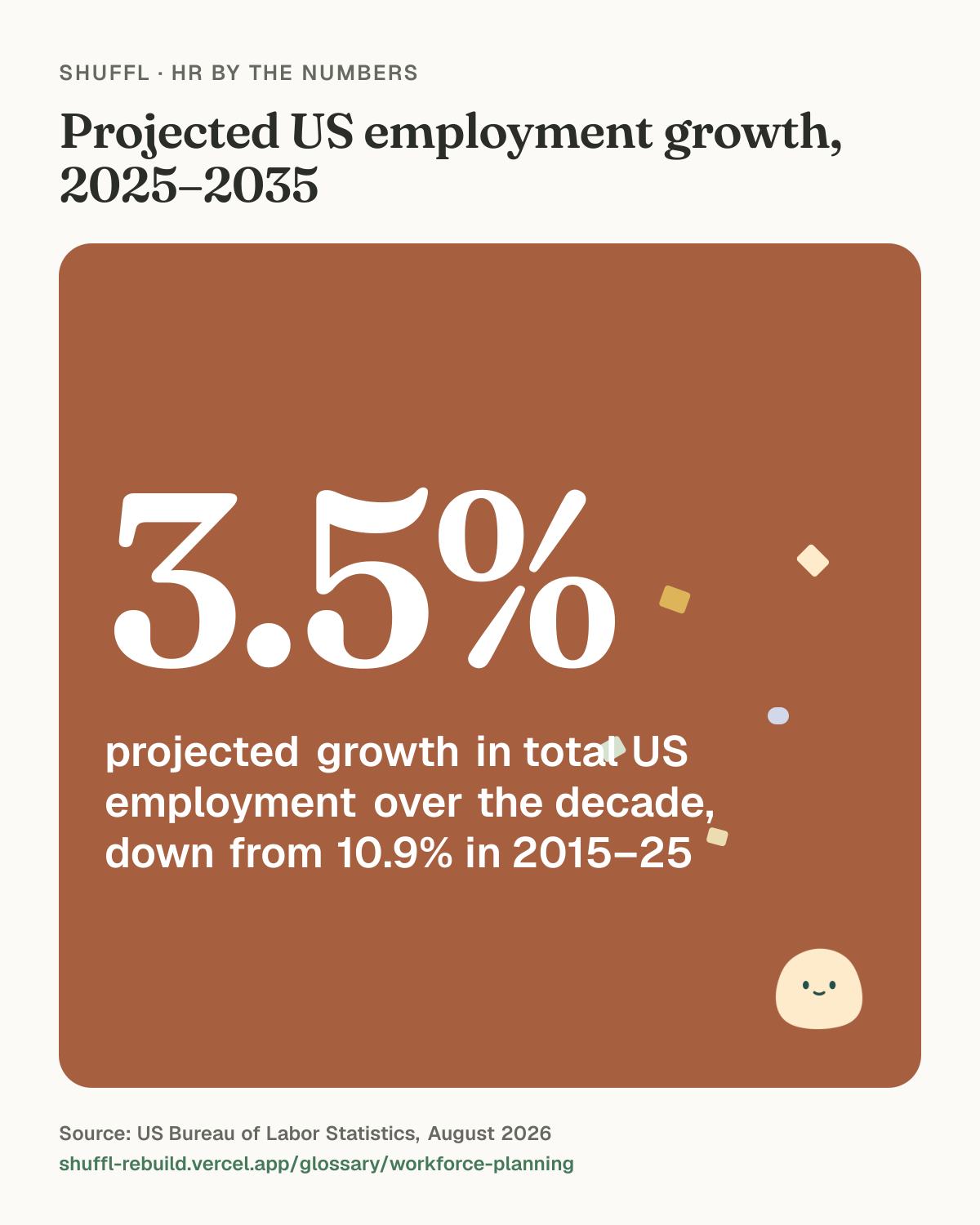
The Bureau of Labor Statistics projects US employment will grow 3.5% from 2025 to 2035, adding 5.9 million jobs. That’s slower than the 10.9% growth of the previous decade1. Some occupations will grow much faster: nurse practitioners by 41.0% and data scientists by 34.6%1.
For a plan, slower overall growth means fewer new people entering the labor market. If your plan depends on hiring into a fast-growing occupation, expect more competition and longer searches, and give more weight to training and promoting people you already have.
Shuffl · HR by the numbers
Projected US employment growth, 2025–2035

Projected US employment growth, 2025–2035: 3.5% projected growth in total US employment over the decade, down from 10.9% in 2015–25. Source: US Bureau of Labor Statistics, August 2026.
An example
A 140-person logistics company plans to open a second warehouse next spring. Operations says the site needs 22 more warehouse associates, 3 shift leads and an operations manager.
The current site has 80 associates and loses about 30% of them a year, so 24 will need replacing anyway. The real hiring target is 46 associates, not 22. For shift leads, two senior associates are ready to step up, so the company promotes them and hires one lead externally. Only 12 of the 80 associates hold forklift certification and the new site needs 20 certified staff, so the plan adds a certification course in the winter, before the busy season.
How to run it each quarter
Keep the plan short enough that department heads will read it. A spreadsheet and a one-page summary are usually enough for companies under 500 people.
Shuffl · HR by the numbers
A quarterly workforce planning cycle
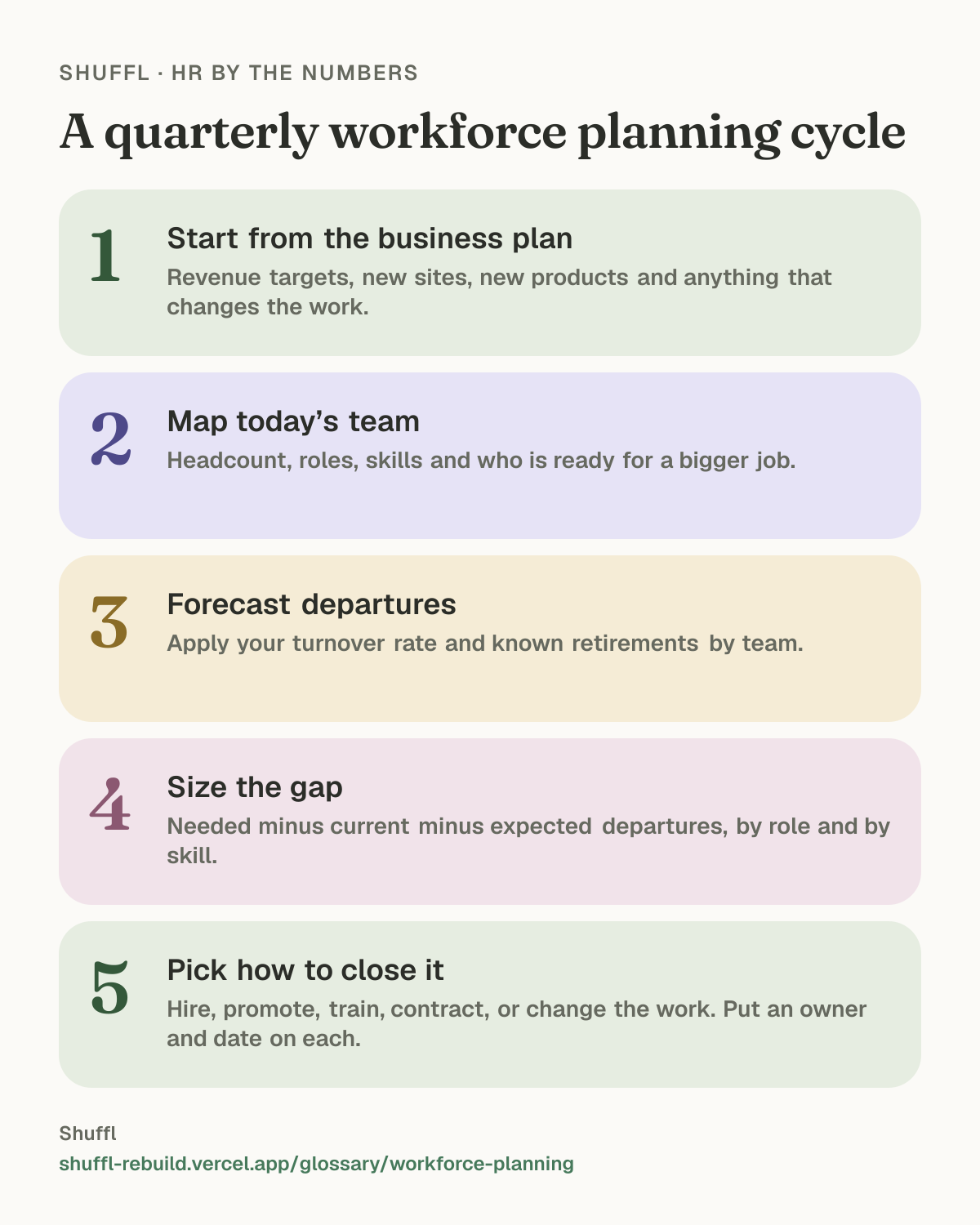
A quarterly workforce planning cycle. 1. Start from the business plan: Revenue targets, new sites, new products and anything that changes the work. 2. Map today’s team: Headcount, roles, skills and who is ready for a bigger job. 3. Forecast departures: Apply your turnover rate and known retirements by team. 4. Size the gap: Needed minus current minus expected departures, by role and by skill. 5. Pick how to close it: Hire, promote, train, contract, or change the work. Put an owner and date on each.
Common questions
- Is workforce planning the same as headcount planning?
- Headcount planning covers the numbers and the budget. Workforce planning also covers skills, locations, internal moves and succession.
- Who owns workforce planning?
- HR usually runs the process, with finance and department leaders owning the numbers for their teams.
Sources
Read on . Numbers change as new studies come out, so check the source before you quote it.
- US Bureau of Labor Statistics, Employment Projections: 2025-2035 Summary, August 2026. Official BLS 10-year projections of employment by industry and occupation.