
HR glossary
HR business partner (HRBP)
An HR business partner (HRBP) is an HR professional who works directly with a business unit’s leaders on people strategy.
An HR business partner is assigned to a part of the business, like engineering or sales, and works with its leaders on people decisions: team structure, hiring plans, performance issues, retention risks and reorgs.
The model comes from Dave Ulrich’s work in the late 1990s. It separates strategic HR work from transactional work like payroll and benefits administration, which shared services teams handle.
A good HRBP knows the business as well as the people in it.
What the research says
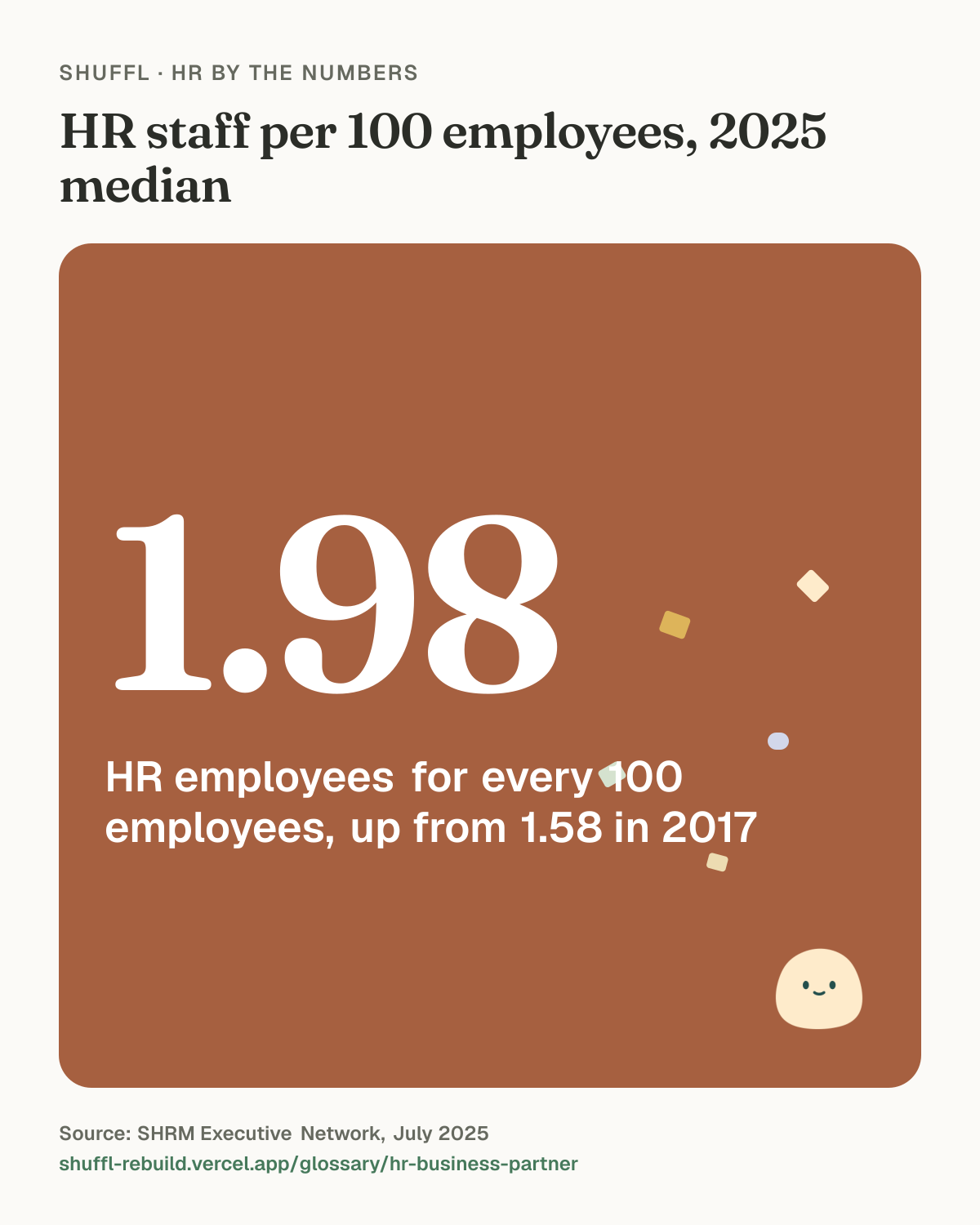
SHRM’s 2025 benchmarking found a median of 1.98 HR employees for every 100 employees, up from 1.58 in 201712. That figure counts everyone in HR, so HRBPs are only a fraction of it. How many people one HRBP can cover depends on how much routine work other parts of HR take off their plate.
Manager development is a large part of HRBP work, and HR rates itself poorly on it. In SHRM’s 2025 State of the Workplace research, only 37% of HR professionals and 42% of US workers said their organization was effective or very effective at leadership and manager development in 20243.
Shuffl · HR by the numbers
HR staff per 100 employees, 2025 median

HR staff per 100 employees, 2025 median: 1.98 HR employees for every 100 employees, up from 1.58 in 2017. Source: SHRM Executive Network, July 2025.
An example
A 1,200-person manufacturer has two HRBPs. One covers its three plants and the other covers sales, finance and engineering. The plant HRBP meets each plant manager weekly and reviews turnover by shift every month.
One quarter she sees second-shift turnover at one plant running at twice the rate of the others. Exit interviews point to a supervisor who changes schedules with a day’s notice. She agrees a two-week notice rule with the plant manager, sets up coaching for the supervisor and tracks turnover for the next two quarters. Payroll and benefits questions from the plants go to the HR help desk, which leaves her time for this kind of work.
What good HRBPs do
- Know the unit’s numbers: headcount plan, turnover, open roles and the business goals behind them.
- Bring data to leadership meetings, like turnover by team or time to fill.
- Push back when a leader’s plan carries a people risk, and explain why.
- Send transactional requests to the right team so they don’t crowd out advisory work.
Common questions
- What is the difference between an HRBP and an HR generalist?
- An HR generalist handles a wide range of day-to-day HR tasks. An HRBP focuses on advising leaders and aligning people plans with business goals.
- How many employees does an HRBP support?
- Often 1 HRBP for every 200 to 500 employees, depending on how complex the organization is.
Sources
Read on . Numbers change as new studies come out, so check the source before you quote it.
- SHRM Executive Network, More support for HR, talent: 3 CHRO benchmarking data insights, July 2025. Findings from SHRM’s 2025 CHRO Benchmarking data brief.
- SHRM, SHRM releases 2025 benchmarking reports, October 2025. Method for SHRM’s 2025 benchmarking program: electronically fielded survey of a random sample of active SHRM members, Jan. 9 to March 3, 2025; 2,371 respondents.
- SHRM, 2025 SHRM State of the Workplace research report, 2025. 1,615 HR professionals surveyed Dec. 9 to 12, 2024 through SHRM’s Voice of Work Research Panel; 238 HR executives; 471 US workers outside HR surveyed Dec. 12 to 16, 2024 on NORC’s AmeriSpeak probability-based panel, weighted to the US adult population.