
HR glossary
Cost per hire
Cost per hire is the average amount an organization spends to fill one position.
Cost per hire adds up what you spent to hire people and divides it by how many you hired. The ANSI/SHRM standard for the metric splits spending into external costs and internal costs.
External costs are money paid to outsiders: job boards, agency fees, background checks, relocation and signing bonuses. Internal costs are what you pay your own people and tools: recruiter salaries, the recruiting team’s software, and referral bonuses.
A low cost per hire isn’t automatically good. Saving on sourcing and losing the new hire in six months costs more than doing it right the first time.
How to calculate cost per hire
Cost per hire = (external costs + internal costs) ÷ total hires
- External costs: agencies, job ads, background checks, relocation, signing bonuses
- Internal costs: recruiting team pay, recruiting software, referral bonuses
Example: You spent 30,000 on external costs and 50,000 on internal costs and made 20 hires. 80,000 ÷ 20 = 4,000 per hire.
What the research says
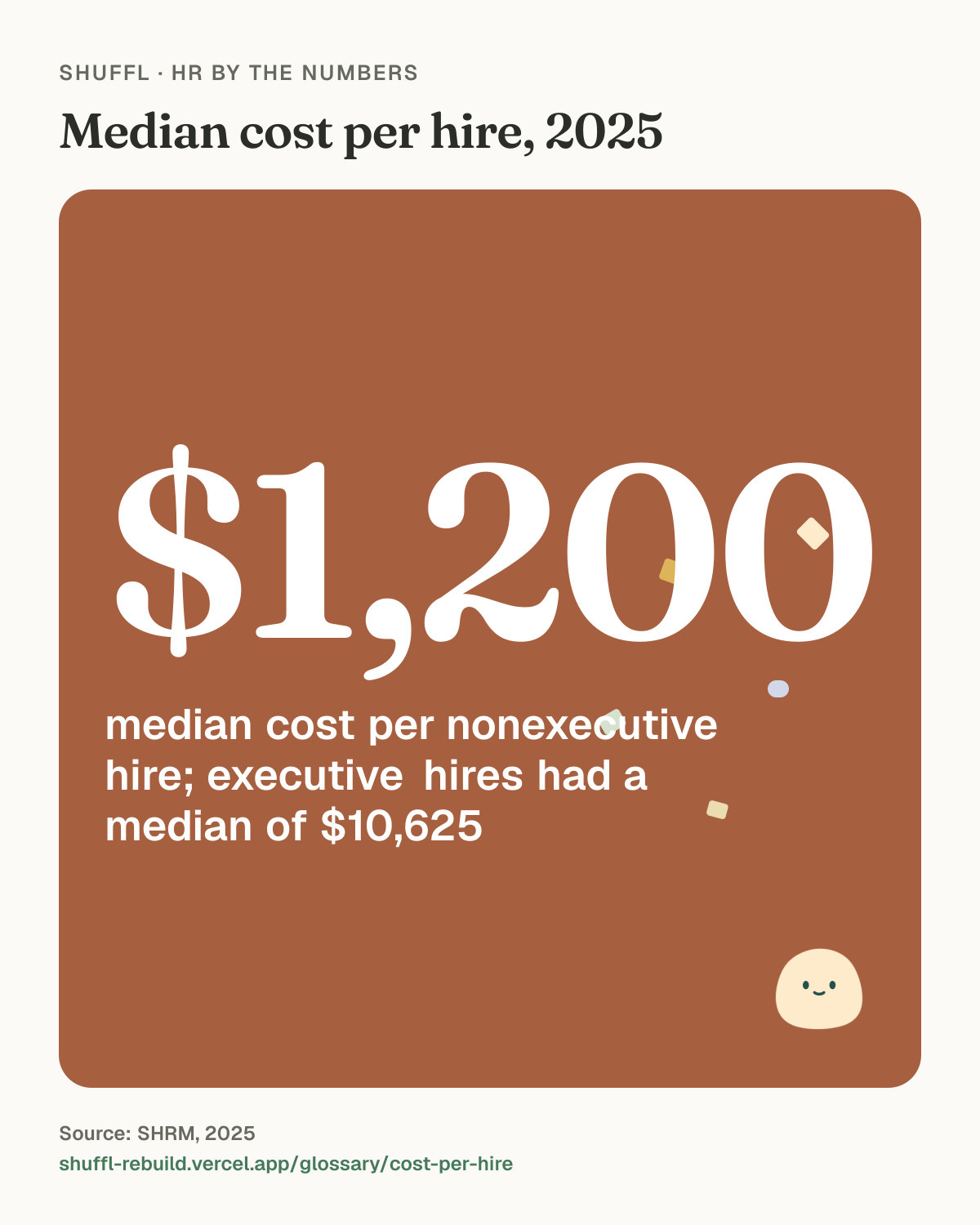
SHRM’s 2025 benchmarking survey found a median cost per hire of $1,200 for nonexecutive roles, a 27% decrease since 2017.1 Executive hiring went the other way. The median reached $10,625, up 113% from 2017 and 21% from 2022.1
These are medians across organizations of every size, and respondents didn’t have to answer every question, so the sample differs from metric to metric.1 They work as a rough check. Your own trend by type of role will tell you more.
Shuffl · HR by the numbers
Median cost per hire, 2025

Median cost per hire, 2025: $1,200 median cost per nonexecutive hire; executive hires had a median of $10,625. Source: SHRM, 2025.
An example
A 250-person healthcare staffing company made 60 hires last year. External costs were 18,000 for job ads, 45,000 in agency fees for three nurse managers and 6,000 for background checks. Internal costs were 95,000 for the recruiting team’s pay and benefits, 12,000 for recruiting software and 9,000 in referral bonuses. The total is 185,000, or 3,083 per hire.
The three agency hires alone cost 45,000, or 15,000 each. The other 57 hires cost 140,000 between them, about 2,456 each. One blended figure would hide the fact that the agency roles cost about six times as much, which is the number the company needs when it decides whether to hire a specialist recruiter.
Common mistakes
Cost per hire is easy to calculate and easy to distort. These are the errors that come up most.
- Blending executive and hourly hires into one number.
- Leaving out recruiter pay and software because they sit in someone else’s budget.
- Counting costs and hires in different periods, so a large December spend lands against January’s hires.
- Pushing the number down while first-year turnover climbs. Work Institute estimates that replacing an employee costs at least 33% of base pay.2
Common questions
- Should interviewer time be included in cost per hire?
- Usually not. Time spent by hiring managers and interviewers is real but hard to measure, so most teams leave it out and track it separately if at all.
- What is the average cost per hire?
- It ranges widely. Hourly roles can cost a few hundred dollars to fill, and executive searches through an agency can cost tens of thousands.
Sources
Read on . Numbers change as new studies come out, so check the source before you quote it.
- SHRM, 2025 Recruiting Executives Benchmarking: Insights to Maximize Recruitment (data brief), 2025. Electronic survey of a random sample of active SHRM members, fielded Jan. 9 to March 3, 2025, with an oversample of VP-level members; 2,371 responded. Unweighted; reports medians; sample size varies by metric.
- Work Institute, 2025 Retention Report: Employee Retention Truths in Today’s Workplace, 2025. Based on 123,297 exit interviews conducted by Work Institute from 2019 to 2024 with more than 175 companies; 14,215 interviews cover 2024 reasons for leaving. Over 90% collected after the employee left, by Work Institute as a third party.