
HR glossary
Offer acceptance rate
Offer acceptance rate is the percentage of job offers that candidates accept.
Offer acceptance rate tells you how often candidates say yes. If it drops, something between the final interview and the offer is going wrong.
The usual causes are pay below market, a slow process, a vague offer, or a candidate who never really wanted the job and was kept in the process too long. Ask every candidate who declines why. Most will tell you.
How to calculate offer acceptance rate
Offer acceptance rate = (offers accepted ÷ offers extended) × 100
- Count formal written offers only, not verbal feelers
Example: You extended 40 offers last year and 34 were accepted. 34 ÷ 40 × 100 = 85%.
What the research says
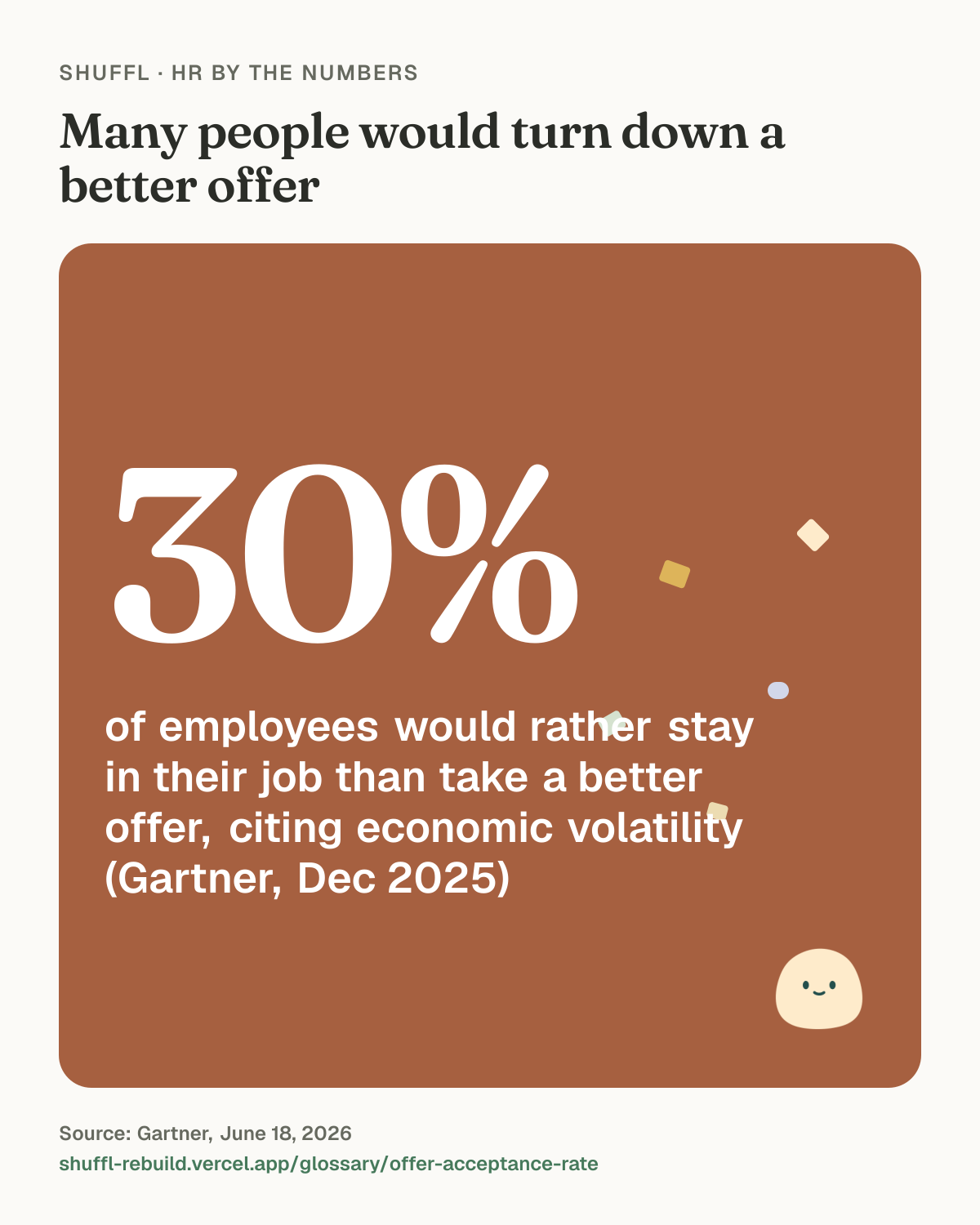
Candidates are harder to move than they were a few years ago. In a December 2025 Gartner survey of 3,072 employees, 30% said they would prefer to stay in their current job because of economic volatility, even if they received a better offer.1 Highly skilled employees were 39% more likely than less skilled employees to stay put.1
Gartner’s advice is to present roles in terms of stability, team continuity and long-term development, and to give candidates a clear reason why changing jobs is worth the risk.1 If your acceptance rate is falling, the offer may be answering the salary question while leaving that one open.
Shuffl · HR by the numbers
Many people would turn down a better offer

Many people would turn down a better offer: 30% of employees would rather stay in their job than take a better offer, citing economic volatility (Gartner, Dec 2025). Source: Gartner, June 18, 2026.
An example
A 500-person manufacturer saw its offer acceptance rate for engineering roles fall from 88% to 71% in a year, with 17 of 24 offers accepted. The recruiting team called all seven people who declined. Four had taken counteroffers from their current employer. Two said the salary was below what they’d understood from the first call. One had accepted another job during the nine days the offer spent waiting for approval.
The company started sharing the salary range in the first recruiter call and let the engineering director approve any offer inside the range. Over the next two quarters, 19 of 22 offers were accepted, or 86%.
How to improve it
Ask everyone who declines why, and keep a simple log of the reasons. After 10 or 15 declines the pattern is usually clear. Track counteroffers separately, since they call for a different response from pay that’s below market. Look at the rate by role and by hiring manager too, because a company-wide figure can hide one team that loses most of its candidates.
Shuffl · HR by the numbers
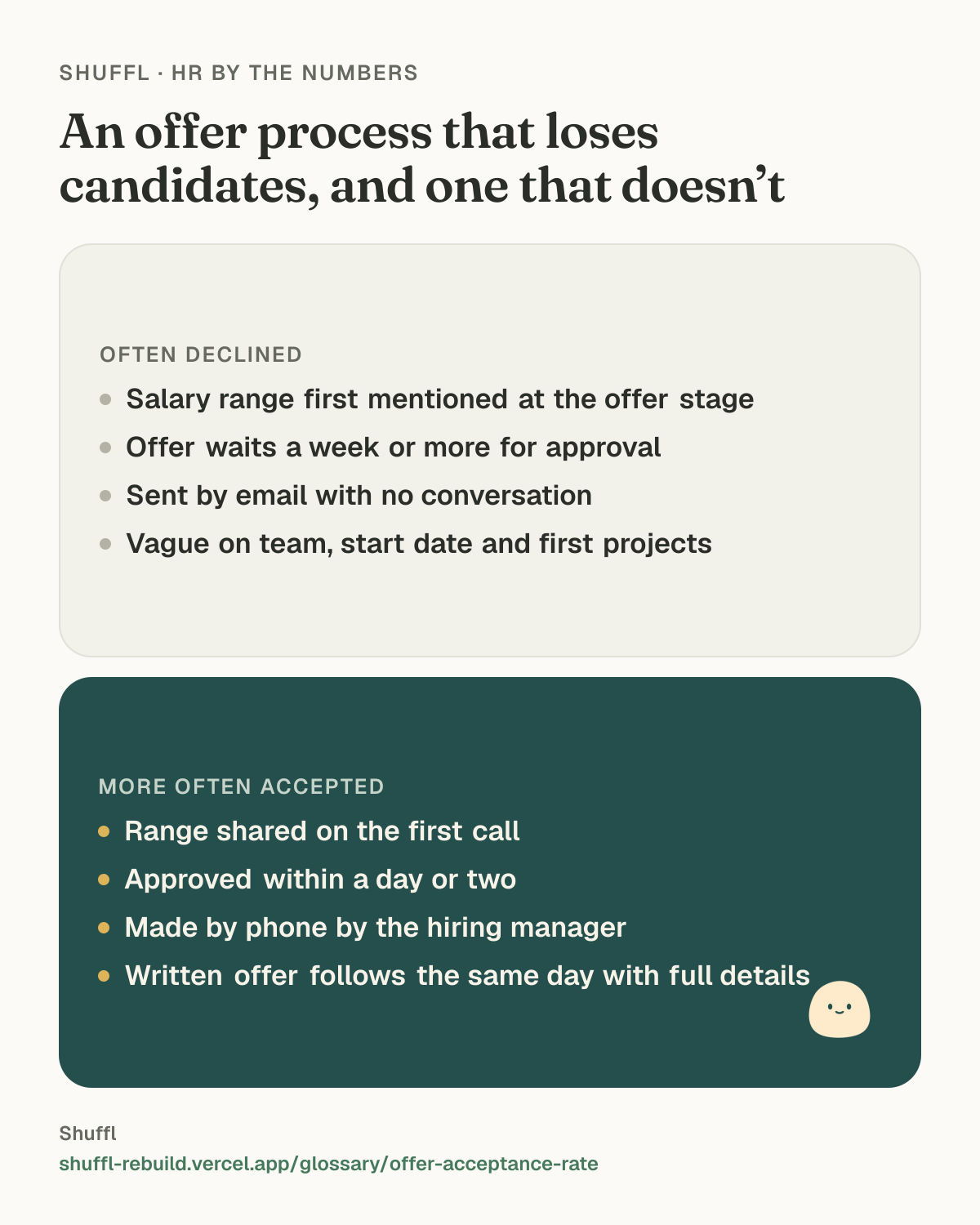
An offer process that loses candidates, and one that doesn’t
An offer process that loses candidates, and one that doesn’t. Often declined: Salary range first mentioned at the offer stage; Offer waits a week or more for approval; Sent by email with no conversation; Vague on team, start date and first projects. More often accepted: Range shared on the first call; Approved within a day or two; Made by phone by the hiring manager; Written offer follows the same day with full details.
Common questions
- What is a good offer acceptance rate?
- Many teams aim for 85% to 90% or higher. A rate far below that is worth investigating role by role.
- How do you improve offer acceptance rate?
- Talk about pay range early, keep the process short, and make the offer call yourself so you can answer questions on the spot.
Sources
Read on . Numbers change as new studies come out, so check the source before you quote it.
- Gartner, Gartner HR Research Finds 48% of Candidates Accepted Job Offers in 4Q25; Down From 85% Two Years Earlier, June 18, 2026. Figures used: a December 2025 Gartner survey of 3,072 employees, and a 1Q26 Gartner survey of 11,838 employees. Page read through the Internet Archive copy because gartner.com blocked direct access.