
HR glossary
Pay transparency
Pay transparency is openness about how much people are paid and how pay decisions are made, including sharing salary ranges.
Pay transparency ranges from telling employees how pay is set to publishing every salary. The most common form today is listing a salary range on job ads.
In the US, Colorado, California, Washington and New York are among the states that require a pay range in job postings. In the EU, the Pay Transparency Directive requires employers to tell candidates the starting pay or its range before the interview and adds pay gap reporting. Member states had until 7 June 2026 to write it into national law.
Before you publish ranges, check that current employees are paid within them. If they aren’t, transparency will surface it.
Where the rules differ
California requires employers with 15 or more employees to include the pay scale in any job posting, and to give a current employee the pay scale for their own position when they ask1. Washington also starts at 15 employees, but the posting must include a general description of all benefits and other compensation along with the wage scale or salary range3. New York’s law covers businesses with four or more employees and applies to promotions and transfers as well as new jobs4. Colorado’s Equal Pay for Equal Work Act, in effect since January 1, 2021, requires employers to announce job openings and advancement opportunities to all employees, with the pay range2.
The EU directive reaches past the job ad. Candidates have a right to the initial pay or its range, and employers may not ask about their pay history. Workers can ask in writing for their own pay level and the average pay, broken down by sex, of people doing the same work or work of equal value5. Employers with 250 or more workers must report on their gender pay gap by 7 June 2027 and every year after that, while those with 100 to 149 workers start in 2031. If a report shows a gap of at least 5% in any category of workers that the employer can’t justify and hasn’t fixed within six months, a joint pay assessment with worker representatives follows5.
This is general information. Thresholds and deadlines keep changing, so check the rules wherever you hire.
What the research says
Posting laws moved the numbers. In August 2023, half of US job postings on Indeed included at least some pay information, nearly triple the 18% share in February 2020. States with posting laws led the way, with Colorado at 81%, Washington at 75% and California at 70%. Mississippi was lowest at 33%7.
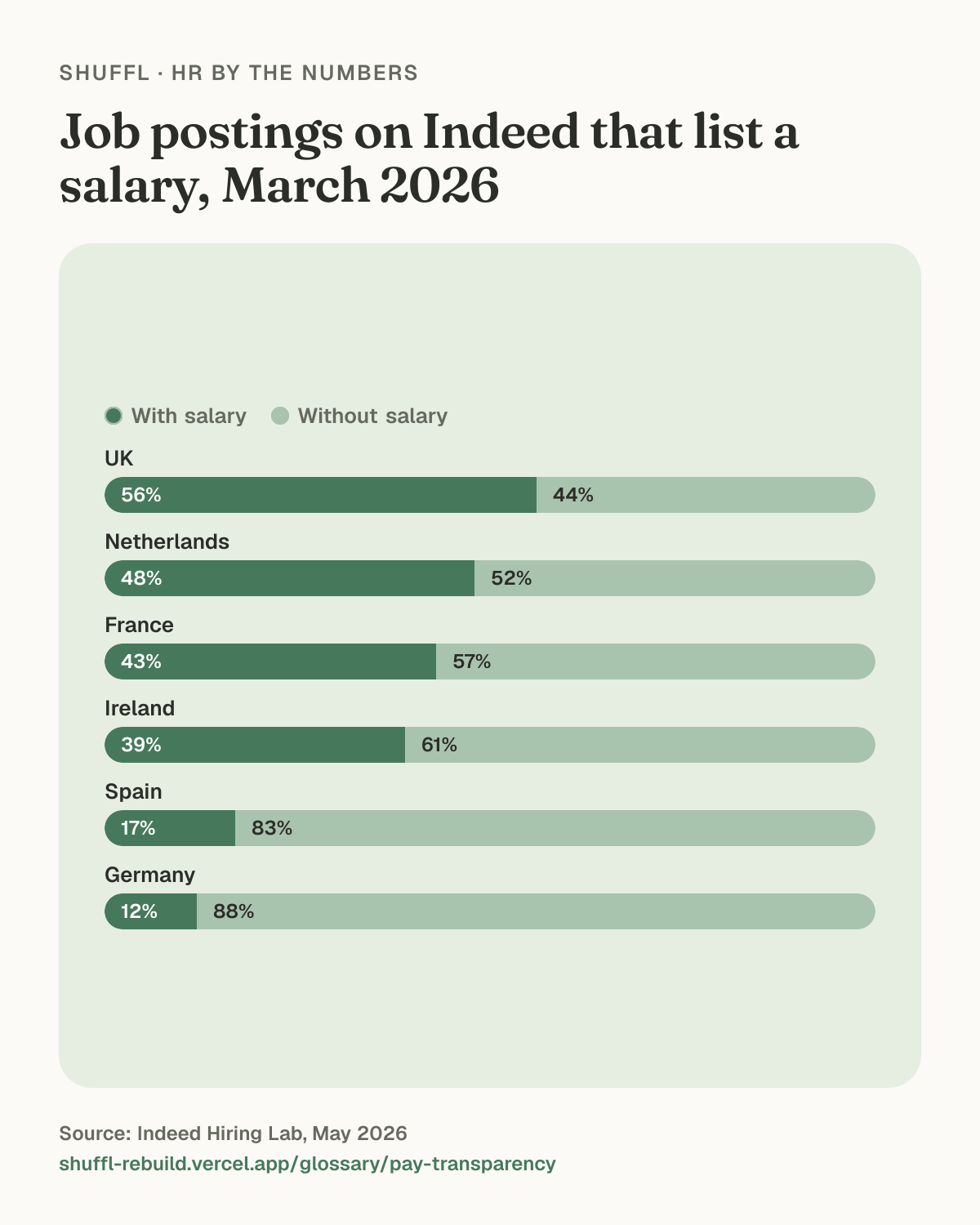
Europe is further behind. In March 2026, 56% of UK postings on Indeed listed a salary, compared with 43% in France and 12% in Germany8. The directive only requires pay information before the interview, so it may never show up in every ad.
Shuffl · HR by the numbers
Job postings on Indeed that list a salary, March 2026
Job postings on Indeed that list a salary, March 2026. UK: 56% With salary, 44% Without salary. Netherlands: 48% With salary, 52% Without salary. France: 43% With salary, 57% Without salary. Ireland: 39% With salary, 61% Without salary. Spain: 17% With salary, 83% Without salary. Germany: 12% With salary, 88% Without salary. Source: Indeed Hiring Lab, May 2026.
What to check before you publish ranges
Candidates and current employees will compare the range with what they know about pay inside the company, so most of the work happens before the first posting goes live.
- Map every current employee to the range for their role. People paid below the posted minimum will notice first.
- Write down how each range was set, including the market data you used and what moves someone up within it.
- Keep ranges honest. California defines the pay scale as a good-faith estimate of what the employer reasonably expects to pay for the role1.
- Remove any policy that bans employees from discussing pay. The NLRB says such rules are unlawful for employees the National Labor Relations Act covers6.
Common questions
- Is it required to post salary ranges in job ads?
- In a growing number of US states, including California, Colorado, New York and Washington. The EU directive requires sharing the starting pay or range with candidates, though not always in the ad itself. Check the rules everywhere you hire.
- Can employees discuss their salaries?
- In the US, the National Labor Relations Act protects most private-sector employees’ right to discuss pay with coworkers. Supervisors, public-sector workers and a few other groups aren’t covered by it.
Sources
Read on . Laws change, so check the source before you act. This page is general information, not legal advice.
- California Legislative Information, California Labor Code § 432.3, Amended by Stats. 2025, Ch. 468 (SB 642), effective January 1, 2026. Primary statute. Subsection (c)(3) requires employers with 15 or more employees to include the pay scale in job postings; (c)(2) covers current employees’ requests.
- Colorado General Assembly, SB19-085, Equal Pay for Equal Work Act, Signed May 22, 2019; effective January 1, 2021. Bill page and legislative summary.
- Washington State Department of Labor & Industries, Equal Pay and Opportunities Act, Accessed September 2026. State regulator guidance on job posting requirements for employers with 15 or more employees.
- New York State Department of Labor, Pay transparency, Accessed September 2026. State regulator guidance. Covers businesses with four or more employees.
- EUR-Lex, Official Journal of the European Union, Directive (EU) 2023/970 on pay transparency, May 2023. Primary legislation. Articles 5, 7, 9, 10 and 34 (transposition by 7 June 2026).
- National Labor Relations Board, Your right to discuss wages, Accessed September 2026. Federal regulator guidance under the National Labor Relations Act.
- Indeed Hiring Lab, Pay transparency is now in a majority of US job postings, with more growth to come, September 2023. Share of unique US job postings on Indeed with employer-provided pay information, by month and state. Data for August 2023.
- Indeed Hiring Lab, Full salary transparency in Europe is still a distant prospect, May 2026. Unique job postings on Indeed with a salary divided by all unique postings in the month. Data for March 2026.