
HR glossary
Compa-ratio
Compa-ratio is an employee’s salary divided by the midpoint of their pay range, showing where they sit in that range.
Compa-ratio compares what someone is paid with the midpoint of the salary range for their role. A ratio of 1.00 (or 100%) means they are paid exactly the midpoint.
Below 1.00 usually means someone new to the role or still growing into it. Above 1.00 fits someone experienced and performing at a high level. A whole team sitting at 0.85 is a warning that you may be underpaying and at risk of losing people.
Compa-ratio is also a fast first check for pay equity. Compare average ratios across groups doing the same work.
How to calculate compa-ratio
Compa-ratio = employee salary ÷ pay range midpoint
- Pay range midpoint: halfway between the range minimum and maximum
- Often shown as a percentage (0.95 = 95%)
Example: An analyst earns 76,000. The range midpoint for the role is 80,000. 76,000 ÷ 80,000 = 0.95.
How raise budgets move compa-ratios
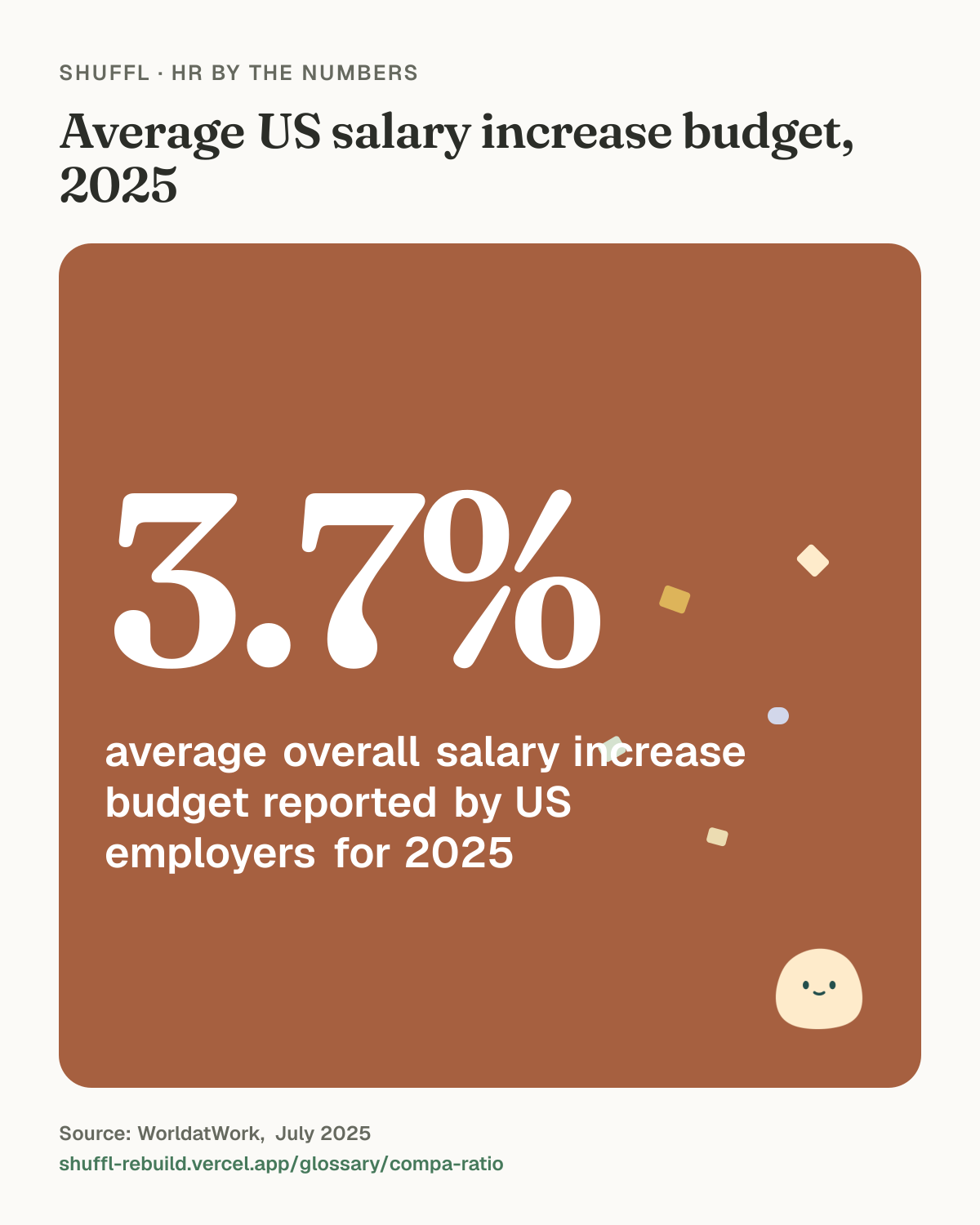
US employers’ average salary increase budget fell from 3.9% in 2024 to 3.7% in 2025, and they expected 3.6% for 2026, according to WorldatWork’s survey of 1,774 organizations1.
That matters because pay ranges usually move up each year as well. If the range midpoint rises by about the same amount as the raise, the employee’s compa-ratio stays where it was. Someone hired low in the range can stay low for years unless they get a larger adjustment on purpose.
Shuffl · HR by the numbers
Average US salary increase budget, 2025

Average US salary increase budget, 2025: 3.7% average overall salary increase budget reported by US employers for 2025. Source: WorldatWork, July 2025.
An example
A 60-person software company has four customer support specialists on a range of 50,000 to 70,000, so the midpoint is 60,000. Their salaries are 51,000, 57,000, 60,600 and 64,800, which gives compa-ratios of 0.85, 0.95, 1.01 and 1.08. The team average is 0.97, which looks healthy until you notice the 0.85.
That person has been in the role for three years and gets strong reviews. Next year the company moves the range up 3%, to a midpoint of 61,800, and gives her a 3.7% raise. Her salary becomes 52,887 and her compa-ratio 0.86. To reach 0.90 she would need about 55,620, a raise of roughly 9%. The compensation team decides to close half the gap this cycle and the rest in six months, and writes down why.
Common mistakes
Compa-ratio is only as good as the ranges behind it and the way you read it.
- Using ranges that haven’t been checked against market data in over a year, so every ratio is measured against an old midpoint.
- Averaging a team and stopping there. A 0.97 average can hide one person at 0.85.
- Comparing ratios across jobs with different ranges without saying so.
- Reading a low ratio as a problem for someone who joined the role two months ago. Check time in role and performance first.
- Treating a compa-ratio comparison as a full pay equity analysis. It’s a first check, and a proper review controls for job, level, location and tenure.
Common questions
- What is a good compa-ratio?
- Most companies target 0.90 to 1.10 for people fully performing in their role.
- What is a group compa-ratio?
- Group compa-ratio averages the individual ratios across a team or job level, so you can see whether that whole group is paid below or above the range midpoint.
Sources
Read on . Numbers change as new studies come out, so check the source before you quote it.
- WorldatWork, 2025 salary increase budgets moderate; 2026 projections indicate further contraction (2025-2026 Salary Budget Survey), July 2025. Survey data collected March 3 to April 15, 2025, from 1,774 organizations, giving 4,250 unique country responses.