
HR glossary
Total compensation
Total compensation is the full value of an employee’s pay and benefits, including salary, bonuses, equity and employer-paid benefits.
Total compensation is the full value of what someone gets for their work. Base salary is only one part.
It adds bonuses, commission, equity, the employer’s share of health insurance and retirement contributions, and other benefits like a learning stipend. A total compensation statement lays it all out for each employee.
Candidates often compare offers on base salary alone. Showing total compensation, clearly, helps them see the whole offer.
What the numbers show
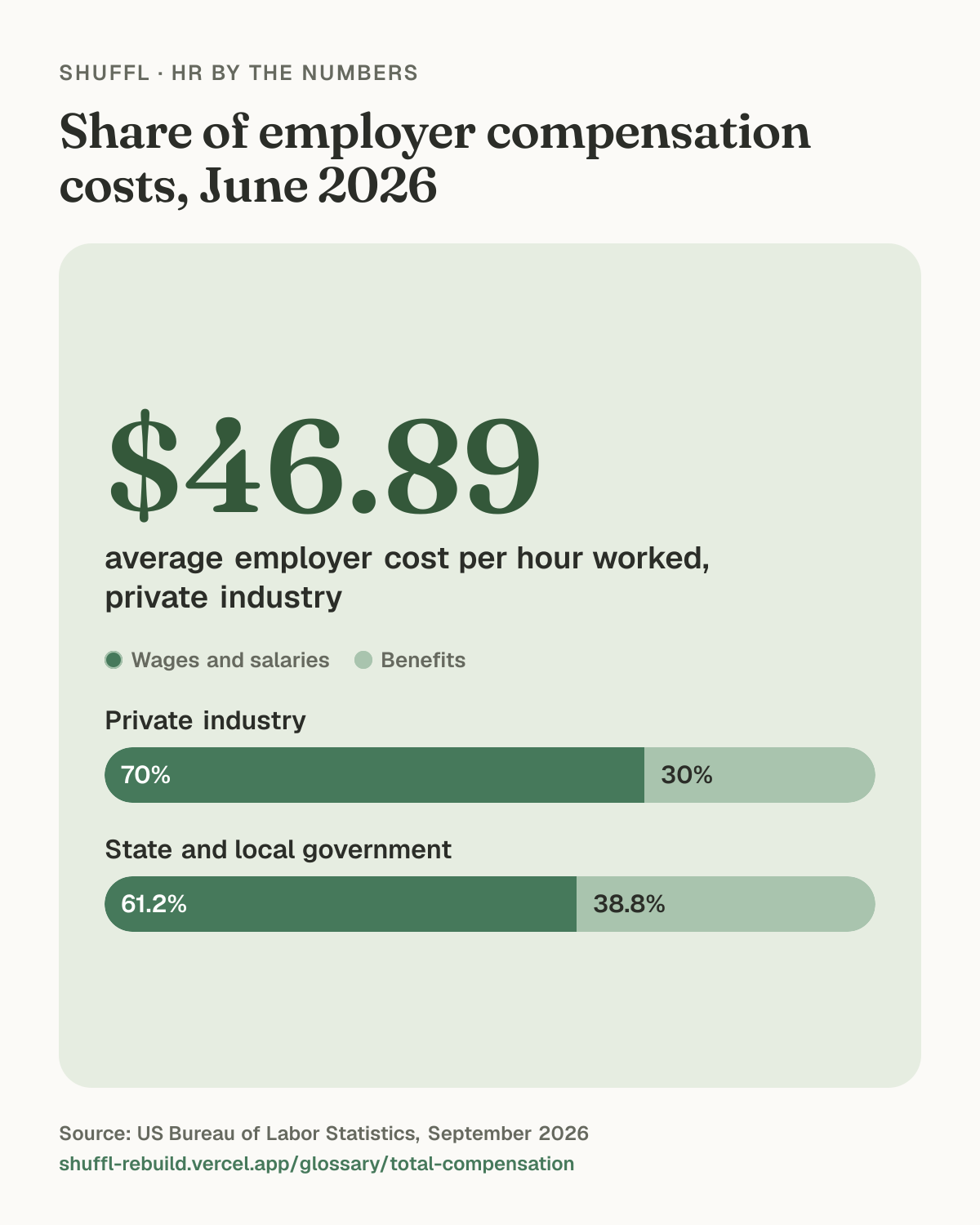
The Bureau of Labor Statistics tracks what employers spend per hour worked. In June 2026, private industry employers spent an average of $46.89 per hour. Wages and salaries were $32.82, or 70.0%, and benefits were $14.07, or 30.0%.1 For state and local government workers the benefits share was 38.8%.1
In private industry the benefit dollars split into insurance (7.9% of total compensation), paid leave (7.5%), legally required benefits such as Social Security and Medicare (7.2%), supplemental pay (4.0%) and retirement and savings (3.3%).1 A candidate who compares offers on base salary alone is looking at about 70 cents of every dollar.
Shuffl · HR by the numbers
Share of employer compensation costs, June 2026
Share of employer compensation costs, June 2026. $46.89 average employer cost per hour worked, private industry. Private industry: 70% Wages and salaries, 30% Benefits. State and local government: 61.2% Wages and salaries, 38.8% Benefits. Source: US Bureau of Labor Statistics, September 2026.
An example
A warehouse supervisor at a 180-person distribution company earns a base salary of $62,000. Her total compensation statement adds $4,100 in overtime, a $3,000 annual bonus, $11,200 for the employer’s share of her health premium, a $2,480 401(k) match (4% of base) and about $5,290 in employer Social Security and Medicare taxes.
That comes to about $88,070, so her base is roughly 70% of the total. The statement also notes that her 15 vacation days and 8 holidays are worth about $5,480 of her base pay, since they’re paid time she isn’t working.
How to present it
A total compensation statement only helps if people read it and believe the numbers.
- Send one a year, a few weeks before open enrollment or pay changes, when people are already thinking about their package.
- Show what the employer pays, including premiums and payroll taxes, which most employees never see on a payslip.
- Show equity with its vesting schedule and the basis for any value you give it.
- In offer letters, list base salary on its own line first, then the rest, so the offer reads as honest.
Common questions
- What is included in total compensation?
- Base pay, overtime, bonuses, commission, equity, employer benefit costs, retirement contributions and paid time off.
- Is total compensation the same as total rewards?
- Total rewards is broader. It adds non-financial things like flexibility, career development and recognition.
Sources
Read on . Numbers change as new studies come out, so check the source before you quote it.
- US Bureau of Labor Statistics, Employer Costs for Employee Compensation, June 2026, September 2026. National Compensation Survey. Probability sample of about 28,300 occupational observations from about 6,600 private industry establishments and about 7,300 observations from about 1,400 state and local government establishments. Category detail from Table 4 (https://www.bls.gov/news.release/ecec.t04.htm).