
HR glossary
Employee benefits
Employee benefits are the non-wage compensation an employer provides, like health insurance, retirement plans and paid time off.
Employee benefits are everything an employer provides beyond pay. Some are required by law, like employer payroll taxes and, in many places, paid sick leave. Others are chosen to attract and keep people.
In the US the core package is usually health, dental and vision insurance, a 401(k) or other retirement plan, paid time off, and life and disability insurance. Parental leave, mental health support, learning budgets and remote work stipends are common extras.
Benefits only help if people understand them. Most HR teams field the same benefits questions every week.
What the research says
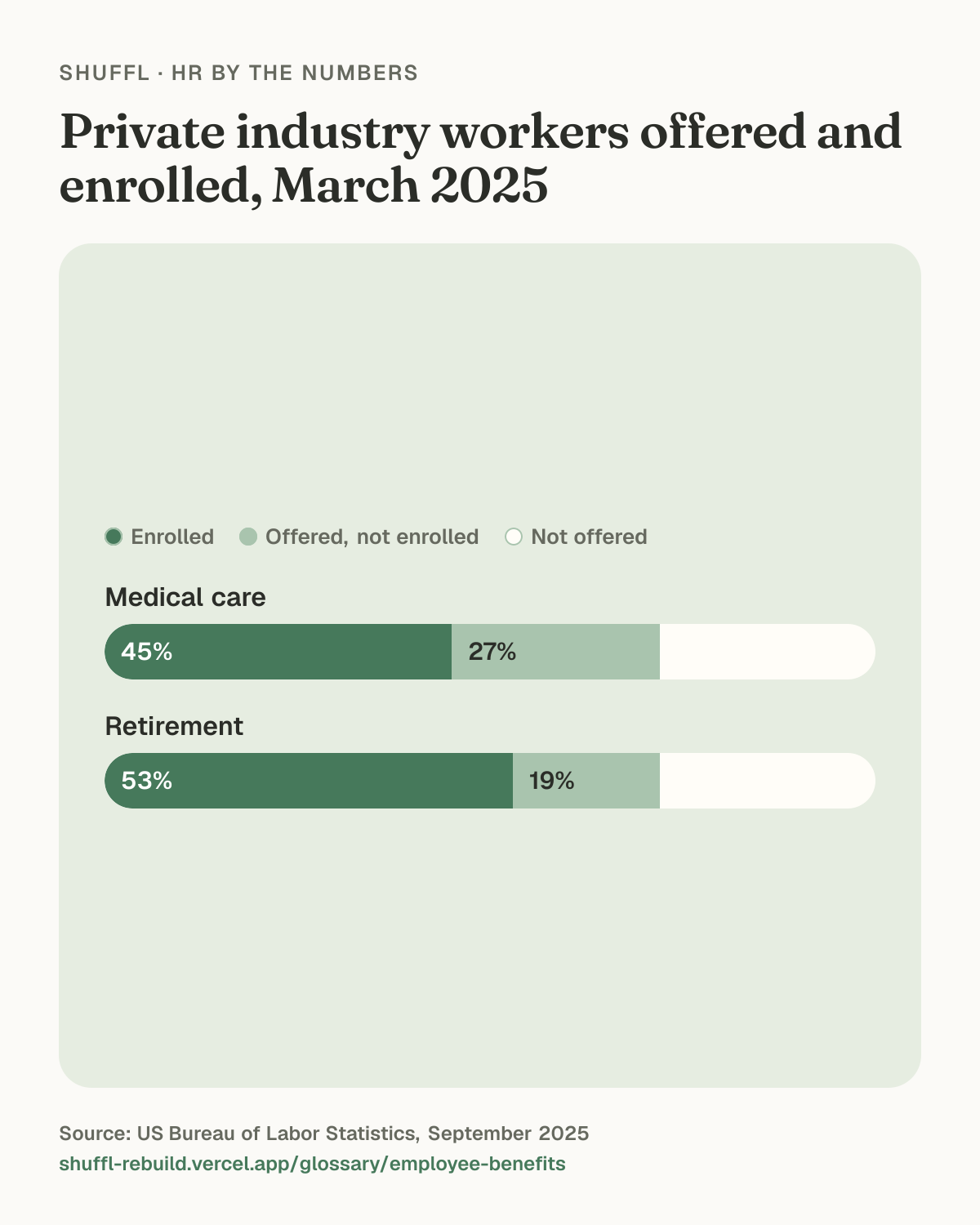
In March 2025, 72% of US private industry workers had access to medical care plans, and 45% took part in one. Retirement benefits were also available to 72%, with 53% participating.1 The gap between access and enrollment is partly workers covered elsewhere, often by a spouse’s plan, and partly people who find the premium too high.
Size makes a big difference. Retirement benefits reached 59% of workers at establishments with fewer than 100 people and 90% at those with 500 or more. Life insurance went from 42% to 87% across the same groups.1 Paid sick leave access ranged from 55% in leisure and hospitality to 97% in information and in finance and insurance.1
Shuffl · HR by the numbers
Private industry workers offered and enrolled, March 2025
Private industry workers offered and enrolled, March 2025. Medical care: 45% Enrolled, 27% Offered, not enrolled, 28% Not offered. Retirement: 53% Enrolled, 19% Offered, not enrolled, 28% Not offered. Source: US Bureau of Labor Statistics, September 2025.
What benefits cost
Across private industry, benefits averaged $14.07 per hour worked in June 2026, or 30.0% of total compensation costs.2 Health insurance is usually the largest single item. KFF’s 2025 survey put the average annual premium at $9,325 for single coverage and $26,993 for family coverage, with workers paying 16% and 26% of those on average.3
An example
A 45-person architecture firm is deciding how much of the health premium to cover. Using a $9,300 single premium, paying 80% instead of 70% costs about $930 more per enrolled employee per year. With 30 people enrolled, that’s roughly $27,900.
Before deciding, the firm checks what staff actually use. Its gym subsidy had 4 claims last year, so it drops it and puts the money toward the higher premium share, which every enrolled employee feels in each paycheck.
Common questions
- Which employee benefits are required by law?
- It varies by country. In the US, employers must pay into Social Security, Medicare and unemployment insurance, and larger employers face requirements to offer health coverage.
- How much do benefits cost an employer?
- A common rule of thumb is 20% to 40% of salary costs, depending on the package and country.
Sources
Read on . Numbers change as new studies come out, so check the source before you quote it.
- US Bureau of Labor Statistics, Employee Benefits in the United States, March 2025, September 2025. National Compensation Survey benefits estimates for March 2025. Sample of 14,600 establishments, 7,660 responding. Retirement participation from Table 1 (https://www.bls.gov/news.release/ebs2.t01.htm).
- US Bureau of Labor Statistics, Employer Costs for Employee Compensation, June 2026, September 2026. National Compensation Survey. Probability sample of about 28,300 occupational observations from about 6,600 private industry establishments and about 7,300 observations from about 1,400 state and local government establishments. Category detail from Table 4 (https://www.bls.gov/news.release/ecec.t04.htm).
- KFF, 2025 Employer Health Benefits Survey, October 2025. Interviews with owners and HR and benefits managers at 1,862 non-federal public and private firms with 10 or more workers, conducted January to July 2025.