
HR glossary
Paid time off (PTO)
Paid time off (PTO) is time away from work that an employee is paid for, including vacation, sick days and personal days.
PTO is time off that employees are paid for. Some companies give one PTO bank to use for any reason. Others keep separate buckets for vacation, sick days and personal days.
In the US, the Fair Labor Standards Act doesn’t require paid vacation, sick leave or holidays, though some states and cities require paid sick leave. Many other countries set a legal minimum. In the EU, every worker is entitled to at least four weeks of paid annual leave.
Unlimited PTO sounds generous, but people sometimes take less time off under it. If you offer it, set a suggested minimum and have managers model it.
What the research says
In March 2025, 80% of US private industry workers had access to paid vacation, 80% to paid sick leave and 81% to paid holidays, according to the BLS National Compensation Survey5. Employer size makes a big difference. Paid vacation was available to 71% of workers at establishments with 1 to 49 workers and to 91% at those with 500 or more6.
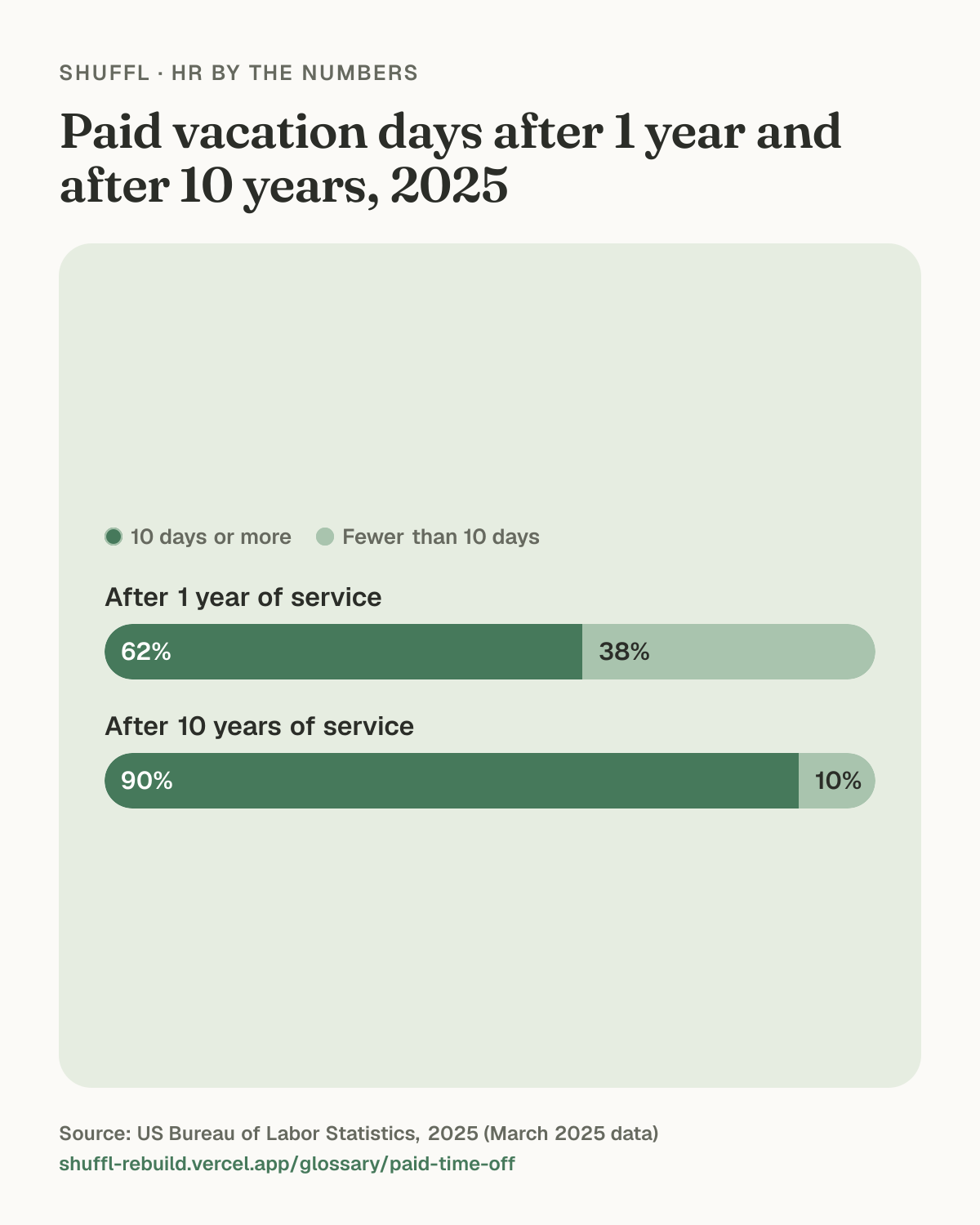
Vacation grows with tenure. After one year of service, 31% of private industry workers got 10 to 14 days of paid vacation and another 31% got 5 to 9 days. After 20 years, 33% got more than 24 days6. A policy that gives everyone the same amount no matter how long they’ve stayed will look thin to long-tenured staff.
Shuffl · HR by the numbers
Paid vacation days after 1 year and after 10 years, 2025
Paid vacation days after 1 year and after 10 years, 2025. After 1 year of service: 62% 10 days or more, 38% Fewer than 10 days. After 10 years of service: 90% 10 days or more, 10% Fewer than 10 days. Source: US Bureau of Labor Statistics, 2025 (March 2025 data).
Where the rules differ
US federal law leaves most of this to employers. The FLSA doesn’t require pay for time not worked, like vacations, sick leave or holidays1, and there are no federal legal requirements for paid sick leave. The FMLA gives eligible employees up to 12 weeks of unpaid leave for certain medical reasons. To qualify, they need 12 months with the employer, 1,250 hours worked in the past 12 months, and a work site with 50 or more employees within 75 miles2.
State and local laws add to this, so check each place you have employees. In California, a policy can’t make employees forfeit vested vacation when they leave, and unused vested vacation is paid as wages at the final rate3. In the EU, every worker is entitled to at least four weeks of paid annual leave, and that minimum can’t be replaced with pay except when employment ends4.
An example
A 90-person software company replaces its separate vacation and sick buckets with one PTO bank that employees earn as they work. Full-time staff accrue 120 hours a year, about 4.6 hours per biweekly paycheck, rising to 160 hours after five years. Up to 40 unused hours carry over into the next year.
Eight of its employees are in California. Its old policy said unused vacation expired at the end of the year, so the company drops that clause and pays out any unused balance when someone leaves3. It also asks managers to check in with anyone who hasn’t taken a day off in six months.
Common questions
- How does PTO accrual work?
- Under an accrual policy, employees earn PTO as they work, for example a few hours per pay period.
- Does unused PTO get paid out when you leave?
- Some US states require it. California treats earned vacation as wages that must be paid out when employment ends. Many other states leave it to company policy.
Sources
Read on . Laws change, so check the source before you act. This page is general information, not legal advice.
- US Department of Labor, Vacation leave, Accessed September 2026. Federal regulator topic page on the FLSA and vacation pay.
- US Department of Labor, Sick leave, Accessed September 2026. Federal regulator topic page on paid sick leave and FMLA eligibility.
- California Legislative Information, California Labor Code § 227.3, Accessed September 2026. Primary statute on payment of vested vacation at termination.
- EUR-Lex, Official Journal of the European Union, Directive 2003/88/EC concerning certain aspects of the organisation of working time, Article 7, November 2003. Primary legislation. Article 7 sets a minimum of four weeks of paid annual leave.
- US Bureau of Labor Statistics, Employee Benefits in the United States, March 2025, Table 6: Selected paid leave benefits, access, September 2025. National Compensation Survey, an establishment survey of civilian employers; reference period March 2025.
- US Bureau of Labor Statistics, Who receives paid vacations?, 2025 (March 2025 data). National Compensation Survey fact sheet; percentages of private industry workers by number of paid vacation days and years of service.