
HR glossary
Time to hire
Time to hire is the number of days between a candidate entering your hiring pipeline and accepting your offer.
Time to hire starts the day a candidate enters your pipeline, by applying or being sourced, and ends when they accept your offer.
It shows how quickly your process moves once you’ve found someone good. Strong candidates often have other offers, so a slow week between interviews can cost you the hire.
Look at where time goes stage by stage. Scheduling interviews is often the biggest delay, not the decision itself.
How to calculate time to hire
Time to hire = offer acceptance date − date candidate entered the pipeline
- Measured in calendar days
- Average it across all hires in the period
Example: A candidate applied on May 3 and accepted the offer on May 24. Time to hire is 21 days.
What the research says
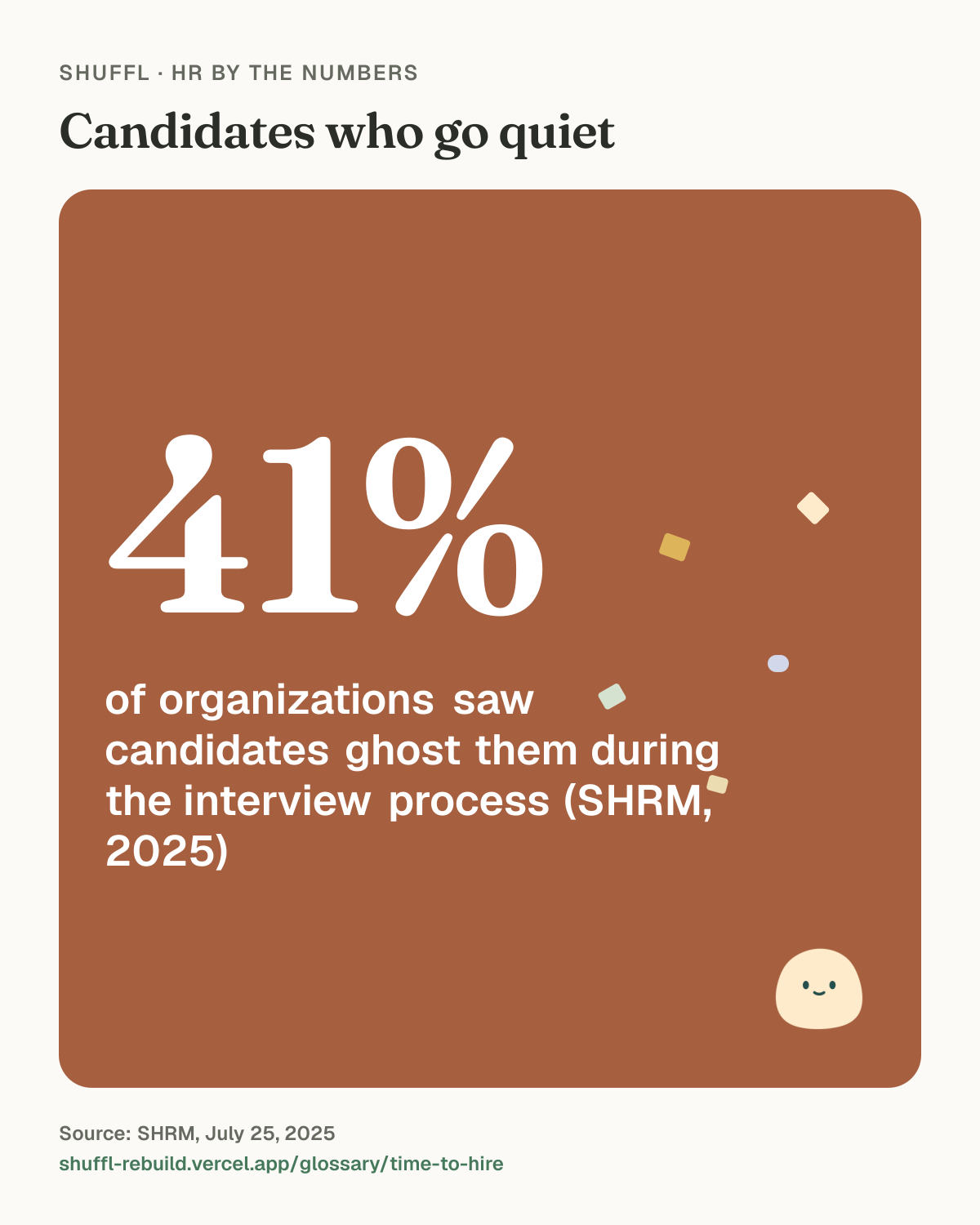
Candidates drop out while they wait. In SHRM’s 2025 Talent Trends survey of 2,040 HR professionals, 41% said candidates were “ghosting” them during the interview process,1 which SHRM defines as applicants suddenly ending all communication without an explanation.2
People are also more cautious about changing jobs. In a December 2025 Gartner survey of 3,072 employees, 30% said they would prefer to stay in their current job because of economic volatility, even if they received a better offer.3 A long gap between interviews gives a hesitant candidate more time to decide to stay put.
Shuffl · HR by the numbers
Candidates who go quiet

Candidates who go quiet: 41% of organizations saw candidates ghost them during the interview process (SHRM, 2025). Source: SHRM, July 25, 2025.
An example
A 180-person fintech tracks time to hire by stage for its engineering roles. Across 12 hires in the last six months, the average was 34 days: 3 days from application to recruiter screen, 5 more to the hiring manager call, 17 to finish the technical interview and panel, 6 for the decision and offer, and 3 for the candidate to accept.
The panel was the slow part, because four engineers rarely had the same free afternoon within a week. The company split the panel into two shorter sessions with different interviewers and set a 48-hour deadline for written feedback. The next quarter’s average was 23 days, and two candidates who were holding other offers accepted.
How to shorten time to hire
Most of the time goes to waiting between steps, so the fixes are mostly about scheduling and deadlines.
- Measure each stage as well as the total, so you know where the days go.
- Hold interview slots on panel members’ calendars before the role opens.
- Set a deadline for interview feedback, such as 24 or 48 hours, and chase it when it’s missed.
- Tell candidates the timeline on the first call and update them each week.
- Agree the salary range before posting, so the offer doesn’t wait on sign-off.
Common questions
- How can you reduce time to hire?
- Book interviews in batches, set a deadline for feedback after each stage, and give hiring managers a clear rubric so decisions don’t stall.
- Where does time to hire data come from?
- Most applicant tracking systems report it automatically from the date a candidate was added and the date they were marked hired.
Sources
Read on . Numbers change as new studies come out, so check the source before you quote it.
- SHRM, Candidate “Ghosting” and Employer Competition Are Fueling Talent Shortages, New SHRM Research Finds, July 25, 2025. Press release for the 2025 Talent Trends report (2,040 HR professionals, surveyed Feb. 3 to 12, 2025).
- SHRM, 2025 Talent Trends, 2025. Survey of 2,040 HR professionals via SHRM’s Voice of Work Research panel, fielded Feb. 3 to Feb. 12, 2025.
- Gartner, Gartner HR Research Finds 48% of Candidates Accepted Job Offers in 4Q25; Down From 85% Two Years Earlier, June 18, 2026. Figures used: a December 2025 Gartner survey of 3,072 employees, and a 1Q26 Gartner survey of 11,838 employees. Page read through the Internet Archive copy because gartner.com blocked direct access.