
HR glossary
Applicant tracking system (ATS)
An applicant tracking system (ATS) is software that manages job postings, applications and candidates through the hiring process.
An applicant tracking system is software for running hiring. It posts jobs, collects applications, moves candidates through interview stages and stores feedback from everyone involved.
Most also schedule interviews, send candidate emails and report on metrics like time to hire. When someone accepts an offer, the ATS usually hands their details to the HRIS so onboarding can start.
What the research says
More ATS features now use AI to write job posts, rank applicants or schedule interviews. In SHRM’s 2025 survey of 2,040 HR professionals, AI use in HR tasks climbed to 43%, up from 26% a year earlier1.
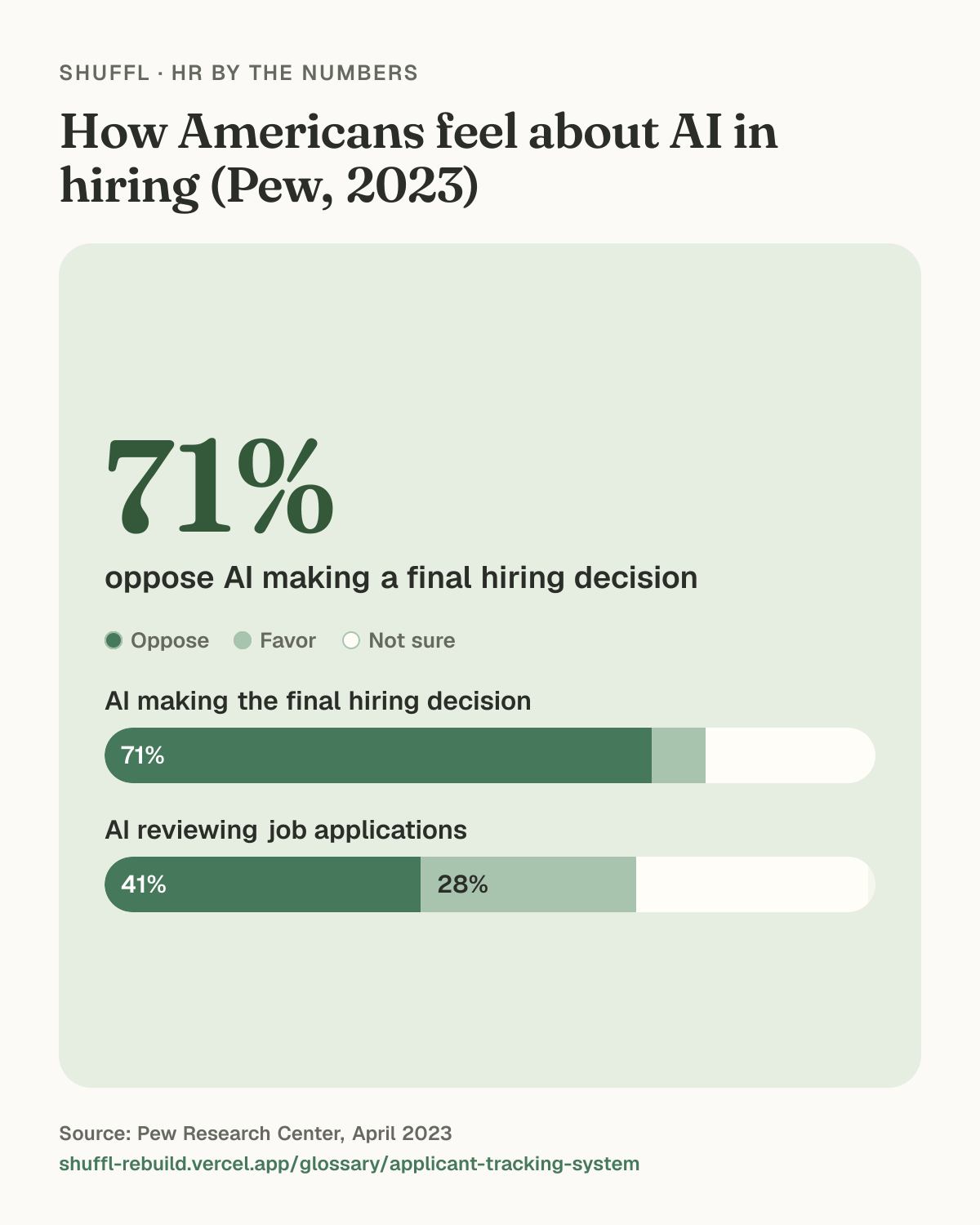
Candidates are wary of it. A 2023 Pew Research Center survey of 11,004 US adults found that 71% oppose AI making a final hiring decision, and 41% oppose employers using AI to review job applications2. For most teams that means using automation to sort and schedule, and keeping a person on every rejection and every offer.
Shuffl · HR by the numbers
How Americans feel about AI in hiring (Pew, 2023)
How Americans feel about AI in hiring (Pew, 2023). 71% oppose AI making a final hiring decision. AI making the final hiring decision: 71% Oppose, 7% Favor, 22% Not sure. AI reviewing job applications: 41% Oppose, 28% Favor, 30% Not sure. Source: Pew Research Center, April 2023.
Where the rules differ
Some places regulate automated screening. New York City’s Local Law 144 bars employers from using an automated employment decision tool unless it has had a bias audit within the past year, the audit results are public, and candidates have been given notice. The city began enforcing it on July 5, 20233.
Other states and countries have their own rules on automated decisions and on how long you keep applicant data. If your ATS scores or ranks candidates, ask the vendor what the feature does and check the rules where you hire.
What to check before you buy one
Most ATS demos look alike. Run a real opening through the trial instead of watching a sales walkthrough.
- Apply to your own job on a phone. If it takes more than a few minutes, candidates will drop off.
- Look at how knockout questions work and who can see the applicants they filter out.
- Check that hired candidates pass to your HRIS with their start date, pay and manager, so nobody retypes them.
- Ask for time to hire and source-of-hire reports built on your own stages.
- Find out how long applicant data is kept and how you delete it on request.
Common questions
- What is the difference between an ATS and an HRIS?
- An ATS handles candidates before they’re hired. An HRIS handles employees after. Many companies run both and connect them.
- Do ATS systems reject resumes automatically?
- Some systems filter on keywords or knockout questions, so a strong resume can get screened out if it doesn’t use the job’s wording. Recruiters still read most applications themselves.
Sources
Read on . Numbers change as new studies come out, so check the source before you quote it.
- SHRM, 2025 Talent Trends, 2025. Survey of 2,040 HR professionals from SHRM’s Voice of Work Research panel, fielded February 3 to 12, 2025. Data unweighted.
- Pew Research Center, Americans’ views on use of AI in hiring (AI in Hiring and Evaluating Workers: What Americans Think), April 2023. Survey of 11,004 US adults on the American Trends Panel, December 12 to 18, 2022, recruited by national random sampling of residential addresses.
- NYC Department of Consumer and Worker Protection, Automated Employment Decision Tools (AEDT), 2023. Regulator page for Local Law 144 of 2021 and its rules.