
HR glossary
Human resources information system (HRIS)
A human resources information system (HRIS) is software that stores employee records and runs core HR processes.
An HRIS is the system of record for employees. It stores who works for you, their job, manager, department, pay and start date.
Most also handle time off, benefits enrollment, onboarding tasks and reporting. Many connect to payroll or include it. You’ll also hear HRMS and HCM used for the same kind of software, usually with more features.
The HRIS is only as useful as its data. Keep managers and departments current, or every report and every tool connected to it will be wrong.
What the research says
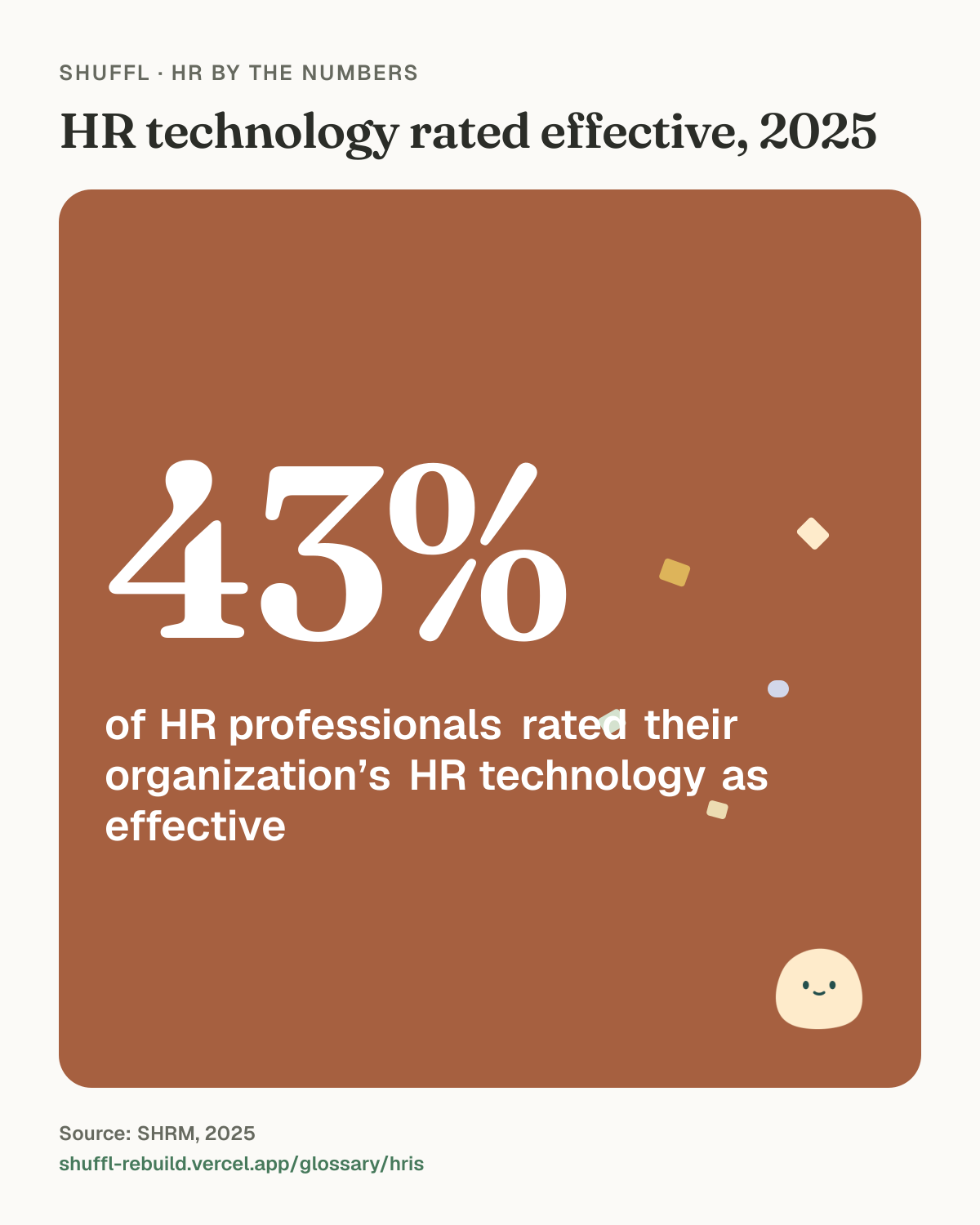
Many HR teams aren’t happy with their tools. In SHRM’s 2025 State of the Workplace research, only 43% of HR professionals, 43% of HR executives and 43% of US workers rated their organization’s HR technology as effective1. SHRM surveyed 1,615 HR professionals in December 2024, along with HR executives and a representative panel of US workers1.
Employees use HR systems every week for things like time tracking and benefits, so a clumsy system is felt well beyond HR. SHRM’s report ties the quality of HR technology directly to how workers judge the HR department1.
Shuffl · HR by the numbers
HR technology rated effective, 2025

HR technology rated effective, 2025: 43% of HR professionals rated their organization’s HR technology as effective. Source: SHRM, 2025.
An example
A 140-person logistics company keeps employee data in three places: payroll, the benefits broker’s portal and a spreadsheet of managers and departments. Someone reconciles them by hand each month, and the org chart is usually a few weeks behind.
When it moves to an HRIS, it makes the HRIS the one place where a new hire, a manager change or a pay change is entered, and payroll and benefits pull from it. The first month is mostly cleanup. The import turns up 23 people with the wrong manager, 9 with old job titles and 4 former employees still listed as active.
What to ask when choosing one
Demos tend to show the same screens. These questions tell systems apart.
- Which system will be the source of truth for each field, and which ones only read from it?
- How does it connect to payroll, benefits, your applicant tracking system and your sign-on provider?
- Can you limit who sees pay, performance notes and medical details by role?
- Can employees update their own address or bank details without emailing HR?
- Which reports can you build without exporting to a spreadsheet?
- How do you get all your data out if you leave?
Common questions
- What is the difference between HRIS and HCM?
- The terms overlap. HRIS usually means core records and processes. HCM (human capital management) often adds talent management, like performance and learning.
- What does an HRIS do?
- Employee records, org charts, time off, benefits, onboarding and reporting. Many include or connect to payroll.
Sources
Read on . Numbers change as new studies come out, so check the source before you quote it.
- SHRM, 2025 SHRM State of the Workplace research report, 2025. 1,615 HR professionals surveyed Dec. 9 to 12, 2024 through SHRM’s Voice of Work Research Panel; 238 HR executives; 471 US workers outside HR surveyed Dec. 12 to 16, 2024 on NORC’s AmeriSpeak probability-based panel, weighted to the US adult population.