
HR glossary
Employee handbook
An employee handbook is a document that explains a company’s policies, benefits and expectations for employees.
An employee handbook tells employees how the company works: policies, benefits, expectations for conduct, how to take time off and how to raise a concern.
In the US, handbooks usually include an at-will statement and a page employees sign to acknowledge they received it. They need updates whenever laws or policies change, which happens more often than most companies update them.
Nobody reads a handbook cover to cover. People search it when they have a question, so make sure the answer is easy to find.
Where the rules differ
Handbook rules are subject to labor law even at companies without a union. The NLRB says employees covered by the National Labor Relations Act can discuss their pay with coworkers whether or not they have a union, and a work rule or policy that bans those conversations, or requires permission first, is unlawful1.
In its 2023 Stericycle decision, the NLRB said a challenged work rule is presumed unlawful if it has a reasonable tendency to chill employees from using their rights. The employer can defend it by showing the rule serves a legitimate and substantial business interest that a narrower rule couldn’t2. That decision replaced a 2017 standard, so check the current test before you rewrite conduct rules.
What the handbook promises can also bind you. In Montana, a firing is wrongful if the employer materially violated an express provision of its own written personnel policy3. Other states treat handbook language differently, so a set disciplinary process in the handbook is worth following.
An example
A 75-person architecture firm last updated its handbook four years ago. The review turns up a confidentiality rule telling staff not to share “salary information,” a leave section that still describes a sick-day policy the firm dropped two years ago, and nothing about its hybrid schedule.
HR narrows the confidentiality rule to client data and trade secrets, replaces the leave section, adds a remote work policy and asks every employee to sign a new acknowledgment.
How to keep it current
A yearly review catches most problems before they cause one. Tie it to a fixed month so it doesn’t slip.
Shuffl · HR by the numbers
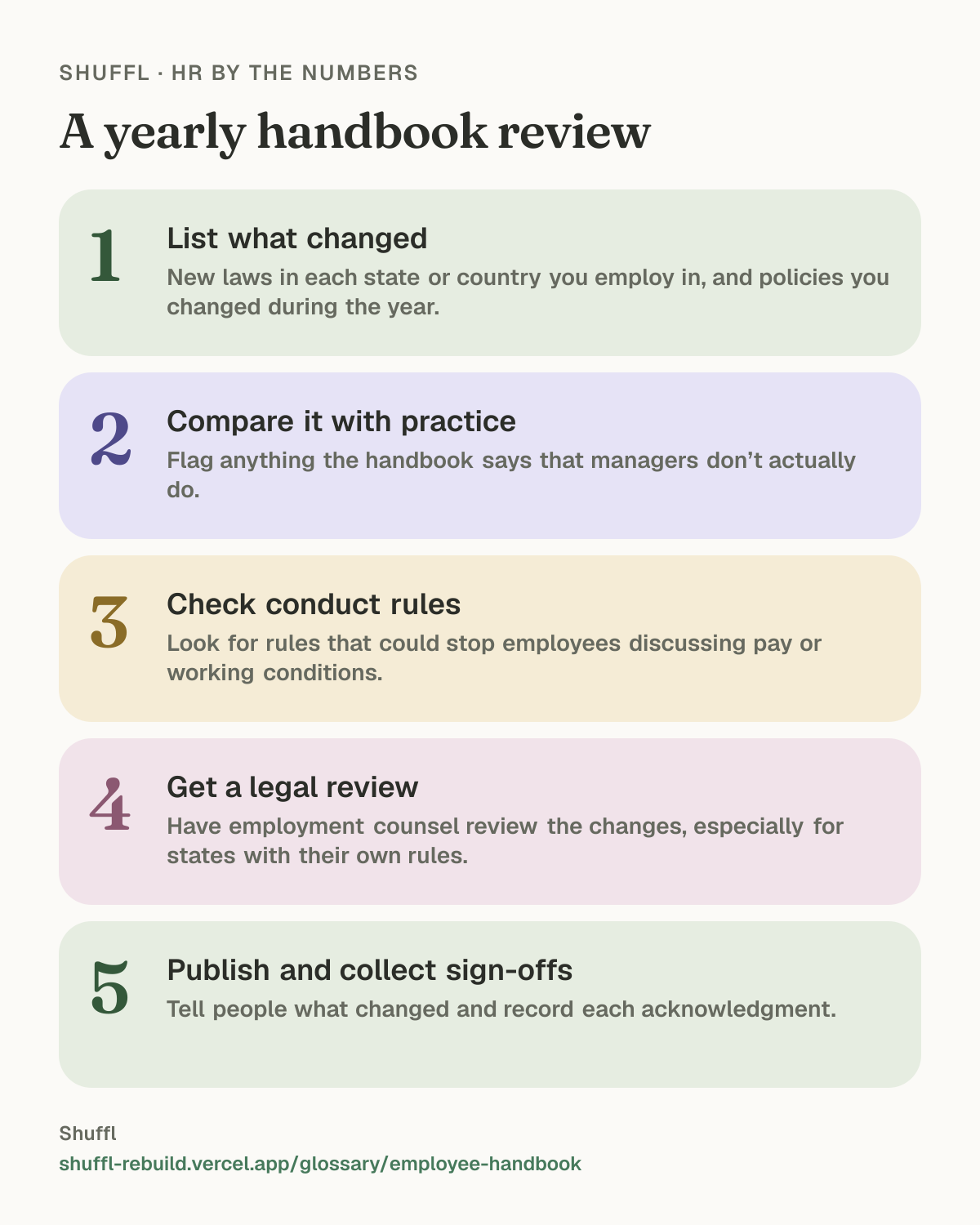
A yearly handbook review
A yearly handbook review. 1. List what changed: New laws in each state or country you employ in, and policies you changed during the year. 2. Compare it with practice: Flag anything the handbook says that managers don’t actually do. 3. Check conduct rules: Look for rules that could stop employees discussing pay or working conditions. 4. Get a legal review: Have employment counsel review the changes, especially for states with their own rules. 5. Publish and collect sign-offs: Tell people what changed and record each acknowledgment.
Common questions
- How often should an employee handbook be updated?
- At least once a year, and whenever a law or major policy changes.
- Is an employee handbook legally required?
- Not everywhere, but it’s the most common way to put required policies in writing and prove employees received them.
Sources
Read on . Numbers change as new studies come out, so check the source before you quote it.
- National Labor Relations Board, Your right to discuss wages, Accessed September 2026. Federal regulator guidance under the National Labor Relations Act.
- National Labor Relations Board, Board adopts new standard for assessing lawfulness of work rules, August 2023. NLRB announcement of Stericycle Inc., which overruled Boeing Co. (2017).
- Montana Legislature, Montana Code Annotated § 39-2-904, Elements of wrongful discharge, Accessed September 2026. Primary statute.