
HR glossary
At-will employment
At-will employment means an employer or employee can end the employment relationship at any time, for any legal reason, without notice.
At-will employment is the default rule in the US. Either side can end the employment at any time, for almost any reason or no reason, without notice.
Montana is the exception. Once an employee finishes the employer’s probationary period, Montana law requires good cause for a firing. Everywhere, an employer still can’t fire someone for an illegal reason, like discrimination or retaliation for a discrimination complaint. A contract or union agreement can also limit it.
Most employee handbooks and offer letters say employment is at will. Saying so doesn’t change the need to document performance issues.
Where the rules differ
Montana’s wrongful discharge law lists three ways a firing can be wrongful. The employer retaliated because the employee refused to violate public policy or reported a violation. The employee had finished the probationary period and the firing wasn’t for good cause. Or the employer materially broke an express provision of its own written personnel policy1. During probation, either side can still end the job for any reason or none, and employers keep the broadest discretion over firing managers and supervisors1.
Federal anti-discrimination law applies in every state. It’s illegal to fire someone because of race, color, religion, sex (including transgender status, sexual orientation and pregnancy), national origin, age (40 or older), disability or genetic information. It’s also illegal to retaliate against someone who complained about discrimination, filed a charge or took part in an investigation2. That’s the federal list. Check state and local law where your employees work as well.
What the research says
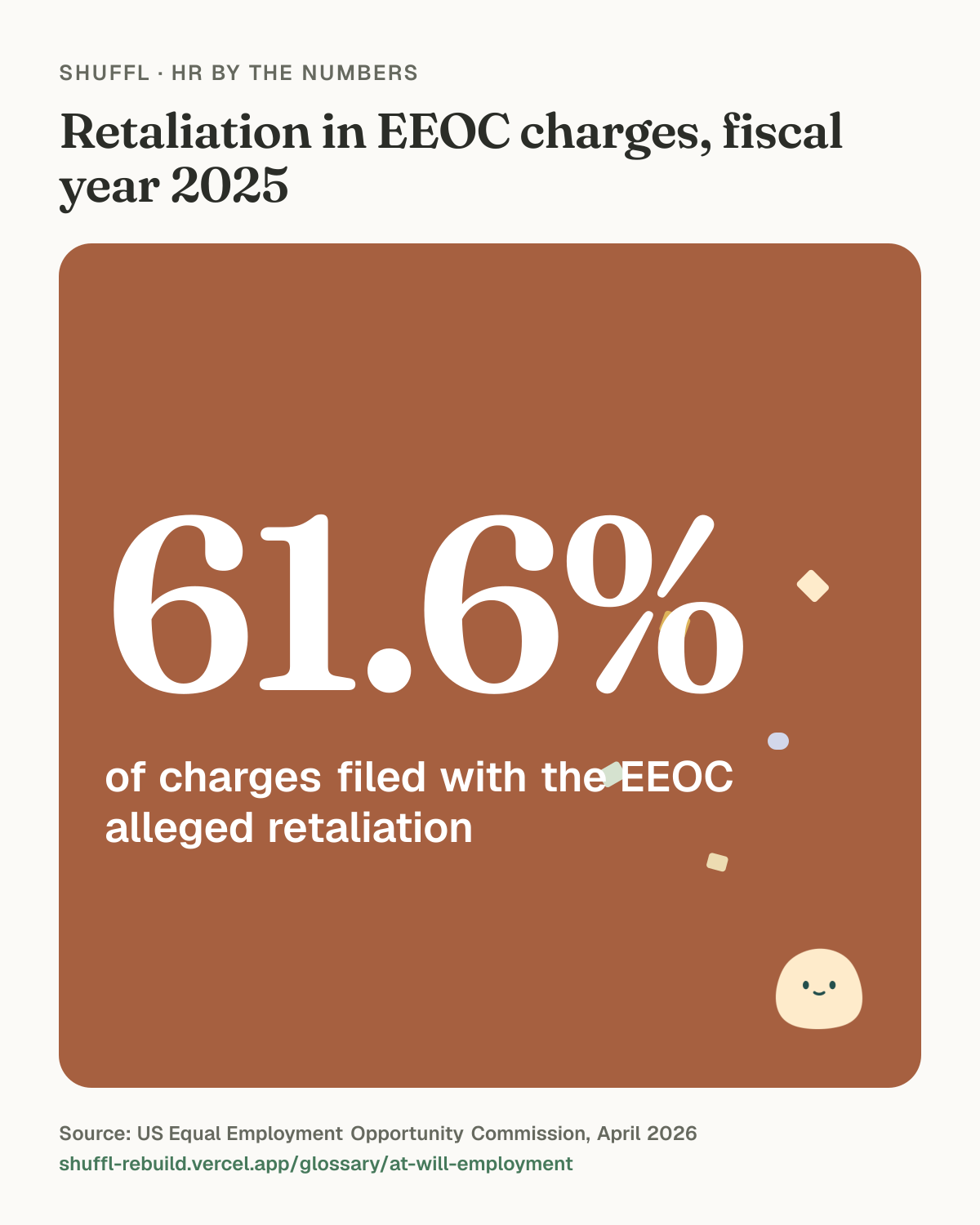
Retaliation is the most common basis in charges filed with the EEOC. In fiscal year 2025, 54,350 of the 88,201 charges, or 61.6%, alleged retaliation. Disability came next at 41.1%, then race at 33.3%3. A single charge can name several bases, so the shares add up to more than 100%.
For an at-will employer, timing is the risk. A firing that comes soon after a complaint can look like retaliation even when the real reason was performance, and the at-will clause in the offer letter won’t answer that question. Notes written at the time will.
Shuffl · HR by the numbers
Retaliation in EEOC charges, fiscal year 2025

Retaliation in EEOC charges, fiscal year 2025: 61.6% of charges filed with the EEOC alleged retaliation. Source: US Equal Employment Opportunity Commission, April 2026.
What to check before you act
This is general information, not legal advice. If any of these questions gets a yes or a maybe, talk to employment counsel before the conversation happens.
- Does a contract, offer letter, union agreement or handbook promise limit how you can end the job, like a set disciplinary process?
- Has the employee recently complained, asked for an accommodation, taken protected leave or taken part in an investigation?
- Does the documentation back the stated reason, and was it written when things happened?
- Have others with similar performance or conduct been treated the same way?
- In Montana, has the employee finished the probationary period, and is there good cause1?
Common questions
- Which state is not at-will?
- Montana. After the employer’s probationary period ends, firing someone there needs good cause.
- Can an at-will employee be fired for any reason?
- No. At-will employment doesn’t allow firing for illegal reasons, like discrimination or retaliation.
Sources
Read on . Laws change, so check the source before you act. This page is general information, not legal advice.
- Montana Legislature, Montana Code Annotated § 39-2-904, Elements of wrongful discharge, Accessed September 2026. Primary statute.
- US Equal Employment Opportunity Commission, Prohibited employment policies and practices, Accessed September 2026. Federal regulator guidance on laws the EEOC enforces.
- US Equal Employment Opportunity Commission, Table E1a. Charge receipts by basis or statute (all statutes), FY 1997 to FY 2025, April 2026. All charges filed with the EEOC in each fiscal year. Charges filed on more than one basis are counted under each, so bases sum to more than the total. Excludes charges filed only with state or local agencies.