
HR glossary
Exempt employee
An exempt employee is one who is not entitled to overtime pay under US wage and hour law, based on their salary and job duties.
Under the US Fair Labor Standards Act, most employees must get overtime pay, at least one and a half times their regular rate, for hours over 40 in a workweek. Exempt employees are the exception.
To be exempt, a role usually has to pass three tests. The person is paid a fixed salary, earns at least the federal minimum of $684 a week, and mainly does executive, administrative or professional work. Some states set a higher bar. California requires a salary of at least twice the state minimum wage for full-time work.
Job titles don’t decide it. The actual duties do. Misclassifying someone as exempt can mean paying years of back overtime.
Where the rules differ
The federal salary floor is $684 a week, which is $35,568 a year. Highly compensated employees can be exempt at $107,432 a year, including at least $684 a week paid on a salary or fee basis, if they regularly perform at least one exempt duty31. Lower weekly levels apply in Puerto Rico, Guam, the US Virgin Islands and the Northern Mariana Islands ($455) and in American Samoa ($380)3.
States can set a higher bar. In California, exempt staff must earn a monthly salary of at least twice the state minimum wage for full-time work, which the Labor Code defines as 40 hours a week2. With the state minimum at $16.90 an hour from January 1, 20264, that works out to $70,304 a year, about twice the federal floor. Check every state where you have exempt staff, since the numbers change as minimum wages rise.
What the research says
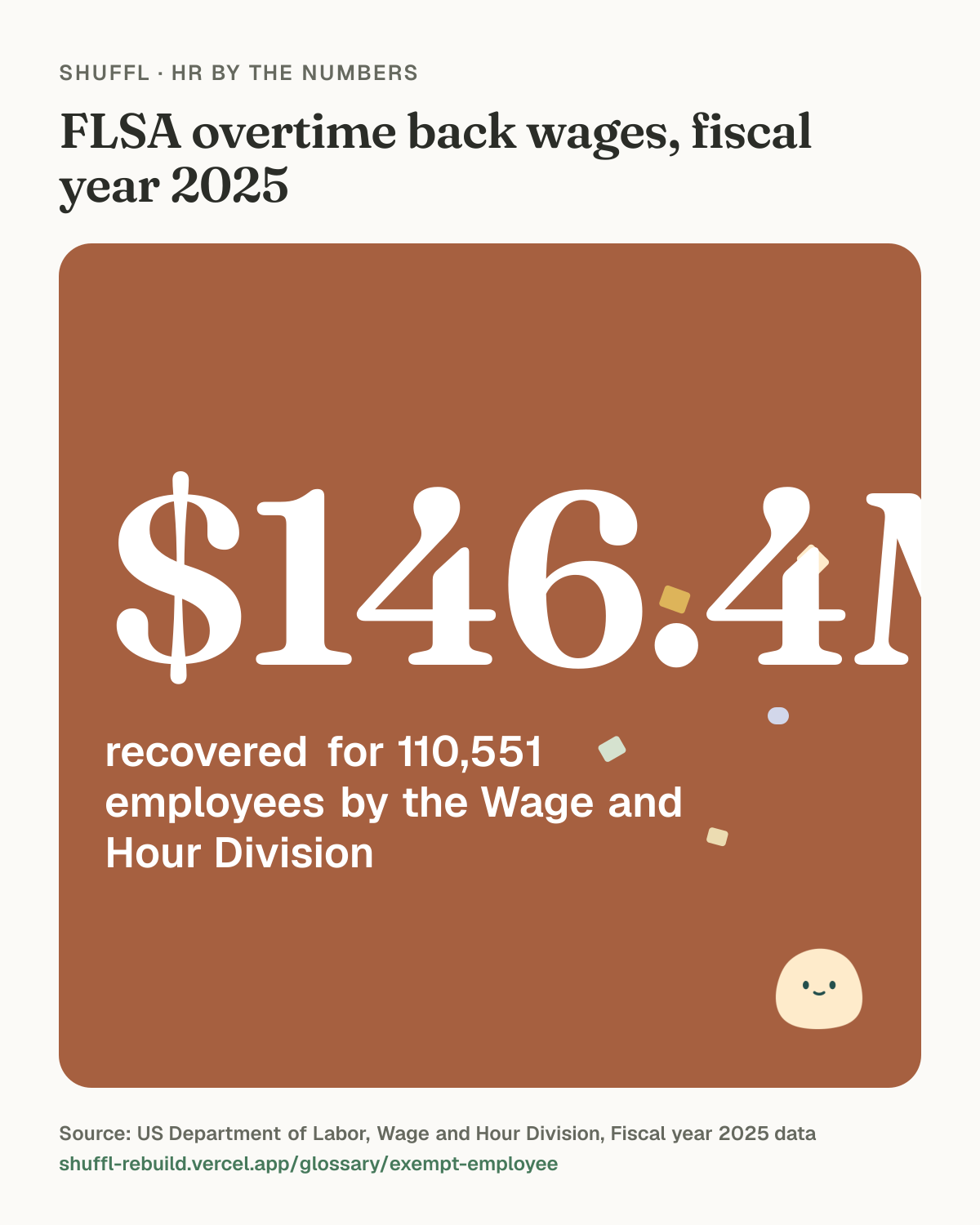
Overtime makes up most of the back wages the Department of Labor recovers under the FLSA. In fiscal year 2025, the Wage and Hour Division recovered $146.4 million in overtime back wages for 110,551 employees, out of $184.4 million in total FLSA back wages5. Across all the laws it enforces, it recovered more than $259 million for 176,957 workers, an average of $1,465 each6.
These totals cover every kind of overtime violation, so misclassification is one part of them and can’t be separated out from these figures.
Shuffl · HR by the numbers
FLSA overtime back wages, fiscal year 2025

FLSA overtime back wages, fiscal year 2025: $146.4M recovered for 110,551 employees by the Wage and Hour Division. Source: US Department of Labor, Wage and Hour Division, Fiscal year 2025 data.
An example
A 60-person marketing agency in Sacramento pays its office coordinator $52,000 a year and has always treated the role as exempt. That clears the federal $35,568 floor but falls well short of California’s $70,304, so the role can’t be exempt there under the salary test2. The coordinator works about five hours of overtime a week. At a regular rate of $25 an hour, that’s $187.50 a week, or about $9,750 a year, before interest or penalties.
- Compare the salary with the federal floor and with the floor in every state where the person works.
- Match the person’s actual primary duty to the executive, administrative or professional test1.
- Confirm they’re paid on a salary basis as the regulations define it1.
- Recheck exempt roles each year when state minimum wages change.
Common questions
- What is the difference between exempt and non-exempt?
- Non-exempt employees must be paid overtime for hours over 40 in a workweek. Exempt employees don’t get overtime.
- Can a salaried employee be non-exempt?
- Yes. Being paid a salary is only one of the tests. A salaried employee who doesn’t meet the duties test is non-exempt.
Sources
Read on . Laws change, so check the source before you act. This page is general information, not legal advice.
- US Department of Labor, Wage and Hour Division, Fact Sheet 17A: Exemption for executive, administrative, professional, computer and outside sales employees under the FLSA, Revised September 2019. Federal regulator fact sheet on the salary level, salary basis and duties tests.
- California Legislative Information, California Labor Code § 515, Accessed September 2026. Primary statute on the exempt salary test and the definition of full-time employment.
- US Department of Labor, Wage and Hour Division, Earnings thresholds for the executive, administrative and professional exemption, Accessed September 2026. Federal regulator page listing the current salary thresholds.
- California Department of Industrial Relations, Labor Commissioner’s Office, Minimum wage frequently asked questions, Accessed September 2026. State regulator page with the 2026 statewide minimum wage.
- US Department of Labor, Wage and Hour Division, Fair Labor Standards Act data, Fiscal year 2025 data. WHD enforcement data: back wages and employees receiving back wages by violation type, from concluded compliance actions.
- US Department of Labor, Wage and Hour Division, Data, Fiscal year 2025 data. WHD enforcement summary across all laws it enforces.