
HR glossary
Performance improvement plan (PIP)
A performance improvement plan (PIP) is a formal document that sets specific goals and a deadline for an employee whose performance is below expectations.
A performance improvement plan puts in writing what an employee needs to improve, how it will be measured, what support they’ll get and by when. Plans usually run 30, 60 or 90 days.
A fair PIP has goals the person can actually reach, regular check-ins, and help like training or clearer priorities. A PIP written to fail is a slow termination, and employees can tell.
Document everything. If the plan ends in a termination, the record matters.
What to check before you start
Many PIPs trace back to unclear expectations. In a 2023 Gallup panel of 18,665 US employees, only 47% strongly agreed they know what is expected of them at work.1 If the employee has never had the standard spelled out, a clear conversation and a few weeks may solve the problem without a formal plan.
Timing matters too. In the US most jobs are at-will, but a PIP can still become evidence in a discrimination or retaliation claim. The EEOC’s 2016 guidance says retaliation is the most frequently alleged basis of discrimination, and it lists lowered evaluations and scrutinizing someone’s work more closely than others’ without justification among actions that can count as retaliation.2 If the employee recently complained, took protected leave or asked for an accommodation, talk to HR or counsel first. Rules differ by state and by country, and many countries outside the US expect a documented, fair process before any dismissal for performance.
What a fair plan looks like
Employees can usually tell within a week whether a plan is meant to help them. The difference shows up in the details.
Shuffl · HR by the numbers
A plan written to succeed vs. a plan written to fail

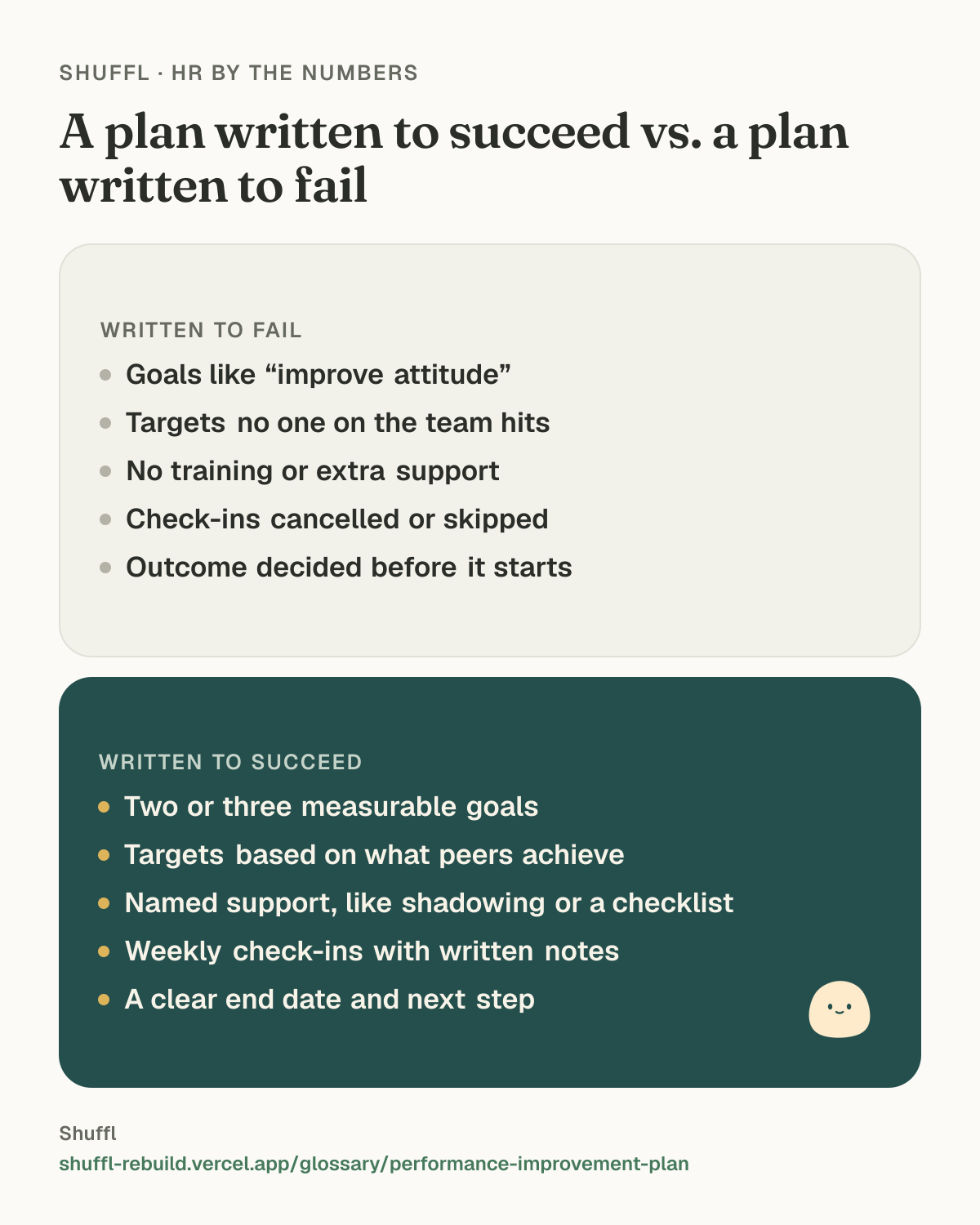
A plan written to succeed vs. a plan written to fail. Written to fail: Goals like “improve attitude”; Targets no one on the team hits; No training or extra support; Check-ins cancelled or skipped; Outcome decided before it starts. Written to succeed: Two or three measurable goals; Targets based on what peers achieve; Named support, like shadowing or a checklist; Weekly check-ins with written notes; A clear end date and next step.
An example
A billing coordinator at a 75-person dental group had an error rate of 9% on submitted claims, against a team average of 2%. Her manager had raised it twice in one-on-ones. The 60-day plan set two targets: under 3% by day 30 and under 2% by day 60.
Support was written in: two shadowing sessions with the billing lead and a pre-submission checklist. They met for 20 minutes every Friday and the manager kept notes. Her rate was 2.4% at day 30 and 1.8% at day 60. The manager closed the plan in writing and kept the file.
Common questions
- Does a PIP mean you will be fired?
- Not always. Many people complete a PIP successfully. It does mean the job is at risk if things don’t improve.
- What should a PIP include?
- Specific areas to improve, measurable goals, the support provided, check-in dates, the end date, and what happens if goals aren’t met.
Sources
Read on . Numbers change as new studies come out, so check the source before you quote it.
- Gallup, 2% of CHROs Think Their Performance Management System Works, May 2024. Gallup CHRO Roundtable survey of 135 Fortune 500 CHROs (June 26 to July 8, 2023) and Gallup Panel study of 18,665 US full- and part-time employees (August 9 to 24, 2023), margin of error ±1.1 points at 95% confidence.
- US Equal Employment Opportunity Commission, Enforcement Guidance on Retaliation and Related Issues, August 2016. Formal EEOC enforcement guidance interpreting federal anti-retaliation provisions.