
HR glossary
One-on-one meeting (1:1)
A one-on-one meeting is a recurring private conversation between a manager and a direct report.
A one-on-one is a regular meeting between a manager and one direct report. It’s the employee’s meeting more than the manager’s. They bring the topics.
Status updates belong somewhere else. Use the time for what’s blocking them, how they’re feeling about the work, feedback both ways, and where they want to grow.
Keep it on the calendar. Cancelling a one-on-one tells someone they’re not a priority.
What the research says
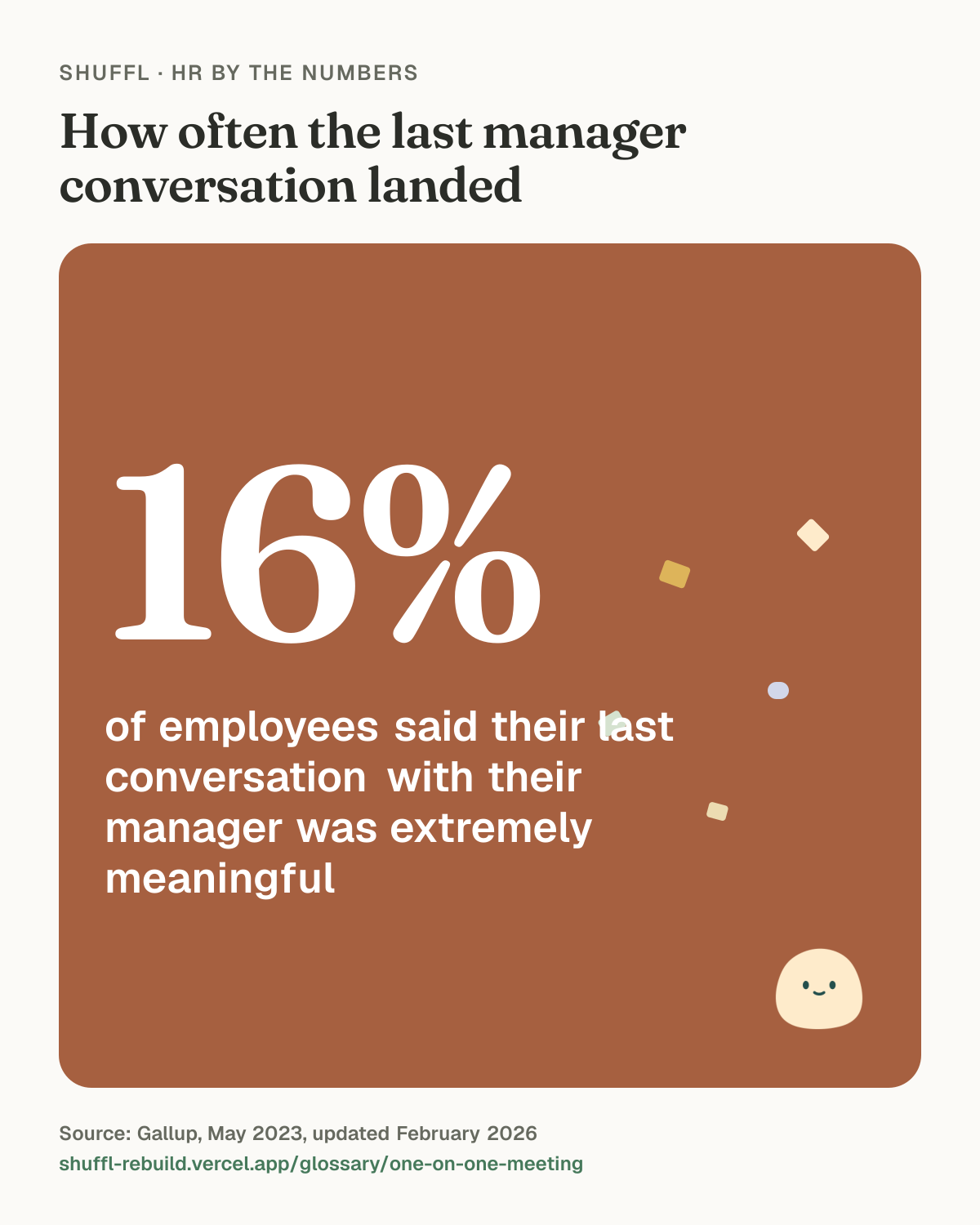
Most managers hold one-on-ones in some form. Few employees come away feeling they were worth the time. In a Gallup study of nearly 15,000 employees, only 16% said the last conversation with their manager was extremely meaningful.1
Gallup’s advice is to keep the meetings short and frequent. Its research found that 15- to 30-minute conversations have a greater impact than 30- to 60-minute ones when they happen regularly, and that managers who skip weekly feedback end up needing longer meetings to catch up. It also reports that 80% of employees who received meaningful feedback in the past week are fully engaged.1
Shuffl · HR by the numbers
How often the last manager conversation landed

How often the last manager conversation landed: 16% of employees said their last conversation with their manager was extremely meaningful. Source: Gallup, May 2023, updated February 2026.
An example
Priya manages six dispatchers at a 140-person regional freight company. She holds a 25-minute one-on-one with each of them every Tuesday. Each dispatcher adds topics to a shared doc by Monday afternoon, and Priya adds hers underneath. She ends every meeting with the same question: “What’s one thing I could do differently?”
In March a dispatcher mentioned that the new routing tool kept double-booking drivers on Fridays. Priya raised it with operations that week and it was fixed within two weeks. She logged the issue and the fix in the doc, so when review season came she had a record of what the dispatcher had spotted, in their own words.
How to run them well
Small habits decide whether a one-on-one stays useful after the first month.
- Let the employee set most of the agenda, and ask them to send topics a day ahead.
- Move status updates to a channel or stand-up so the meeting time goes to blockers, feedback and growth.
- Reschedule rather than cancel. If you have to cancel, say why and offer another slot that week.
- Write down what you both agreed to do and start the next meeting by checking on it.
- Set aside one meeting a quarter for career goals, so it doesn’t get crowded out by this week’s work.
Common questions
- How often should one-on-one meetings happen?
- Weekly or every two weeks, for 30 minutes, is common.
- What should you talk about in a one-on-one?
- Blockers, priorities, feedback, career goals and anything the employee wants to raise.
Sources
Read on . Numbers change as new studies come out, so check the source before you quote it.
- Gallup, A Great Manager’s Most Important Habit, May 2023, updated February 2026. Gallup article on manager conversations. The 16% figure comes from a Gallup study of nearly 15,000 employees; the article draws on Gallup workplace research and 17 studies of manager upskilling (14,774 participants, 2,354 teams).