
HR glossary
Psychological safety
Psychological safety is a shared belief within a team that it is safe to speak up, ask questions and admit mistakes.
Psychological safety is the belief that you won’t be punished or embarrassed for speaking up with a question, a concern or a mistake. Harvard professor Amy Edmondson defined it for teams in a 1999 study.
It became widely known after Google’s Project Aristotle research found it was the factor that most set its effective teams apart.
It’s built in small moments. A manager who says “I don’t know, what do you think?” and thanks people for bad news, instead of shooting the messenger, is building it.
What the research says
Edmondson’s 1999 study looked at 51 work teams in a manufacturing company. Team psychological safety was associated with learning behavior, and learning behavior in turn linked it to team performance.1
Google’s Project Aristotle studied 180 teams, 115 in engineering and 65 in sales, and ranked psychological safety first of five dynamics, ahead of dependability, structure and clarity, meaning and impact.2 People on teams with a stronger team culture were less likely to leave Google and were rated as effective twice as often by executives.
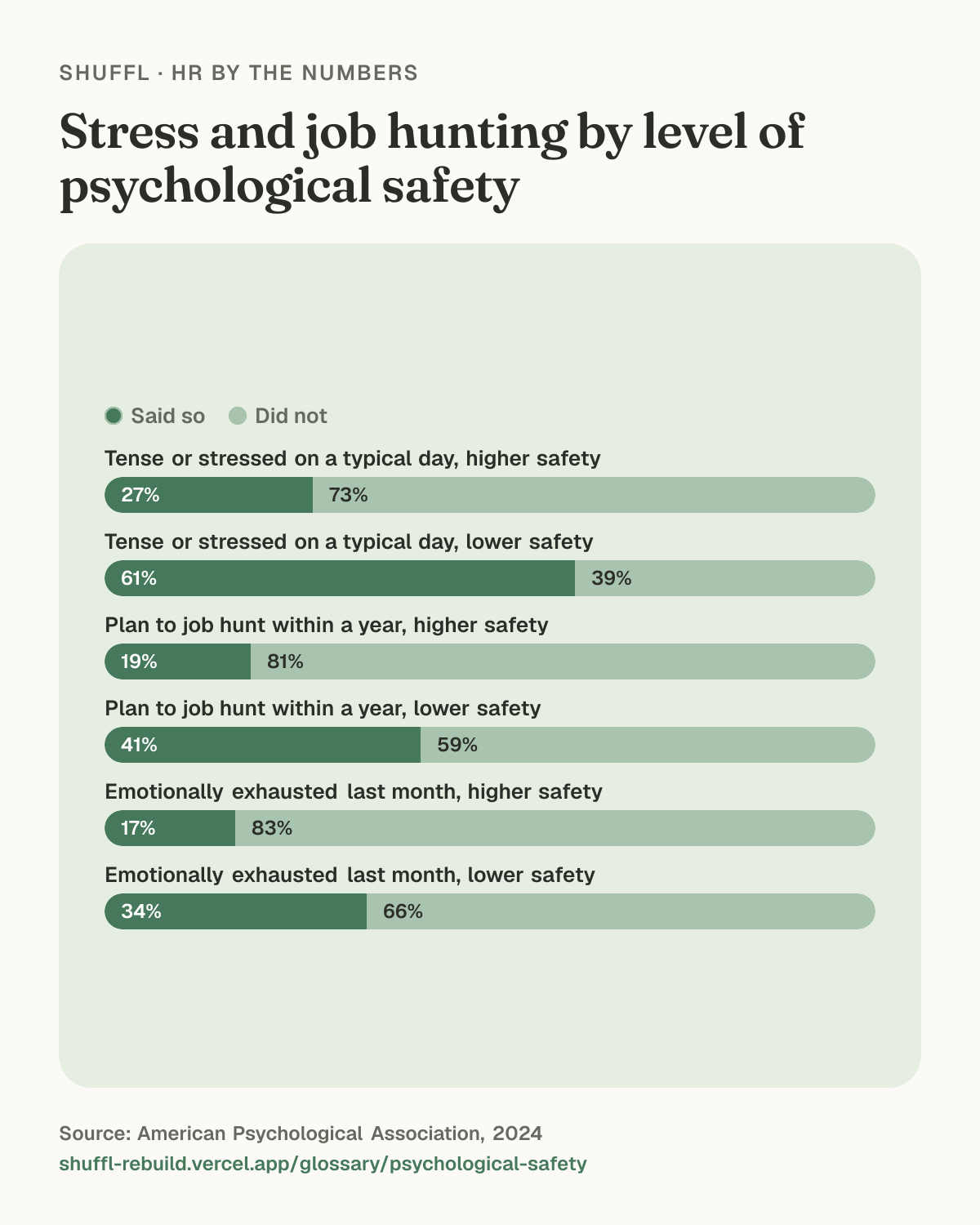
APA’s 2024 Work in America survey measured psychological safety with seven items adapted from Edmondson’s scale. Workers with lower psychological safety were much more likely to feel tense or stressed out on a typical workday and to plan to look for a new job within a year.3
Shuffl · HR by the numbers
Stress and job hunting by level of psychological safety
Stress and job hunting by level of psychological safety. Tense or stressed on a typical day, higher safety: 27% Said so, 73% Did not. Tense or stressed on a typical day, lower safety: 61% Said so, 39% Did not. Plan to job hunt within a year, higher safety: 19% Said so, 81% Did not. Plan to job hunt within a year, lower safety: 41% Said so, 59% Did not. Emotionally exhausted last month, higher safety: 17% Said so, 83% Did not. Emotionally exhausted last month, lower safety: 34% Said so, 66% Did not. Source: American Psychological Association, 2024.
An example
At a 70-person online retailer, a warehouse team lead notices that mis-picks are being fixed quietly and never reported. In a one-on-one, a picker admits people assume a reported error will count against them.
The operations manager starts the next team meeting by describing a stock-count mistake she made the month before and what it cost. After that, errors go into a shared log with no names attached, and the team reviews the log each Friday. Reported mis-picks triple in the first month. Most turn out to come from two bins with similar labels, and the team relabels them.
What managers can do
- Ask for views before you give your own, so people aren’t just agreeing with the boss.
- Respond to bad news with thanks and a question, such as “What do you think happened?”
- Talk about your own mistakes, including recent ones.
- Run reviews of incidents that focus on the process and leave names out.
- Measure it with statements like “Employees are comfortable bringing up problems and tough issues,” asked confidentially and reported by team.
Common questions
- Does psychological safety mean everyone is nice?
- No. It means disagreement is safe to voice. Teams with high psychological safety often argue more, and more productively.
- How do you measure psychological safety?
- Ask team members, confidentially, whether they agree with statements like “If I make a mistake on this team, it is not held against me.”
Sources
Read on . Numbers change as new studies come out, so check the source before you quote it.
- Administrative Science Quarterly, Psychological Safety and Learning Behavior in Work Teams (Amy Edmondson), vol. 44, no. 2, pp. 350-383, June 1999. Peer-reviewed multimethod field study of 51 work teams in a manufacturing company.
- Google re:Work, Guide: Understand team effectiveness, Undated guide. Project Aristotle studied 180 Google teams (115 engineering project teams and 65 sales pods), selected with input from executives.
- American Psychological Association, 2024 Work in America Survey: Psychological Safety in the Changing Workplace, 2024. Online survey by The Harris Poll of more than 2,000 employed U.S. adults, March 25 to April 3, 2024. Psychological safety measured with seven items adapted from Edmondson’s scale.