
HR glossary
Employee engagement
Employee engagement is how committed and involved employees are in their work and their organization.
Engaged employees care about their work and put real effort into it. They know what’s expected of them, feel their work matters, and want the company to do well.
Engagement isn’t the same as happiness. Someone can enjoy the free lunch and still be checked out. It shows up in whether people go past the minimum, stay, and recommend the company to friends.
Most companies measure it with surveys. The bigger lever is the manager. People’s engagement tracks closely with how their manager treats them, so start there when scores are low.
What the research says
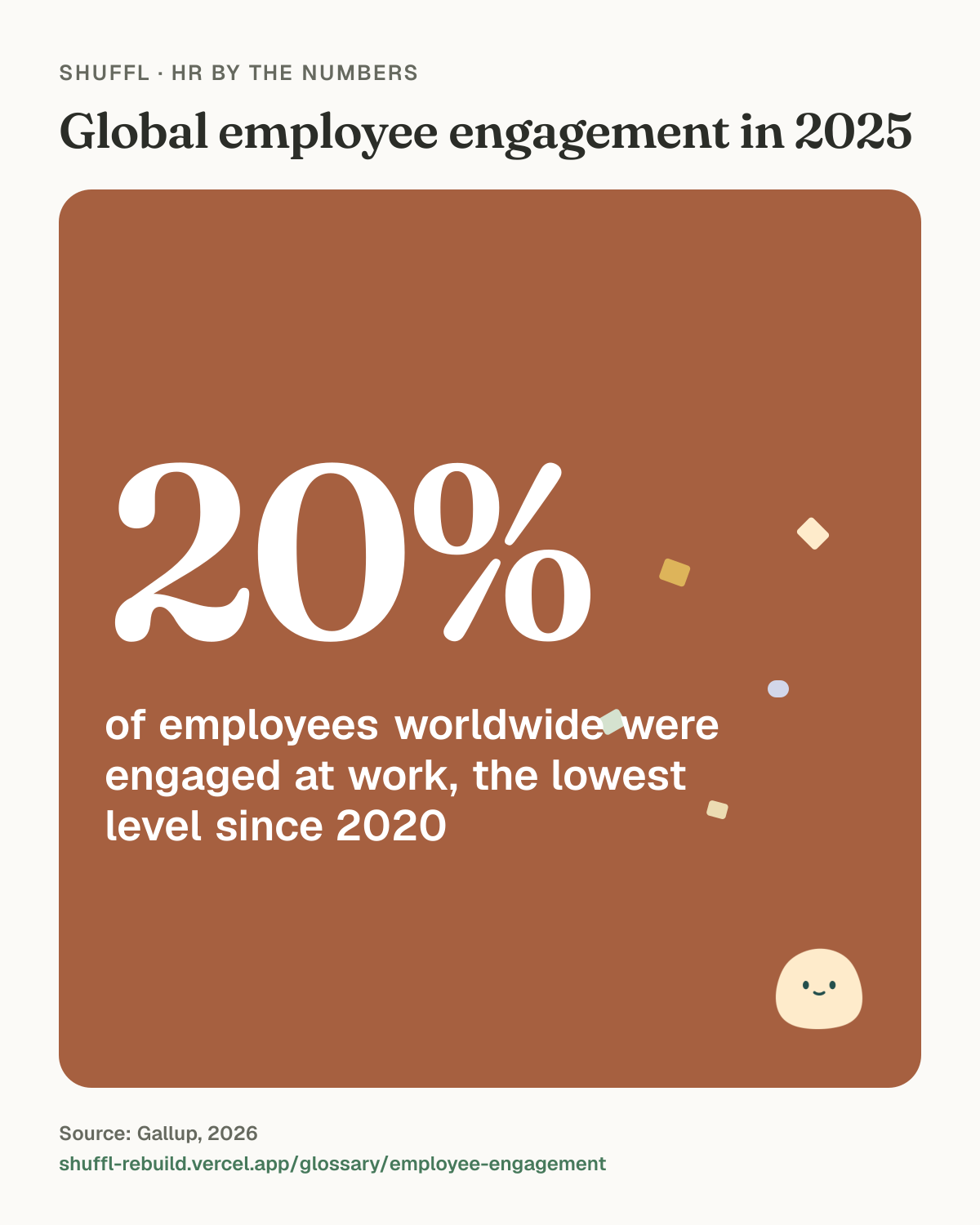
Gallup’s State of the Global Workplace report found that global engagement fell to 20% in 2025, its lowest level since 2020 and down from a 2022 peak of 23%.1 Gallup estimates that low engagement cost the world economy about $10 trillion in lost productivity that year, or 9% of GDP.
Managers drove most of the drop. Their engagement fell five points in one year, from 27% in 2024 to 22% in 2025, so they are now barely more engaged than the people they lead.1 That matters because a disengaged manager is the person expected to lift everyone else’s scores.
In the US, 31% of employees were engaged and 18% were actively disengaged in the first half of 2026.2 Only 49% strongly agreed that they know what’s expected of them at work, and clarity of expectations is one of the two items that has fallen most over the past five years.
Shuffl · HR by the numbers
Global employee engagement in 2025

Global employee engagement in 2025: 20% of employees worldwide were engaged at work, the lowest level since 2020. Source: Gallup, 2026.
An example
A 220-person software company runs its annual survey and gets a company-wide engagement score of 74 out of 100. The customer support team, 26 people, scores 58. The lowest item for that team is “I know what is expected of me at work,” at 2.9 out of 5 against 4.1 for the company.
In the team discussion, agents explain that they’re measured on ticket speed and on customer satisfaction, and the two targets pull against each other. The support lead picks satisfaction as the main goal, drops the speed target to a floor, and starts fortnightly one-on-ones. A pulse survey three months later puts the expectations item at 3.8 and the team score at 67.
How to raise engagement
Survey scores move slowly, and they move team by team. Company-wide programs help less than a manager who works on one or two problems with their own people.
- Give every manager their own team’s results, as long as the group is big enough to keep answers anonymous.
- Start with clarity. If people can’t describe what good work looks like in their role, other items rarely improve.
- Ask each team to pick one or two items to work on and to name who owns each one.
- Tell people what changed because of the survey, and say plainly which requests you won’t act on and why.
- Track manager engagement on its own. Managers need support and development too.
Common questions
- How do you measure employee engagement?
- With an annual engagement survey, shorter pulse surveys in between, and signals like eNPS, retention and absenteeism.
- How do you improve employee engagement?
- Clear expectations, regular one-on-ones, recognition, and following up visibly on survey results. Asking and then doing nothing lowers engagement.
Sources
Read on . Numbers change as new studies come out, so check the source before you quote it.
- Gallup, State of the Global Workplace: 2026 Report, 2026. Primarily the Gallup World Poll. 2025 data: 263,810 respondents (141,444 employed) in 140+ countries and territories, collected January to December 2025, plus U.S. web samples.
- Gallup, Employee Engagement Remains Flat as AI Adoption Accelerates, July 2026. Self-administered web surveys of 43,262 U.S. employees, Feb. 4-19 and May 6-20, 2026. Margin of error ±0.7 points at 95% confidence.