
HR glossary
Pulse survey
A pulse survey is a short, frequent employee survey that tracks how people feel over time.
A pulse survey is small and frequent. Instead of 60 questions once a year, you ask a handful, or even one, every week or month.
Short surveys get more answers and fresher data. You can see how a policy change landed within weeks, not wait until next year.
Keep answers confidential and only show results for groups large enough that nobody can be singled out. Then share what you heard and what you’ll change. Without that last step, response rates drop fast.
What the research says
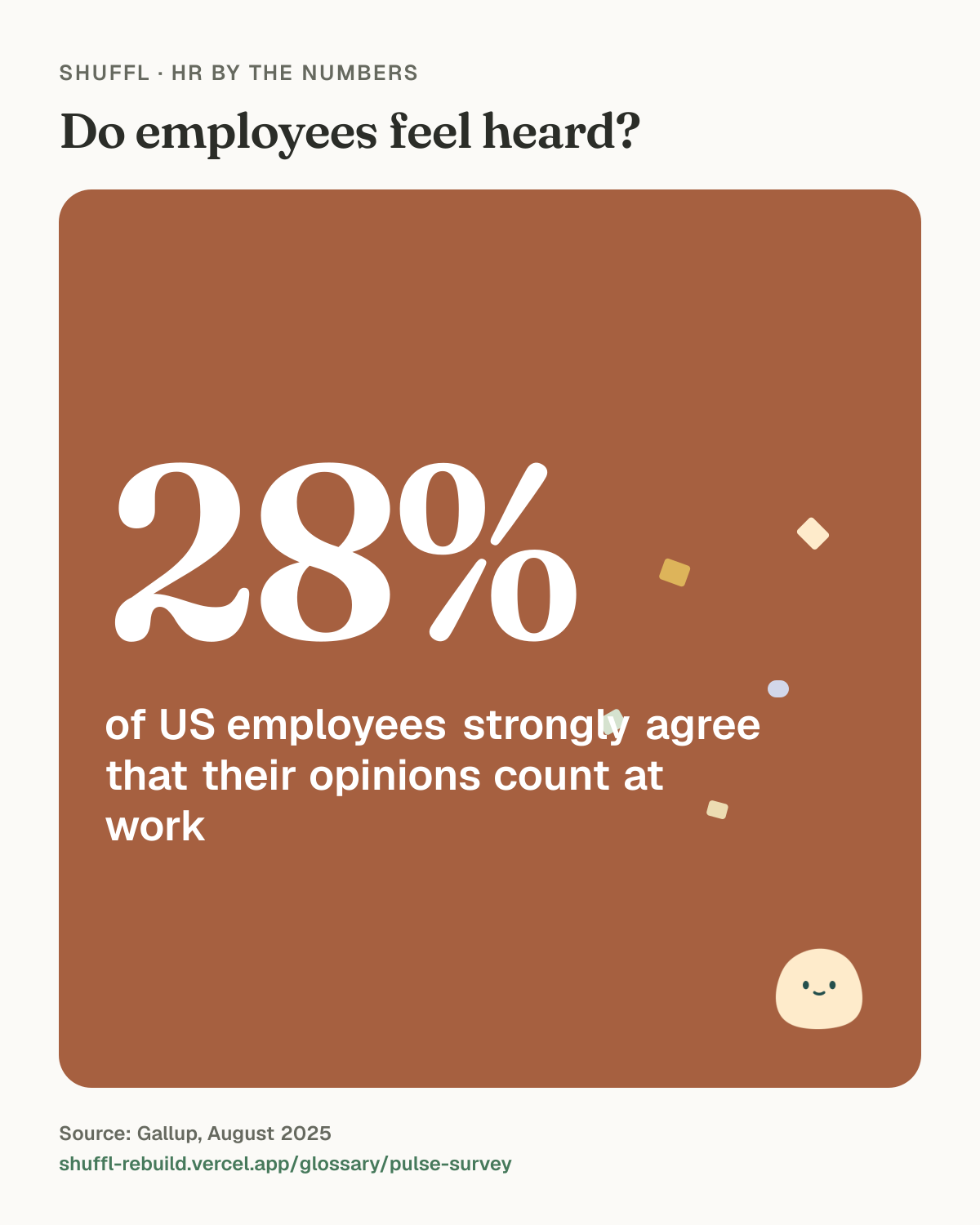
In Gallup’s US survey from the second quarter of 2025, 28% of employees strongly agreed that their opinions count at work.1 A pulse survey is one way to ask for opinions, but people judge it by what happens next.
A 2006 Gallup analysis looked at workgroups surveyed twice in a row. Groups in the top quartile on the item “Action plans from the last survey have had a positive impact on my workplace” increased their engagement scores by an average of 10%. Groups in the bottom quartile saw scores fall by an average of 3%.2 The data is old, so use it as a rough guide.
Shuffl · HR by the numbers
Do employees feel heard?

Do employees feel heard?: 28% of US employees strongly agree that their opinions count at work. Source: Gallup, August 2025.
An example
A 300-person home health agency starts a monthly pulse of five questions. Month one gets a 71% response rate. HR reads the results but doesn’t share them, and by month four only 48% respond.
In month five the agency posts a short “you said, we did” note: caregivers had flagged late schedule changes, so schedules are now locked 10 days out. It also says which request it can’t meet yet, mileage rates, and why. The next pulse gets 66%, and the comments are longer and more specific.
How to run pulse surveys people keep answering
Decide who sees results before you send the first one. Set a minimum group size, often five responses, below which results stay hidden, and keep it the same every time.
Shuffl · HR by the numbers
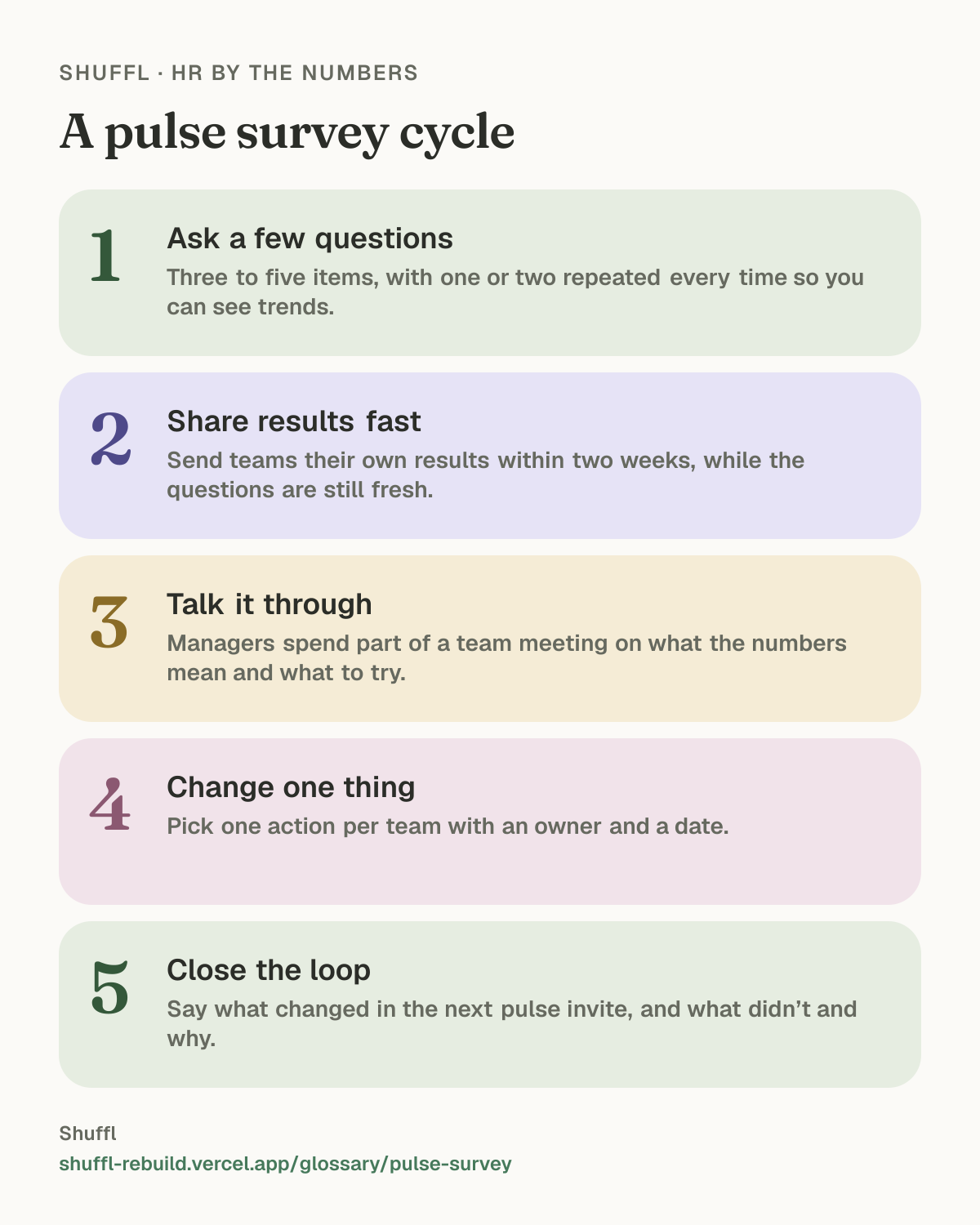
A pulse survey cycle
A pulse survey cycle. 1. Ask a few questions: Three to five items, with one or two repeated every time so you can see trends. 2. Share results fast: Send teams their own results within two weeks, while the questions are still fresh. 3. Talk it through: Managers spend part of a team meeting on what the numbers mean and what to try. 4. Change one thing: Pick one action per team with an owner and a date. 5. Close the loop: Say what changed in the next pulse invite, and what didn’t and why.
Common questions
- How many questions should a pulse survey have?
- Anywhere from one to about 15. Fewer questions asked more often works well.
- How often should you send pulse surveys?
- Weekly to quarterly. Pick a pace you can respond to.
Sources
Read on . Numbers change as new studies come out, so check the source before you quote it.
- Gallup, Anemic Employee Engagement Points to Leadership Challenges, August 2025. Web survey of 17,660 U.S. employees on the Gallup Panel, May 7-16, 2025 (±1.1 points). Open-ended themes from 7,542 valid responses in Q1 2025 (±1.7 points).
- Gallup, What to Do With Employee Survey Results, August 2006. Workgroups with Q12 data trended across two consecutive survey administrations, sorted into quartiles on the item “Action plans from the last survey have had a positive impact on my workplace.”