
HR glossary
Employee Net Promoter Score (eNPS)
Employee Net Promoter Score (eNPS) measures how likely employees are to recommend their company as a place to work, on a scale from −100 to +100.
eNPS asks one question: “On a scale of 0 to 10, how likely are you to recommend this company as a place to work?” People who answer 9 or 10 are promoters. 7 and 8 are passives. Anyone at 6 or below is a detractor.
The idea comes from the customer Net Promoter Score that Fred Reichheld and Bain & Company introduced in 2003. HR teams borrowed it because it is quick to answer and easy to track from one quarter to the next.
The score on its own won’t tell you why people feel the way they do. Pair it with an open follow-up like “What’s the main reason for your score?” and read every answer. Watch the trend, too. A single number says little, and a drop of 15 points after a reorg says a lot.
How to calculate eNPS
eNPS = % promoters − % detractors
- Promoters: answered 9 or 10
- Detractors: answered 0 to 6
- Passives (7 or 8) count in the total but are not subtracted
Example: 100 people respond. 45 are promoters and 20 are detractors. 45% − 20% gives an eNPS of +25.
What the research says
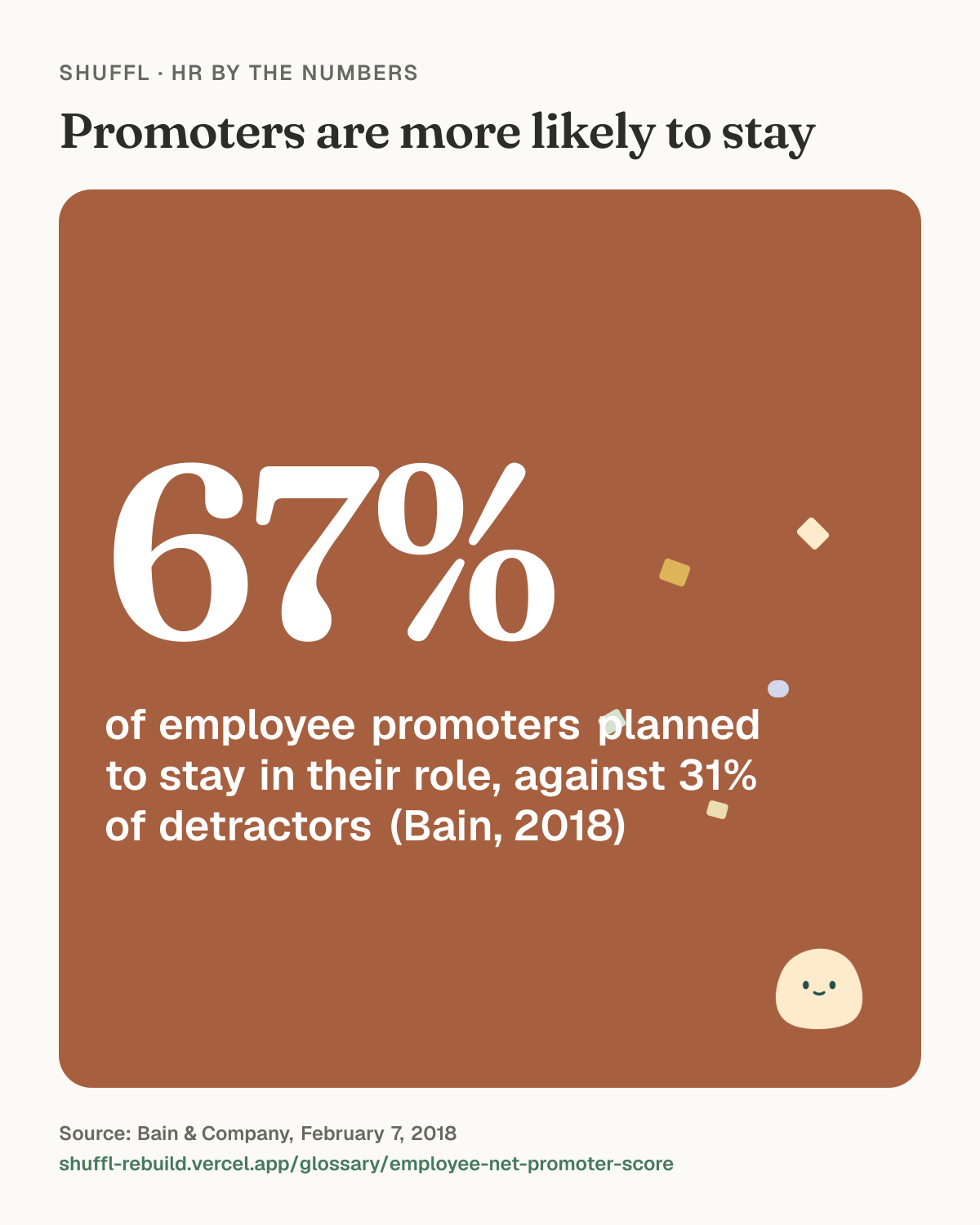
Bain & Company, where the Net Promoter idea started, has tested it on employees. In a survey of almost 2,500 employees published in 2018, 67% of employee promoters planned to stay in their current role, compared with 31% of detractors.1 Promoters were also more likely to speak well of the company in public: 76% said they had made positive comments about their employer over the past year, against 36% of detractors.1
The same Bain brief reports that at one bank, the employees with the highest eNPS generated customer Net Promoter Scores more than three times higher.1 That’s one company’s data. It’s a good reason to check whether your own eNPS and customer scores move together, team by team.
Shuffl · HR by the numbers
Promoters are more likely to stay

Promoters are more likely to stay: 67% of employee promoters planned to stay in their role, against 31% of detractors (Bain, 2018). Source: Bain & Company, February 7, 2018.
An example
A 220-person software company runs eNPS every quarter. In the first quarter, 180 people answer: 72 promoters (40%), 63 passives and 45 detractors (25%). The score is +15.
That spring, customer support moves to a new on-call rota. The next survey has about the same number of responses, but promoters fall to 58 and detractors rise to 61, so the score drops to about −2. Company-wide, it looks like a general dip. Split by team, most of the new detractors sit in support, and their comments mention weekend call-outs. HR takes this to the support lead, the rota changes, and support’s score recovers most of the way the following quarter.
Common mistakes
Most eNPS problems come from how the results are reported and used, rather than from the question itself.
- Showing a score for a team of four or five. One person is 20% or more of the responses, so a single change of mood swings the number. Set a minimum group size before you report by team.
- Promising anonymity you can’t keep. If a comment about a specific project makes the author obvious to their manager, people stop being honest.
- Comparing your eNPS with customer NPS benchmarks. Different people are answering a different question.
- Running the survey and going quiet. Tell people what you heard and what will change, even when the answer is “not much yet.”
Common questions
- What is a good eNPS score?
- Anything above 0 means you have more promoters than detractors. Many HR teams treat +10 to +30 as healthy and anything above +50 as unusually strong. Your own trend matters more than an outside benchmark.
- How often should you run an eNPS survey?
- Quarterly is common. Monthly works if you act on the results. Asking more often than you can respond teaches people that the survey goes nowhere.
- Do passives count in eNPS?
- Yes. Passives count toward the total number of responses, so they pull the score toward zero, but they are neither added nor subtracted.
Sources
Read on . Numbers change as new studies come out, so check the source before you quote it.
- Bain & Company, Net Promoter for People: Give Employees a Voice, Get Their Best, February 7, 2018. Brief by Darci Darnell and Rob Markey. The retention and advocacy figures come from a Bain survey of almost 2,500 employees; the bank finding is from Bain research at one bank, with no sample size given.