
HR glossary
Employee experience (EX)
Employee experience (EX) is the sum of everything employees see, do and feel at work, across the whole employee lifecycle.
Employee experience covers every moment someone has with an employer, from the first job ad they see to the day they leave. It includes the tools they use, the office or remote setup, how easy it is to get help, and how their manager treats them.
A common way in is to map the journey. Pick a moment that matters, like the first week or asking for parental leave, walk through it as an employee, and note every place it’s confusing or slow.
What employees say is missing
In early 2025 Gallup asked US employees, “What’s missing from your current work experience that would make you feel more connected to your employer?”1 32% described their workplace as isolated or impersonal, rising to 44% of Gen Z workers and 41% of remote employees. Another 29% said they lack clear, honest or consistent communication from leaders, and 25% said their organization underinvests in people, pay, tools or staffing.
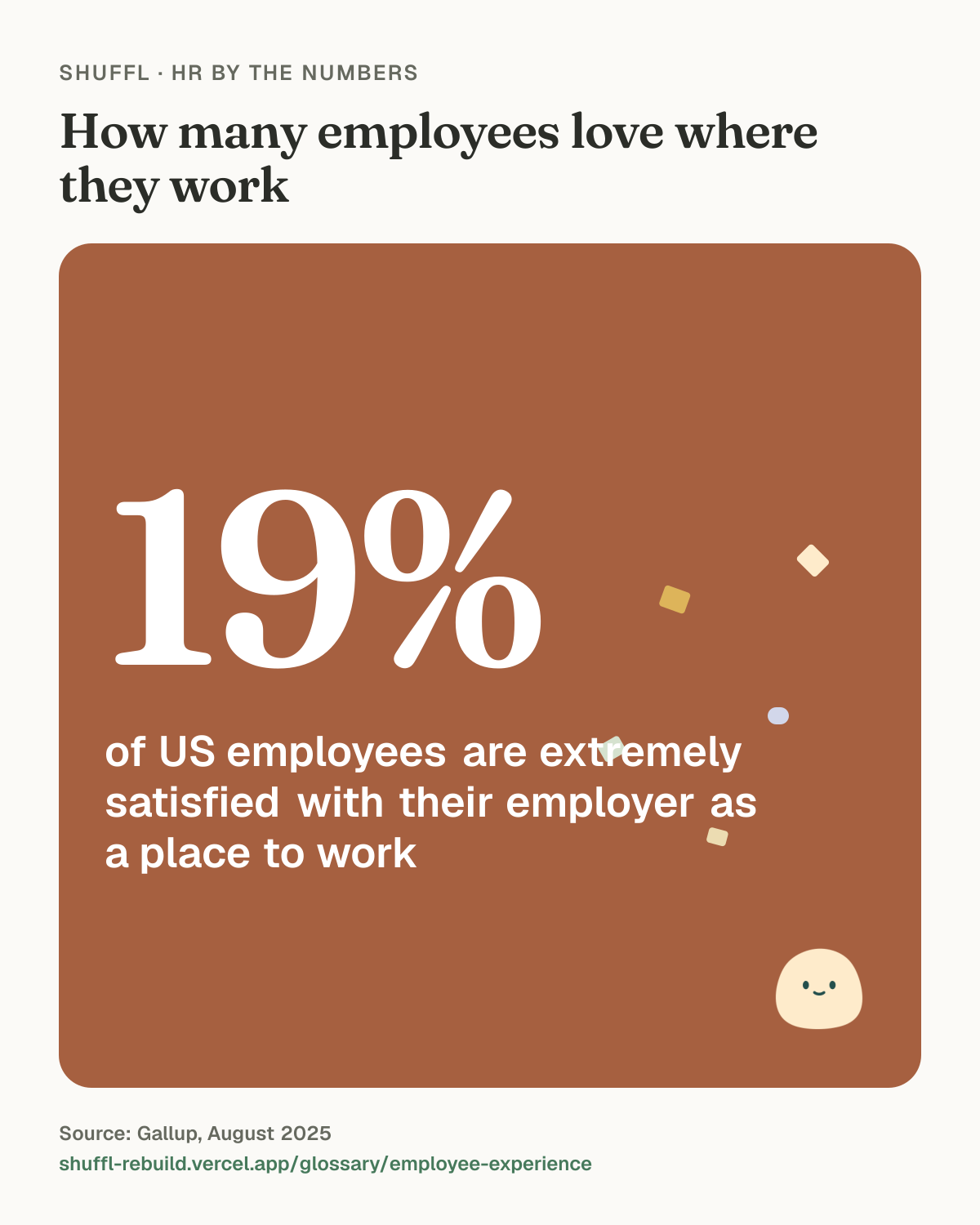
The same research found that fewer than one in five employees (19%) are extremely satisfied with their employer as a place to work, and 51% are actively looking or keeping an eye out for other jobs.1
Where people work is part of the experience. In APA’s 2024 Work in America survey, 33% of workers were not working in their preferred mode, whether that was in-person, hybrid or remote. Those who were in their preferred location were more likely to recommend their workplace as a good place to work (87% vs. 69%).2
Shuffl · HR by the numbers
How many employees love where they work

How many employees love where they work: 19% of US employees are extremely satisfied with their employer as a place to work. Source: Gallup, August 2025.
An example: mapping one moment
A 90-person dental group picks parental leave as its first journey to map. HR sits down with two people who took leave in the past year and walks through what happened, step by step.
The list is long. The policy lived in a 2021 PDF on a shared drive. Employees had to email HR to ask which state forms applied, then chase their manager for sign-off. Nobody told payroll, so one person’s first paycheck back was wrong. The group rewrites the policy as a single page with a checklist, adds a step that notifies payroll automatically, and asks the next two people on leave whether it worked.
Where to start
Improving employee experience is mostly unglamorous process work. It’s easier to keep going when the work is a list of specific moments, each with an owner.
- Pick a few moments that happen rarely but matter a lot: the first week, a leave request, a change of manager, the last day.
- Map each one with people who went through it recently. HR’s view of the process is usually the tidy version.
- Count the handoffs and waiting time. Each “who handles this?” email is a place to fix.
- Change one thing at a time, then tell people it changed and ask whether it helped.
- Watch survey comments and exit interview themes for moments you didn’t think to map.
Common questions
- What is the difference between employee experience and engagement?
- Experience is what the company provides. Engagement is how employees respond to it. A better experience usually leads to higher engagement.
- What is an example of a poor employee experience?
- Getting answers to everyday questions. If finding the parental leave policy takes three emails, that’s an experience problem.
Sources
Read on . Numbers change as new studies come out, so check the source before you quote it.
- Gallup, Anemic Employee Engagement Points to Leadership Challenges, August 2025. Web survey of 17,660 U.S. employees on the Gallup Panel, May 7-16, 2025 (±1.1 points). Open-ended themes from 7,542 valid responses in Q1 2025 (±1.7 points).
- American Psychological Association, 2024 Work in America Survey: Psychological Safety in the Changing Workplace, 2024. Online survey by The Harris Poll of more than 2,000 employed U.S. adults, March 25 to April 3, 2024. Psychological safety measured with seven items adapted from Edmondson’s scale.