
HR glossary
Onboarding
Onboarding is the process of welcoming new hires and helping them become productive, confident members of the organization.
Onboarding is everything that happens to turn a new hire into a productive, connected member of the team. Paperwork is the smallest part.
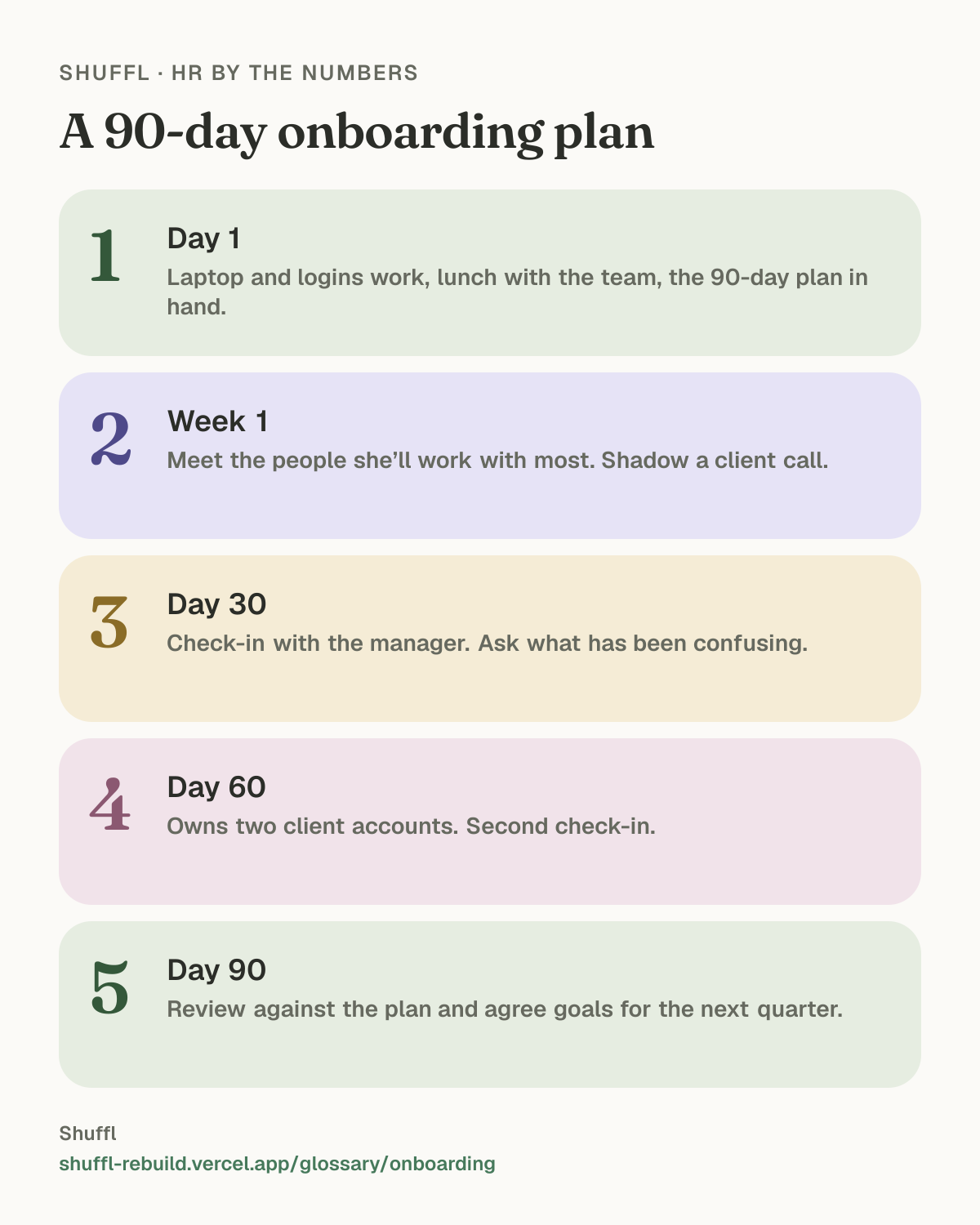
A good onboarding plan covers the first 90 days. Day one gets accounts, equipment and a warm welcome. The first weeks cover how the company works, who to ask for what, and a first piece of real work. By the end, the new hire should know what success looks like in their role and have a few people they’d happily message with a question.
Assign a buddy. Schedule check-ins at 30, 60 and 90 days. Ask the new hire what was confusing, and fix it for the next person.
What the research says
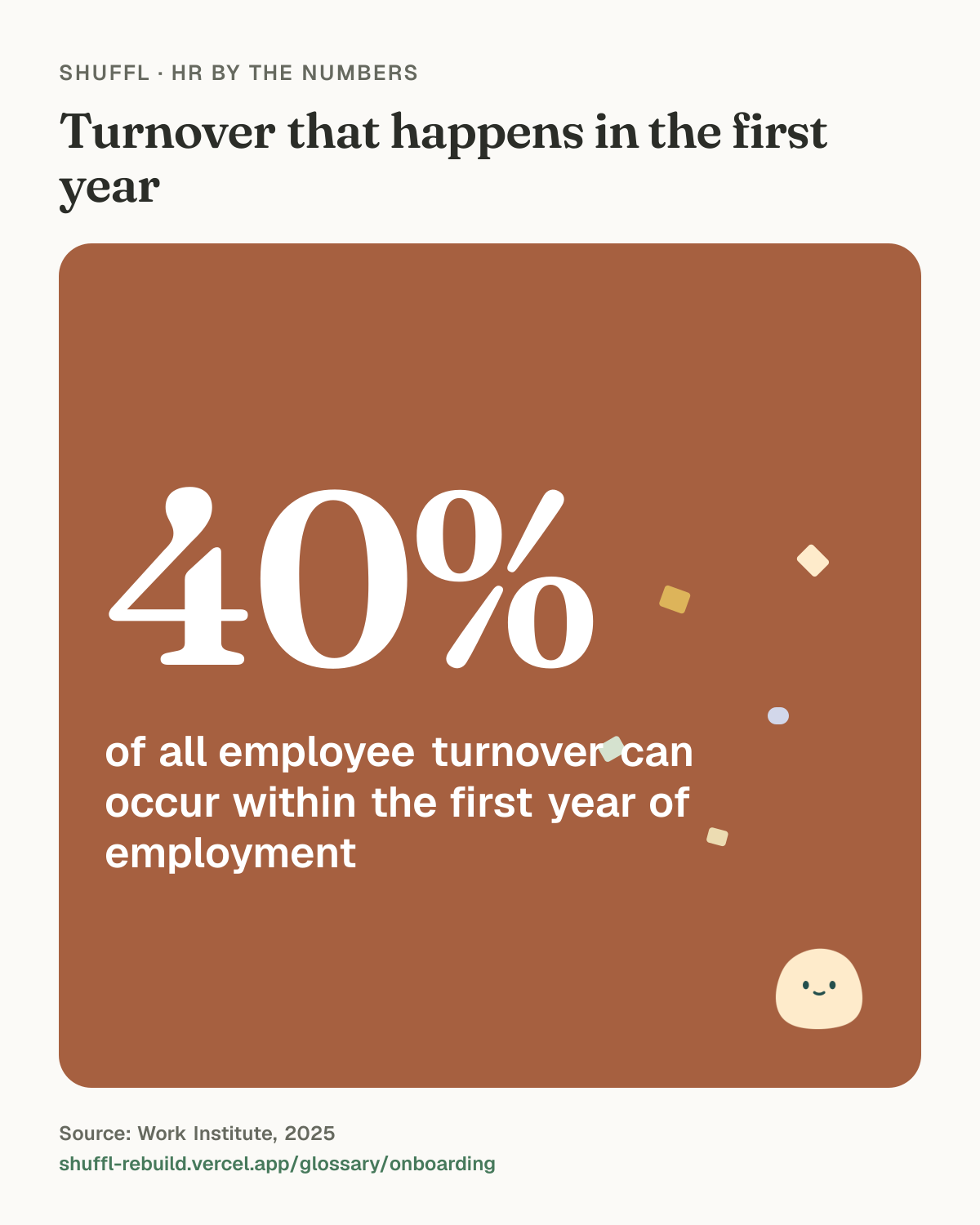
Early exits are common and expensive. Work Institute’s 2025 Retention Report, based on 123,297 exit interviews since 2019, found that as much as 40% of all turnover happens in the first year1. Someone who leaves in month five has cost you recruiting and training and given little back.
The reasons are often fixable. Work-life balance accounted for 15.1% of first-year turnover in 2024, and involuntary exits in the first year rose from 6.7% in 2022 to 9.3% in 20241. A rise in firings that early often means expectations weren’t clear during hiring or onboarding.
Shuffl · HR by the numbers
Turnover that happens in the first year

Turnover that happens in the first year: 40% of all employee turnover can occur within the first year of employment. Source: Work Institute, 2025.
An example
A 200-person regional bank hires a commercial loan officer. Her manager writes the 90-day plan before she starts and shares it on day one. It lists who she’ll meet, which two existing clients she’ll take over in month two, and what a good first quarter looks like: three new client meetings and her first loan through credit review.
At the 30-day check-in she says nobody explained how credit review works. HR adds a one-hour session with the credit team to the plan for the next hire.
Shuffl · HR by the numbers
A 90-day onboarding plan
A 90-day onboarding plan. 1. Day 1: Laptop and logins work, lunch with the team, the 90-day plan in hand. 2. Week 1: Meet the people she’ll work with most. Shadow a client call. 3. Day 30: Check-in with the manager. Ask what has been confusing. 4. Day 60: Owns two client accounts. Second check-in. 5. Day 90: Review against the plan and agree goals for the next quarter.
Common mistakes
Most onboarding problems are small and repeated with every hire.
- Equipment and logins that aren’t ready on day one.
- A first week of policy videos with no real work.
- No written plan, so the new hire guesses what success looks like.
- Check-ins that stop after week two.
- Never asking new hires what went wrong, so the same gaps hit the next person.
Common questions
- How long should onboarding last?
- Formal programs often run for the first 90 days. For complex roles, it can take six months to a year before someone is fully up to speed.
- What is the difference between onboarding and orientation?
- Orientation is a single session, often on day one, covering policies and logistics. Onboarding is the longer process that orientation is part of.
Sources
Read on . Numbers change as new studies come out, so check the source before you quote it.
- Work Institute, 2025 Retention Report: Employee Retention Truths in Today’s Workplace, 2025. Based on 123,297 exit interviews Work Institute conducted from 2019 to 2024 (14,215 in 2024) with employees of over 175 US companies, over 90% collected after the employee left and by Work Institute as a third party. Leader figures come from a survey of 88 HR and operational leaders, December 1, 2024 to January 15, 2025.