
HR glossary
Employee retention rate
Employee retention rate is the percentage of employees who stay with an organization through a set period.
Retention rate looks at the people you had at the start of a period and asks how many are still there at the end. New hires during the period are left out on purpose, so a hiring spree can’t hide losses.
It is the flip side of turnover, but the two don’t always add up to 100%, because turnover counts departures of people hired mid-period and retention doesn’t.
Slice it by tenure. First-year retention is where most companies find their biggest problems, and it usually points back to hiring or onboarding.
How to calculate employee retention rate
Retention rate = (employees still employed at end who were there at start ÷ employees at start) × 100
- Count only people employed on the first day of the period
- New hires during the period are excluded
Example: You had 200 employees on January 1. 176 of them were still employed on December 31. 176 ÷ 200 × 100 = 88% retention.
What the research says
BLS data from January 2026 puts the median tenure of U.S. wage and salary workers at 4.1 years, up from 3.9 years in 2024.1 Age makes a large difference. The median for workers 55 to 64 was 9.6 years, compared with 3.0 years for workers 25 to 34.1 A company with a young workforce will usually show lower retention than one with an older workforce, even when both are well run.
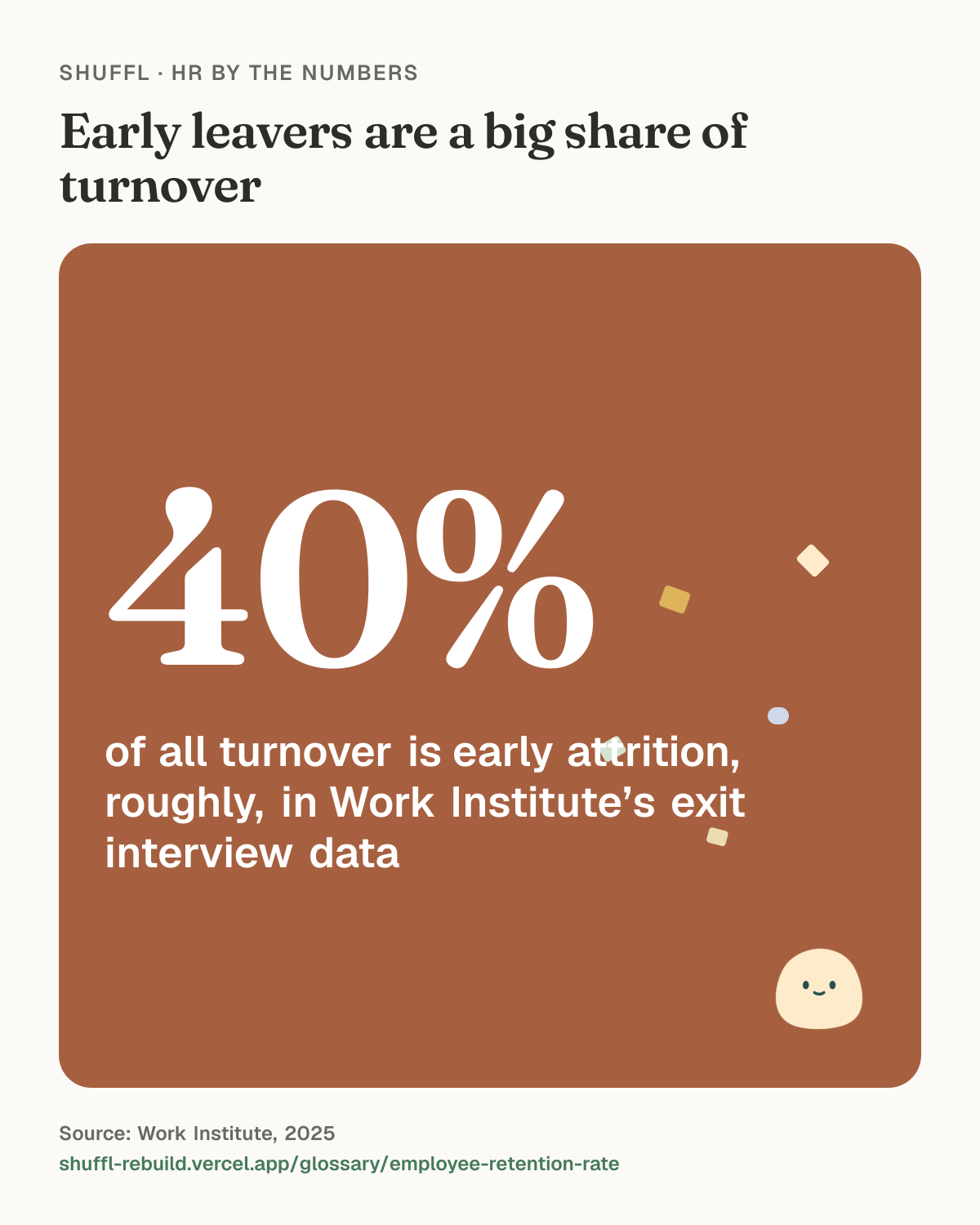
Most of the loss happens early. In Work Institute’s exit interview data, early attrition makes up roughly 40% of all turnover.2
Low quit rates may also be flattering some retention numbers. A Gartner survey of 11,838 employees in early 2026 found intent to stay down 19% over two years, which Gartner reads as a sign of attrition to come once the job market picks up.3
Shuffl · HR by the numbers
Early leavers are a big share of turnover

Early leavers are a big share of turnover: 40% of all turnover is early attrition, roughly, in Work Institute’s exit interview data. Source: Work Institute, 2025.
An example
A 400-person retail chain had 400 employees on January 1, and 344 of them were still there on December 31. That’s 86% retention. Split by tenure at the start of the year, the picture changes:
- More than two years: 230 of 250 stayed (92%).
- One to two years: 72 of 85 stayed (85%).
- Less than one year: 42 of 65 stayed (65%).
How to improve retention
In the retail example, the loss sits with people in their first year, so the chain’s next step is to look at how store managers handle a new hire’s first 90 days. The same approach works anywhere: find the group with the lowest rate and start there.
- Report retention by tenure band and by manager, as well as company-wide.
- Give new hires a clear role, a named buddy and a weekly check-in with their manager for the first three months.
- Hold stay interviews once or twice a year with people you want to keep.
- Show people where they can go next. Career development was the most common reason for leaving in Work Institute’s 2024 data.2
- Review pay first for the teams and roles with the lowest retention.
Common questions
- What is a good employee retention rate?
- It depends on industry and role. Many office-based companies aim for 90% or more annually. Measure first-year retention separately, since it is almost always lower.
- What improves employee retention?
- Clear expectations from day one, a manager who meets with people regularly, fair pay, and real chances to grow. Stay interviews help you find out which of these is missing.
Sources
Read on . Numbers change as new studies come out, so check the source before you quote it.
- U.S. Bureau of Labor Statistics, Employee Tenure in 2026, September 24, 2026. January 2026 supplement to the Current Population Survey, a monthly sample survey of about 60,000 eligible households. Covers wage and salary workers.
- Work Institute, 2025 Retention Report: Employee Retention Truths in Today’s Workplace, 2025. Based on 123,297 exit interviews conducted by Work Institute from 2019 to 2024 with more than 175 companies; 14,215 interviews cover 2024 reasons for leaving. Over 90% collected after the employee left, by Work Institute as a third party.
- Gartner, Gartner HR Research Finds 48% of Candidates Accepted Job Offers in 4Q25; Down From 85% Two Years Earlier, June 18, 2026. Figures used: a December 2025 Gartner survey of 3,072 employees, and a 1Q26 Gartner survey of 11,838 employees. Page read through the Internet Archive copy because gartner.com blocked direct access.