
HR glossary
Belonging
Belonging is employees’ sense that they are accepted, valued and connected to the people they work with.
Belonging at work is the feeling that you’re accepted as you are and that people would notice if you weren’t there. It’s different from being included in a meeting invite.
Loneliness hurts belonging, and remote and hybrid work make it easier to go weeks without a real conversation outside your own team. Small, regular connections help: a coffee chat with someone from another team, a buddy for new hires, a manager who asks about more than tasks.
What the research says
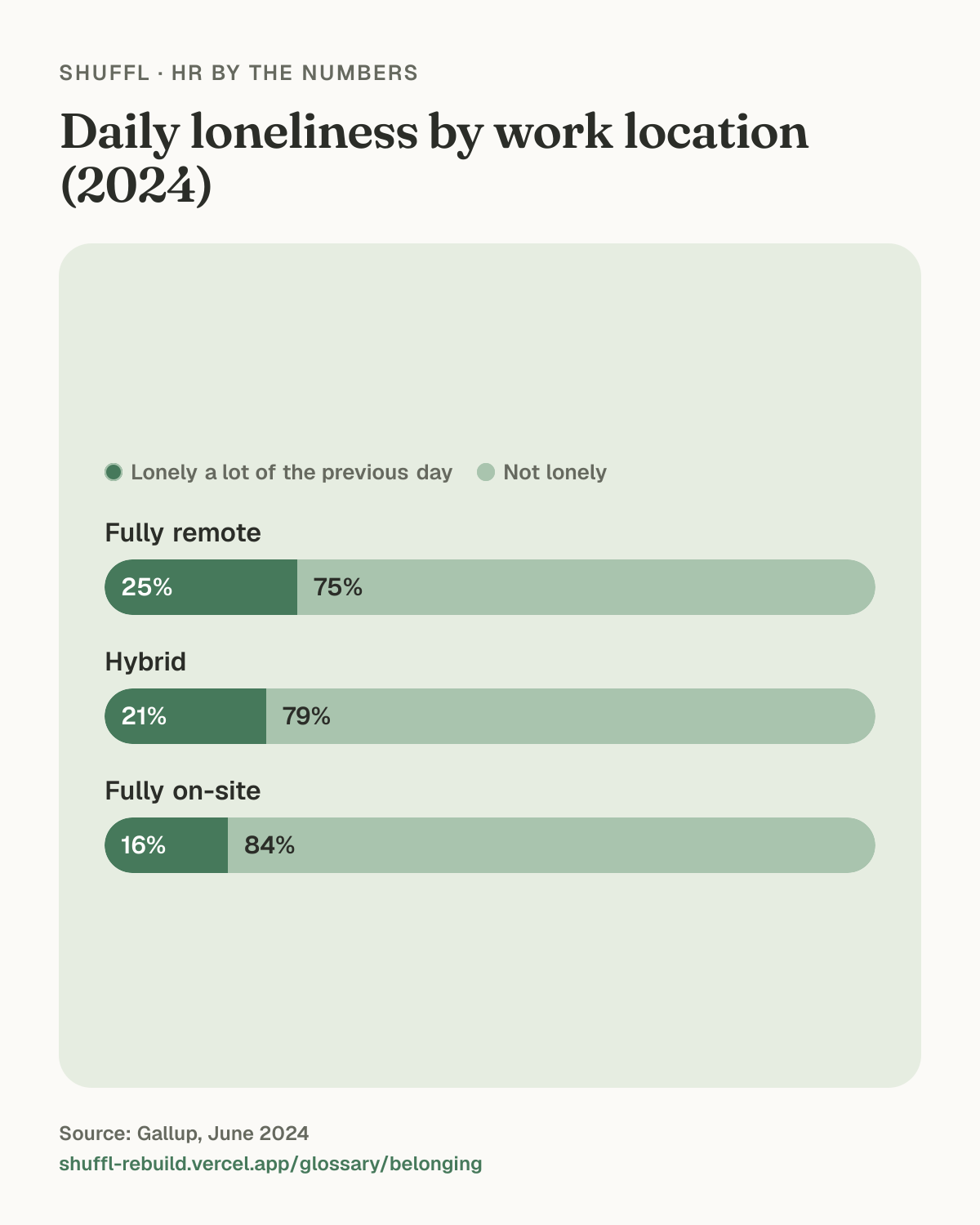
Gallup’s 2024 global data found that one in five employees experienced loneliness a lot of the previous day. Work location showed the biggest differences: 25% of fully remote employees reported loneliness, compared with 21% of hybrid workers and 16% of those fully on-site.1
In a separate US study, Gallup found engaged employees were 64% less likely to be lonely than those who are not engaged. Friendship at work helped less than you might expect. Employees who reported a very close friend at work were 21% less likely to be lonely.1
Belonging also differs by level. In APA’s 2025 Work in America survey, 93% of upper managers agreed that they feel like they belong at work, compared with 84% of middle managers, 83% of individual contributors and 82% of frontline workers.2
Shuffl · HR by the numbers
Daily loneliness by work location (2024)
Daily loneliness by work location (2024). Fully remote: 25% Lonely a lot of the previous day, 75% Not lonely. Hybrid: 21% Lonely a lot of the previous day, 79% Not lonely. Fully on-site: 16% Lonely a lot of the previous day, 84% Not lonely. Source: Gallup, June 2024.
An example
A 250-person insurance company moves to hybrid work. A year later, the belonging item in its survey (“I feel like I belong here”) has fallen from 4.0 to 3.5 out of 5, and the drop is sharpest among people hired after the move.
HR gives each new hire a buddy from another team for their first 90 days and asks managers to set one in-office day a month when the whole team is there. It also starts a monthly coffee match that pairs people at random. At the next survey the item is back to 3.8 for recent hires, and several comments mention the buddy by name.
How to build belonging
Belonging grows from lots of small contacts over time, so it responds to routine more than to one-off events.
- Give new hires a named person to ask questions, outside their reporting line.
- Plan in-person time around work that benefits from it, and make sure remote staff get the same information.
- Watch who speaks in meetings and who gets invited to the informal ones.
- Ask the belonging question in surveys and split results by tenure, location and level.
Common questions
- What is the difference between inclusion and belonging?
- Inclusion is what the organization does, like inviting people in and giving them a voice. Belonging is how people feel as a result.
- How do you measure belonging?
- Survey questions like “I feel I belong at this company” and “I have a friend at work” are common measures.
Sources
Read on . Numbers change as new studies come out, so check the source before you quote it.
- Gallup, 1 in 5 Employees Worldwide Feel Lonely, June 2024. Global figures from the State of the Global Workplace 2024 report (Gallup World Poll). U.S. engagement comparison from a web survey of 19,846 U.S. employees on the Gallup Panel, Feb. 6-16, 2024 (±1.0 points).
- American Psychological Association, 2025 Work in America Survey: The Experience of Working in America During Times of Change, July 2025. Online survey by The Harris Poll of 2,017 employed U.S. adults, March 26 to April 4, 2025. Weighted; ±3.2 points at 95% confidence.