
HR glossary
Employee resource group (ERG)
An employee resource group (ERG) is a voluntary, employee-led group built around a shared identity, background or interest.
Employee resource groups bring together people who share an identity or life experience. Common examples are groups for women, parents, veterans, LGBTQ+ employees and employees of color. They’re open to allies too.
The idea is often traced to Xerox in 1970, where Black employees formed a caucus to push for fair treatment.
Good ERGs have an executive sponsor, a budget and a direct line to leadership. Leading one is real work, so many companies now recognize or pay ERG leaders for it.
How common ERGs are
In a 2023 Pew Research Center survey, 26% of US workers said their workplace has affinity groups or employee resource groups based on a shared identity such as gender, race or being a parent. Another 37% weren’t sure whether their workplace had them.1
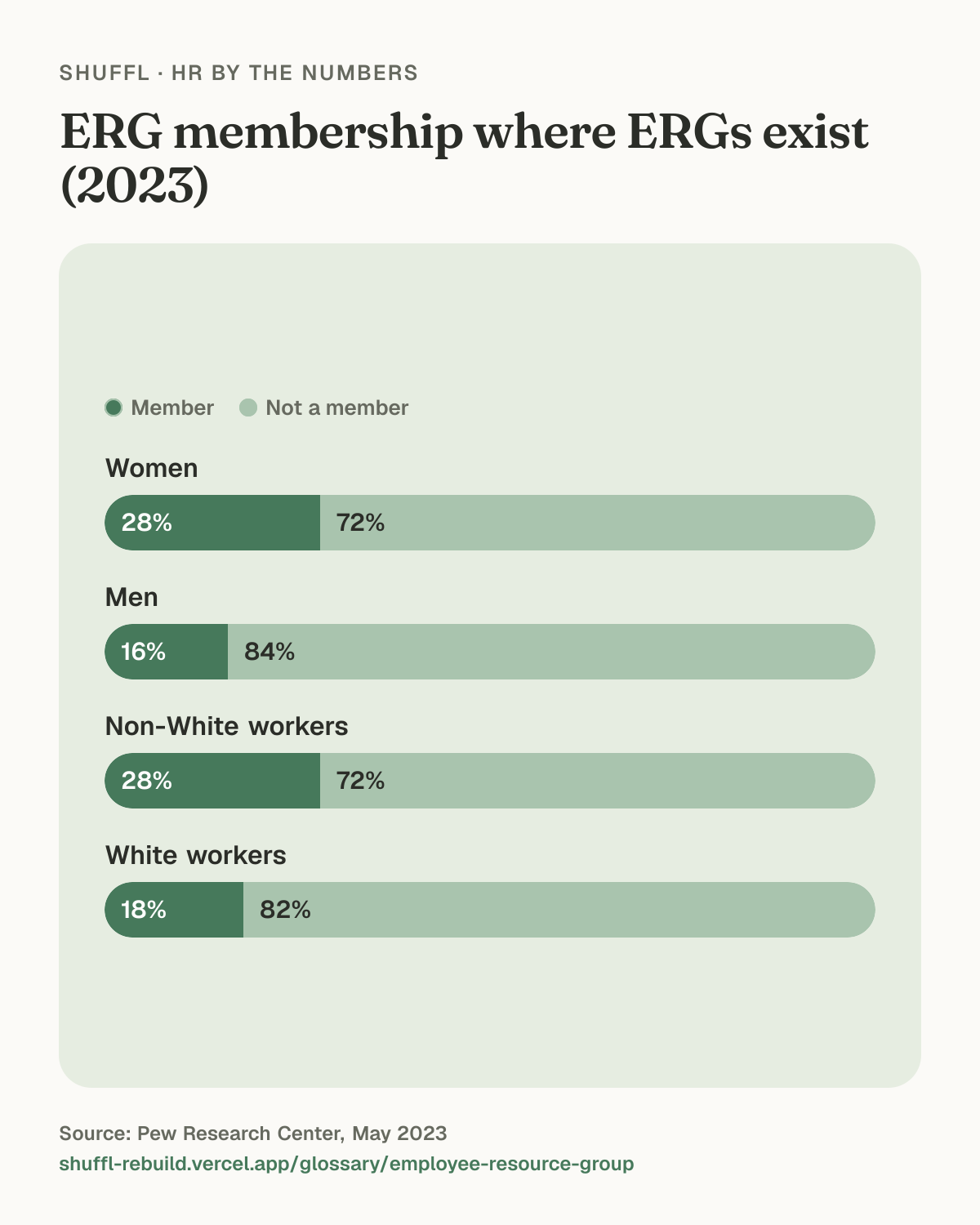
Membership is lower than availability. Just 6% of all workers said they belong to one. Among workers whose workplace has ERGs, 22% are members, with women more likely to join than men and non-White workers more likely than White workers.1
Shuffl · HR by the numbers
ERG membership where ERGs exist (2023)
ERG membership where ERGs exist (2023). Women: 28% Member, 72% Not a member. Men: 16% Member, 84% Not a member. Non-White workers: 28% Member, 72% Not a member. White workers: 18% Member, 82% Not a member. Source: Pew Research Center, May 2023.
What to check before you act
In the US, the EEOC’s March 2025 technical assistance on DEI says that limiting membership in ERGs, business resource groups or other affinity groups to certain protected groups can be unlawful segregation under Title VII.2 This applies to employer-sponsored activity, which includes giving groups company time, space or other support. Title VII covers private employers with 15 or more employees, and state laws and rules outside the US differ, so check local advice before changing a program.
- Make membership and events open to every employee, and say so in the group’s description.
- Give every group the same process for asking for budget, meeting space and leadership time.
- Keep decisions about hiring, pay and promotion out of ERG channels.
- Review group charters once a year with legal or employment counsel.
An example
A 400-person logistics company has a parents’ group started by a few warehouse supervisors. They ask for an executive sponsor and a budget of $3,000 a year. The first thing the group does is survey members about shift swaps, which leads HR to publish a clear swap policy for all staff. The group is open to anyone, and about a fifth of its 45 members aren’t parents.
Common questions
- Who can join an employee resource group?
- Anyone, in most companies. ERGs are typically open to members of the group and to allies.
- What do ERGs do?
- They hold events, mentor members, advise on policy and benefits, and help with recruiting.
Sources
Read on . Numbers change as new studies come out, so check the source before you quote it.
- Pew Research Center, Diversity, Equity and Inclusion in the Workplace, May 2023. American Trends Panel survey of 5,902 U.S. workers, Feb. 6-12, 2023. ERG findings based on 4,744 workers who are not self-employed at organizations with 10 or more people. Weighted to be nationally representative.
- U.S. Equal Employment Opportunity Commission, What You Should Know About DEI-Related Discrimination at Work, March 2025. Technical assistance released with the Department of Justice on March 19, 2025, based on Title VII. Title VII covers private employers with 15 or more employees.