
HR glossary
Time to fill
Time to fill is the number of days between opening a job and a candidate accepting the offer.
Time to fill measures how long a role stays open. The clock usually starts when the job requisition is approved and stops when a candidate accepts the offer.
Hiring managers care about it because an empty seat means work piling up on the rest of the team. Finance cares because it drives hiring plans.
A long time to fill isn’t always a recruiting problem. Slow approvals, an unclear job description and a hiring manager who takes a week to review resumes all add days.
How to calculate time to fill
Time to fill = offer acceptance date − requisition approval date
- Measured in calendar days
- Some teams start the clock at job posting instead. Pick one and stick with it
Example: The requisition was approved on March 1. The candidate accepted on April 12. Time to fill is 42 days.
What the research says
SHRM’s 2025 benchmarking survey of 2,371 members found a median time to fill of about a month and a half for both executive and nonexecutive roles.1 Executive roles used to take noticeably longer. Their median fell from 60 days in 2022 to 45 days in 2025.1
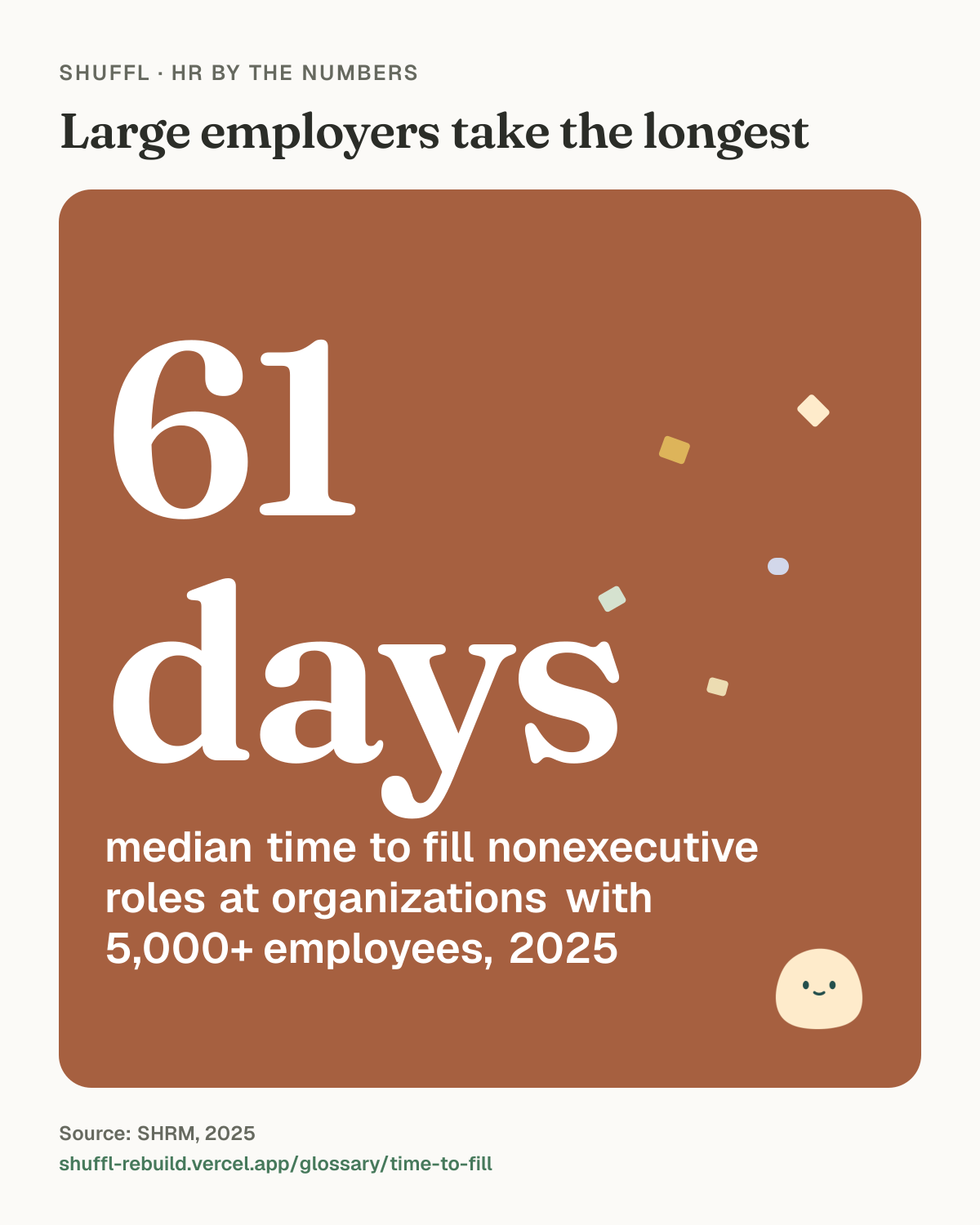
Organization size now makes the bigger difference. Employers with 5,000 or more people reported 61 days for nonexecutive roles and 60 for executives, and spent nearly twice as long getting positions approved, posted and interviewed.1 Their recruiters also carry the heaviest load, a median of 60 requisitions a year against 20 across all organizations with dedicated recruiters.1
Candidate supply adds days as well. In SHRM’s 2025 Talent Trends survey of 2,040 HR professionals,3 69% of employers said they were having difficulty filling full-time roles, and 51% reported a low number of applicants.2
Shuffl · HR by the numbers
Large employers take the longest

Large employers take the longest: 61 days median time to fill nonexecutive roles at organizations with 5,000+ employees, 2025. Source: SHRM, 2025.
Where the days go
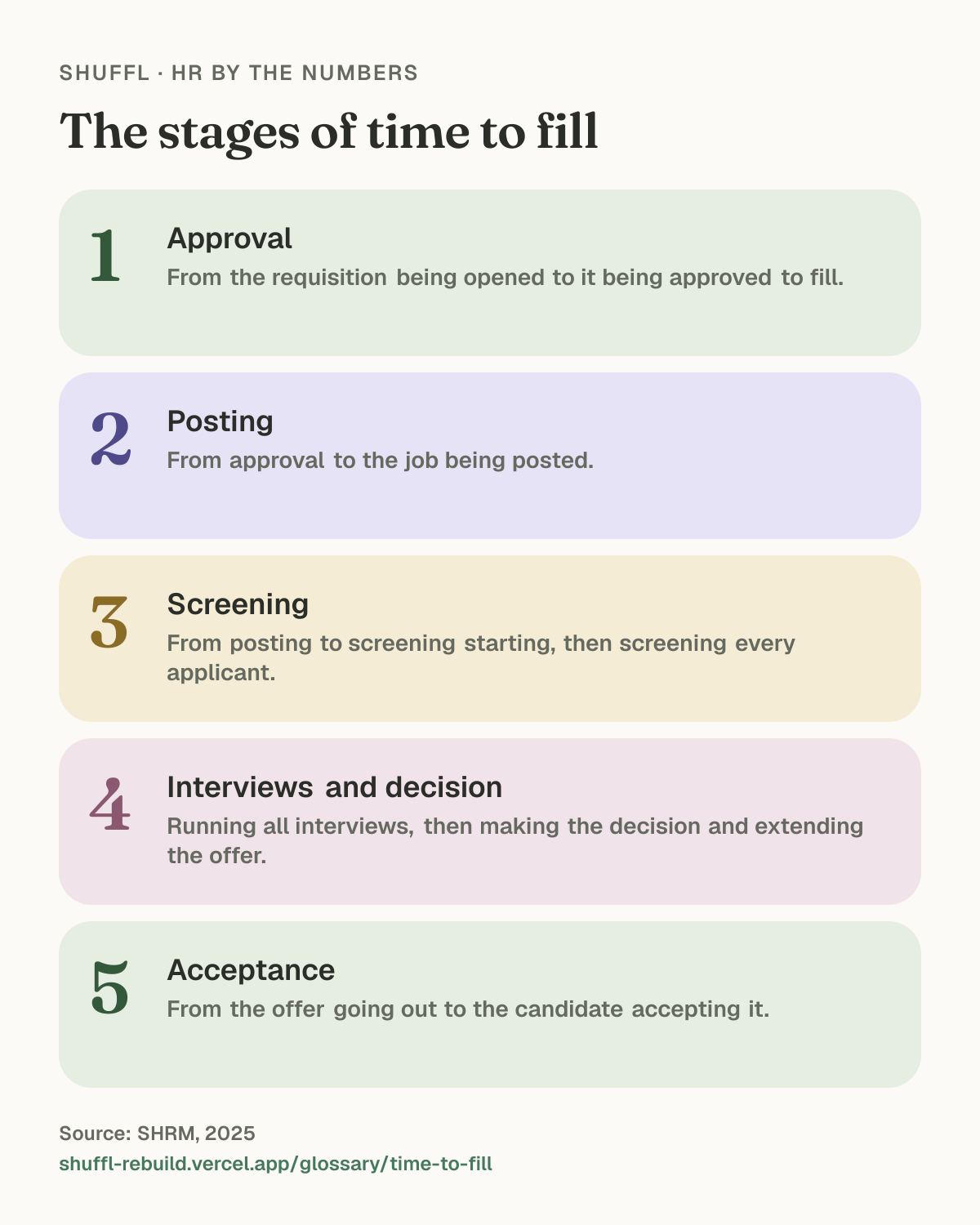
SHRM splits time to fill into stages, from the requisition being opened to the offer being accepted. Timing each stage in your own process shows which one is slow.1
Shuffl · HR by the numbers
The stages of time to fill
The stages of time to fill. 1. Approval: From the requisition being opened to it being approved to fill. 2. Posting: From approval to the job being posted. 3. Screening: From posting to screening starting, then screening every applicant. 4. Interviews and decision: Running all interviews, then making the decision and extending the offer. 5. Acceptance: From the offer going out to the candidate accepting it. Source: SHRM, 2025.
An example
A 60-person marketing agency needs a senior designer. The requisition waits 9 days for the finance director’s sign-off and another 4 before the job is posted. Screening starts 6 days later and takes 5. Interviews take 14 days, the decision and offer take 6, and the candidate accepts after 4. Time to fill is 48 days.
Only 18 of those days were spent interviewing or waiting on the candidate. The agency gives itself a standing budget for replacement hires, so they no longer need sign-off, and books interview panels before the job goes live. The next designer hire takes 31 days.
Common questions
- What is the difference between time to fill and time to hire?
- Time to fill starts when the job opens. Time to hire starts when the eventual hire first enters your pipeline. Time to fill measures the whole process. Time to hire measures how fast you move a good candidate.
- What is a typical time to fill?
- Many companies land between 30 and 45 days. Senior and specialist roles often take much longer.
Sources
Read on . Numbers change as new studies come out, so check the source before you quote it.
- SHRM, 2025 Recruiting Executives Benchmarking: Insights to Maximize Recruitment (data brief), 2025. Electronic survey of a random sample of active SHRM members, fielded Jan. 9 to March 3, 2025, with an oversample of VP-level members; 2,371 responded. Unweighted; reports medians; sample size varies by metric.
- SHRM, Candidate “Ghosting” and Employer Competition Are Fueling Talent Shortages, New SHRM Research Finds, July 25, 2025. Press release for the 2025 Talent Trends report (2,040 HR professionals, surveyed Feb. 3 to 12, 2025).
- SHRM, 2025 Talent Trends, 2025. Survey of 2,040 HR professionals via SHRM’s Voice of Work Research panel, fielded Feb. 3 to Feb. 12, 2025.