
· Shuffl team
What is employee self-service, and what should it cover?
Employee self-service lets people get HR answers and handle routine tasks without waiting on HR. What it should cover, what it shouldn’t, and how to set it up.
Short answer
Employee self-service lets people get HR answers and do routine tasks, like updating bank details or requesting time off, without waiting on HR. It should cover the questions with one answer for everyone and route personal ones to a person. In one survey, employees resolved only 47% of their HR needs themselves.1
The question your HR system already answers
Monday, 8:40am. Someone on the warehouse team messages you: how do I change the bank account my pay goes into? The form has been in the HR system for two years. Your company bought that system so this message would never reach you.
In Applaud’s survey of 1,000 UK employees at organizations with more than 2,000 staff, 79% sought HR help at least once a month, averaging 3.6 HR needs per person per month. Employees said they resolve only 47% of those needs themselves.1 The rest end up with HR or a manager.
Shuffl · HR by the numbers
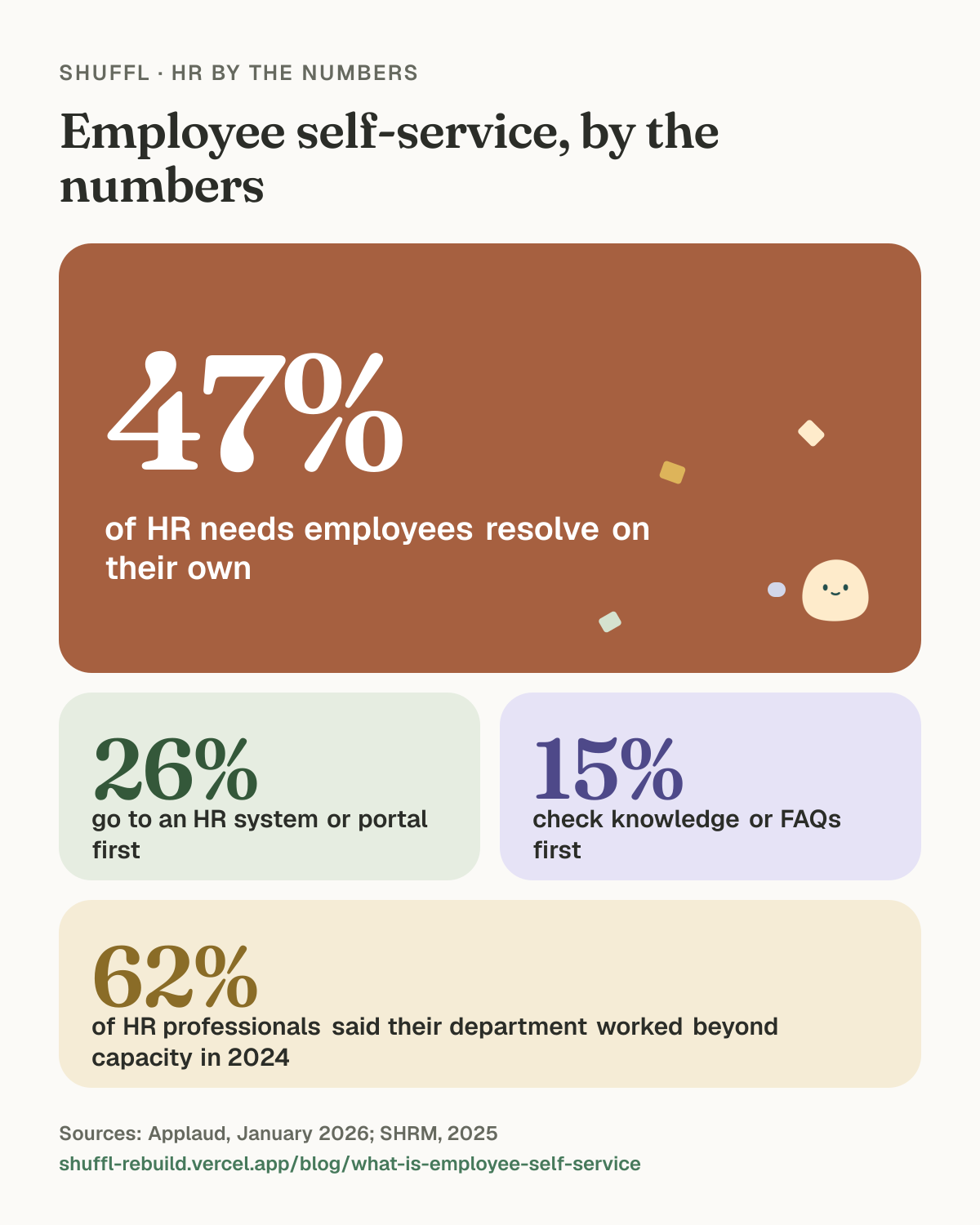
Employee self-service, by the numbers

Employee self-service, by the numbers. 47% of HR needs employees resolve on their own (Applaud, January 2026). 26% go to an HR system or portal first (Applaud, January 2026). 15% check knowledge or FAQs first (Applaud, January 2026). 62% of HR professionals said their department worked beyond capacity in 2024 (SHRM, 2025).
What is employee self-service?
Employee self-service means people can get HR answers and handle routine HR tasks on their own, at any hour, without waiting for someone in HR to reply.
It has two halves. Transactions are the things an employee does: update an address, download a payslip, request time off, enroll in benefits. They live in your HRIS or payroll system. Answers are the things an employee needs to know: how parental leave works, when enrollment closes, who approves expenses. They live in your handbook and knowledge base.
Companies often buy software for the first half and expect the second to take care of itself. The questions in your inbox show how that went.
Shuffl · HR by the numbers
What makes self-service work
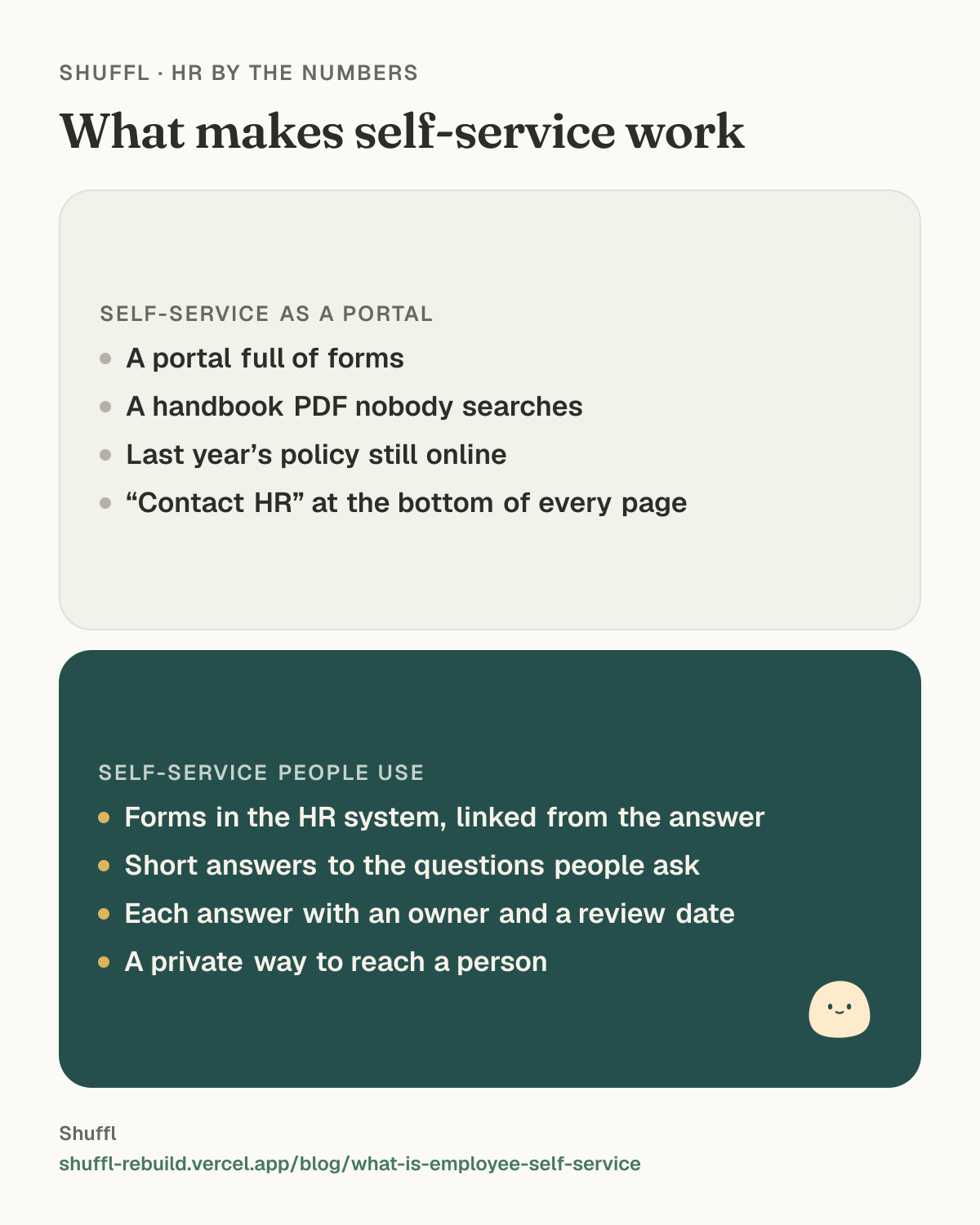
What makes self-service work. Self-service as a portal: A portal full of forms; A handbook PDF nobody searches; Last year’s policy still online; “Contact HR” at the bottom of every page. Self-service people use: Forms in the HR system, linked from the answer; Short answers to the questions people ask; Each answer with an owner and a review date; A private way to reach a person.
What should employee self-service cover?
Start from the questions you already get, and make sure each has a home. A good list for most companies:
- Personal details: address, emergency contact, bank account and tax forms.
- Pay: payslips, pay dates and year-end tax documents.
- Time off: balances, requests and the holiday calendar.
- Benefits: what each plan covers, how to enroll and what to do after a life event.
- Policies people ask about every month: leave, expenses, remote work, sick days, travel.
- The org chart and directory, so people can see who their manager is and who to ask.
- A private way to reach a person when the answer depends on their own situation.
Why do employees skip self-service?
In the same Applaud survey, only 26% of employees go to an HR system or portal first, and just 15% use knowledge or FAQs. Another 24% email, phone or message HR directly. For frontline workers, 34% ask a colleague first and only 20% use HR systems.1
People skip the portal for ordinary reasons. It needs a separate login, the search doesn’t understand their words, or the last answer they found there was out of date. Benefits are the hardest case: MetLife found only 57% of US employees fully understand what their benefits cover.3
So put answers where people already ask, in plain words, and keep them current. A short answer with a date on it gets used more than a complete policy nobody can find.
Shuffl · HR by the numbers
Where frontline workers go first
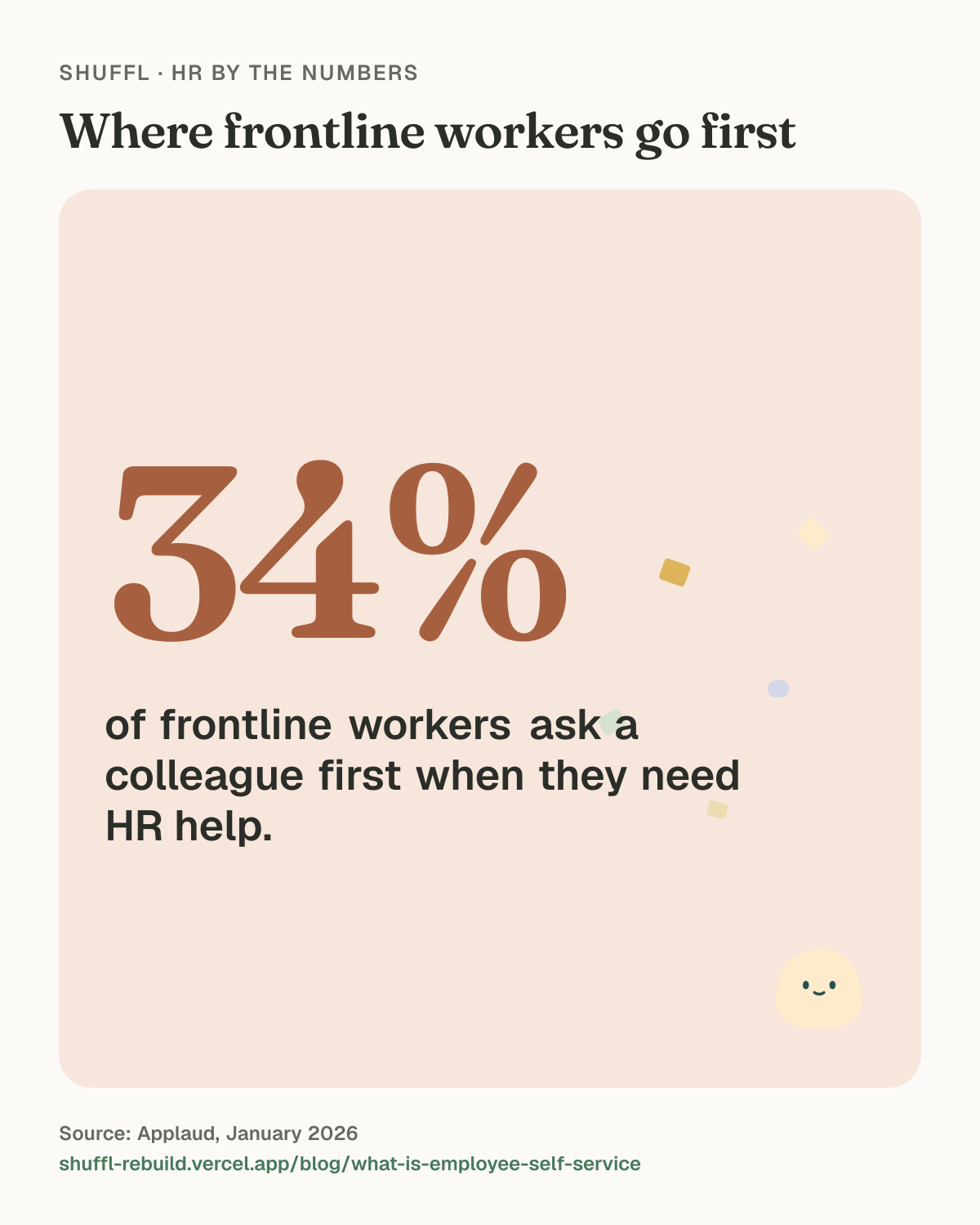
Where frontline workers go first: 34% of frontline workers ask a colleague first when they need HR help.. Source: Applaud, January 2026.
What shouldn’t be self-service?
Some questions have one answer for everyone who can read the policy. Self-service handles those well. Others depend on one person’s facts or need judgement: a complaint about a manager, medical leave, an accommodation, a pay mistake, a visa question.
For those, self-service should do one thing well: get the employee to the right person, privately, without making them explain everything twice. A form that ends in “email HR” doesn’t count.
Shuffl · Worth quoting
On employee self-service
On employee self-service: “Self-service should answer the questions that have one answer for everyone, and get the rest to a person fast.”
Self-service should answer the questions that have one answer for everyone, and get the rest to a person fast.
How do you set up employee self-service?
HR teams are stretched. In SHRM’s 2025 State of the Workplace report, 62% of HR professionals said their department operated beyond typical capacity in 2024, and 57% said it lacked enough staff for its workload.2 Self-service that works gives some of that time back. A small HR team can set it up in this order:
- Pull the last three months of questions from email, Slack and tickets. Group them, and count.
- For each transaction in the top 20, find where it lives in your HRIS or payroll system, and write one line on how to do it with a link.
- For each policy question, write a short answer first and the detail after it. Use the words employees use.
- Give every answer an owner and a review date, and decide who can read it.
- Put the answers where people ask: Slack, Teams or the intranet they already open.
- Name a private route to a person for anything personal, and say who will see it.
- Each month, look at the questions self-service couldn’t answer and write the next answers.
How Shuffl handles this
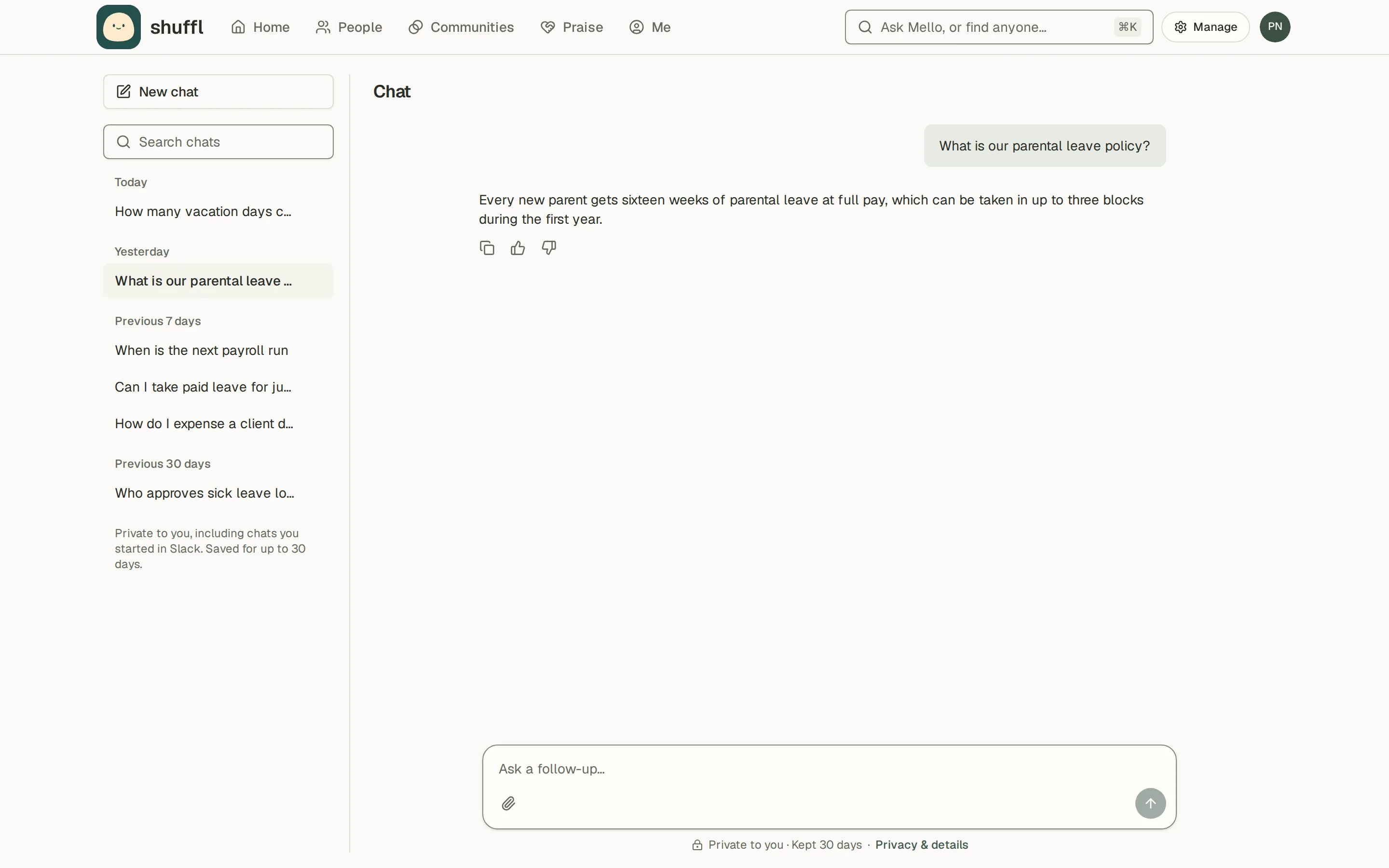
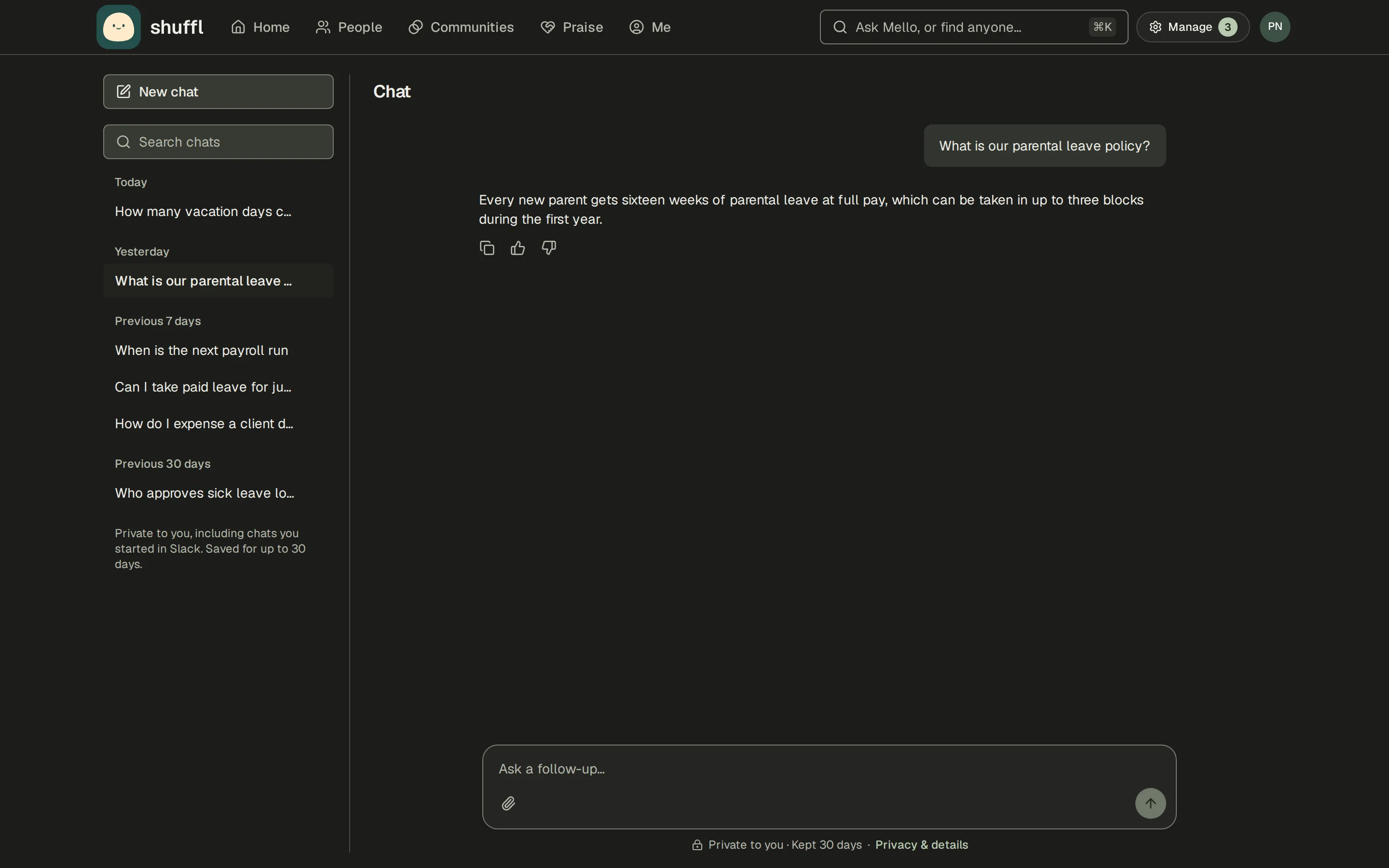
Shuffl covers the answers half and the route to a person. Employees ask Mello in Slack or on the web, and it answers from Knowledge HR published to them, with a link to the passage it used. Each source has an audience, an effective date and a review date. Once the review date passes, Mello stops answering from it until someone in HR reviews it.
Mello also knows the employee’s record in People, such as location, employment type and team, so it answers the part of a policy that applies to them. People has the directory and the org chart. If your company connected BambooHR, Rippling, HiBob or Deel, Mello reads the employee’s own time-off balance. It doesn’t book leave. It prepares an HR request with the dates.
When a person needs to help, Mello prepares a short message and shows who will receive it, and nothing goes until the employee chooses Share with HR or Send to HR. Sensitive request categories open only for the people you name. Knowledge → Insights lists the questions Mello couldn’t answer under Missing guidance, which is your monthly list of what to write next.
Shuffl, Mello included, is free for every team at any size.
Frequently asked questions
Is employee self-service the same as an HR portal?
An HR portal is one part of it: the place where employees change their details, see payslips and request leave. Self-service also needs written answers to common questions and a clear way to reach a person.
What should an employee self-service portal include?
Personal details, tax and bank forms, payslips, time off, benefits enrollment and life events, plus answers on the policies people ask about most. Add the org chart, so people can see who to ask.
What HR tasks should not be self-service?
Complaints, medical leave, accommodations, pay disputes and anything that depends on one person’s situation. Self-service should route those to a named person in private.
How do you know if employee self-service is working?
Ask where people go first when they have an HR question, and count how many of last quarter’s questions to HR already had a written answer. If most did, the answers are hard to find.
Sources
- Applaud, 2026 State of HR Service report, January 2026. Censuswide survey of 1,000 UK employees at organizations with 2,000+ staff, late 2025.
- SHRM, 2025 SHRM State of the Workplace research report, 2025. 1,615 HR professionals surveyed Dec. 9 to 12, 2024 through SHRM’s Voice of Work Research Panel.
- MetLife, 23rd Annual U.S. Employee Benefit Trends Study, September 2025. 2,500 full-time US employees aged 21 and over, fielded June–July 2025.