
HR glossary
Quiet quitting
Quiet quitting describes employees who do the work their role requires and nothing beyond it.
Quiet quitting went viral on TikTok in 2022. The quitter doesn’t actually leave. They do exactly what their job requires, then stop: no late nights, no extra projects, no answering messages on the weekend.
Some see it as disengagement. Others see it as healthy boundaries. Either way, it’s a signal worth listening to. People usually pull back after putting in extra effort that nobody noticed or rewarded.
What the research says
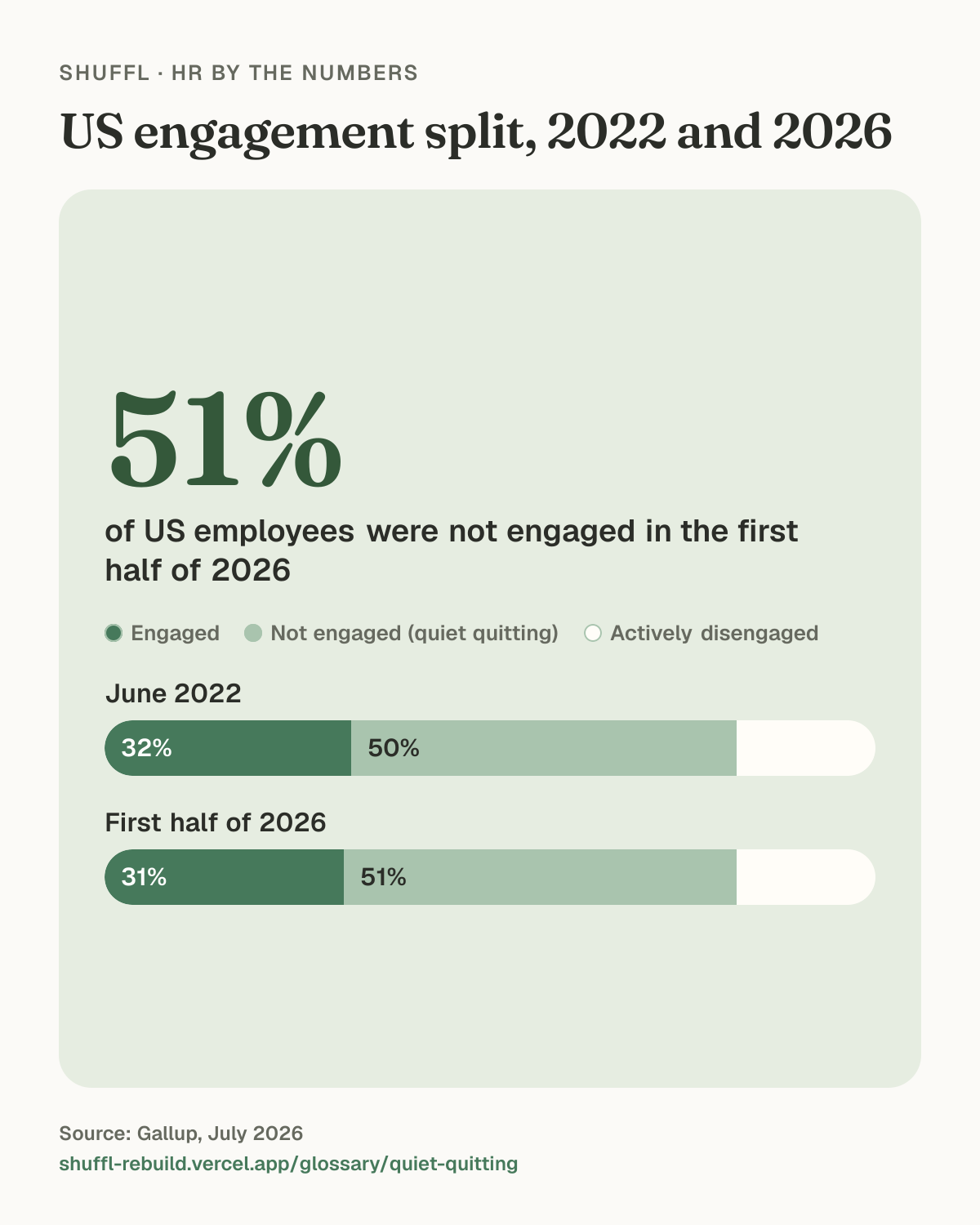
When the phrase went viral in 2022, Gallup matched it to its “not engaged” group: people who do the minimum required and are psychologically detached from their job. A June 2022 survey of 15,091 US employees put that group at about half of the workforce, which Gallup described as quiet quitters making up at least 50% of the US workforce.1
The picture has barely moved. In the first half of 2026, 31% of US employees were engaged and 18% were actively disengaged, which leaves 51% not engaged.2 Gallup’s global report now uses the label directly and describes not engaged employees as quietly quitting.3
Shuffl · HR by the numbers
US engagement split, 2022 and 2026
US engagement split, 2022 and 2026. 51% of US employees were not engaged in the first half of 2026. June 2022: 32% Engaged, 50% Not engaged (quiet quitting), 18% Actively disengaged. First half of 2026: 31% Engaged, 51% Not engaged (quiet quitting), 18% Actively disengaged. Source: Gallup, July 2026.
An example
At a 120-person marketing agency, an account manager who used to answer client emails at night and mentor juniors now logs off at 5:30 and turns down extra projects. Her work is still on time and her clients are happy.
In a one-on-one, her manager asks what changed. She says she was passed over for a promotion after a year of unpaid extra work, and nobody explained why. The manager can’t reverse the decision, but he sets out what the next level requires, adds mentoring to her formal goals, and books a review in six months.
How managers can respond
- Treat it as information about the job, since the person is still meeting expectations.
- Ask what changed, in a one-on-one, before drawing conclusions.
- Write down what the role actually requires, so extra effort is visible when it happens.
- Recognize or reward extra work when you ask for it, and stop relying on it by default.
- Look at the team as a whole. If several people have pulled back at once, workload or management is the likelier cause.
Common questions
- Is quiet quitting a performance issue?
- No. If someone meets their job’s expectations, they are doing their job. The question for managers is whether the expectations are clear and fair.
- How do managers respond to quiet quitting?
- Regular one-on-ones, recognition for extra effort, and a workload people can sustain.
Sources
Read on . Numbers change as new studies come out, so check the source before you quote it.
- Gallup, Is Quiet Quitting Real?, September 2022. Random sample of 15,091 full- and part-time U.S. employees aged 18 and over, surveyed in June 2022.
- Gallup, Employee Engagement Remains Flat as AI Adoption Accelerates, July 2026. Self-administered web surveys of 43,262 U.S. employees, Feb. 4-19 and May 6-20, 2026. Margin of error ±0.7 points at 95% confidence.
- Gallup, State of the Global Workplace: 2026 Report, 2026. Primarily the Gallup World Poll. 2025 data: 263,810 respondents (141,444 employed) in 140+ countries and territories, collected January to December 2025, plus U.S. web samples.