
HR glossary
Objectives and key results (OKRs)
OKRs (objectives and key results) are a goal-setting method that pairs a qualitative objective with measurable key results.
OKRs pair an objective, what you want to achieve, with two to five key results that show whether you got there. “Make onboarding great” is an objective. “New hire 90-day retention goes from 85% to 95%” is a key result.
Andy Grove developed the method at Intel. John Doerr brought it to Google in 1999, and from there it spread across tech.
OKRs are meant to be ambitious. Hitting about 70% of a stretch key result is often counted as a success, which is why many companies keep them separate from performance ratings.
What the research says
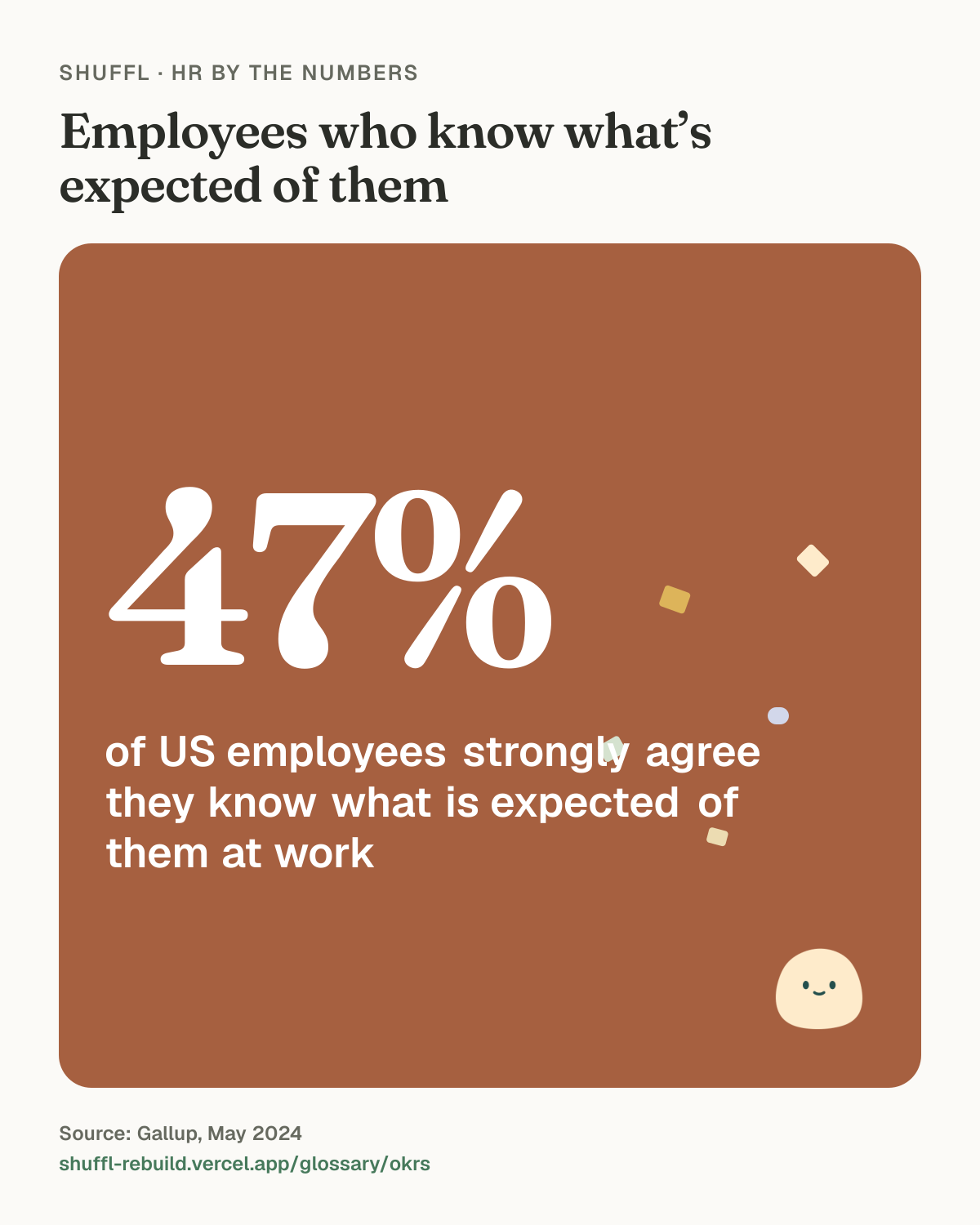
OKRs exist to make priorities clear, and clarity is in short supply. In a 2023 Gallup panel of 18,665 US employees, only 47% strongly agreed they know what is expected of them at work, down from 61% in 2015.1
The same research found that employees who are actively involved in setting their goals are two times as likely to have clear expectations.1 Top-down OKRs that simply cascade to every team miss that. Many companies set the company objectives centrally and let teams draft their own key results.
Shuffl · HR by the numbers
Employees who know what’s expected of them

Employees who know what’s expected of them: 47% of US employees strongly agree they know what is expected of them at work. Source: Gallup, May 2024.
An example
The people team at a 300-person software company set this objective for the third quarter: “New hires get productive faster.” Its three key results were to cut the time to an engineer’s first shipped ticket from 34 days to 21, lift the 30-day new-hire survey score from 3.6 to 4.2, and raise the share of hires with a buddy assigned before day one from 60% to 100%.
At the end of the quarter the numbers were 26 days, 4.0 and 96%. Scored as progress toward each target, that’s 0.6, 0.7 and 0.9, or about 0.7 overall. The team counted it as a good quarter and carried the first key result into the next one.
Common mistakes
Most OKR programs that stall run into the same few problems.
- Writing tasks as key results. “Launch a buddy program” is a task. “Every hire has a buddy by day one” is a result.
- Setting too many. Three objectives with three key results each is plenty for a team.
- Tying bonuses directly to scores, which pushes people to set targets they know they’ll hit.
- Setting them and not looking again until the quarter ends. A short check every two to four weeks keeps them live.
Common questions
- What is the difference between OKRs and KPIs?
- KPIs track ongoing health, like turnover rate. OKRs set a change you want to make in a set period.
- How often are OKRs set?
- Quarterly is most common, often with yearly company-level OKRs above them.
Sources
Read on . Numbers change as new studies come out, so check the source before you quote it.
- Gallup, 2% of CHROs Think Their Performance Management System Works, May 2024. Gallup CHRO Roundtable survey of 135 Fortune 500 CHROs (June 26 to July 8, 2023) and Gallup Panel study of 18,665 US full- and part-time employees (August 9 to 24, 2023), margin of error ±1.1 points at 95% confidence.