
HR glossary
360-degree feedback
360-degree feedback is a review method that collects feedback on an employee from their manager, peers, direct reports and themselves.
360-degree feedback gets input from all around someone: their manager, peers, direct reports and sometimes customers, plus their own self-assessment.
It’s most useful for development, especially for managers, whose reports see things their boss never will. Tying it to pay tends to make feedback cautious.
Keep responses anonymous and use enough reviewers, usually at least three per group, that nobody can be identified.
What the research says
A 2005 meta-analysis by Smither, London and Reilly pooled 24 longitudinal studies of multisource feedback. It found that improvement in ratings from direct reports, peers and supervisors over time is generally small.1
The same paper describes who does improve. Change was more likely when the feedback showed a need to change, when the person reacted positively and believed change was feasible, and when they set goals and took action afterward.1 In practice, the debrief and the follow-up do more work than the survey itself.
Shuffl · HR by the numbers
A 360 cycle that leads to change
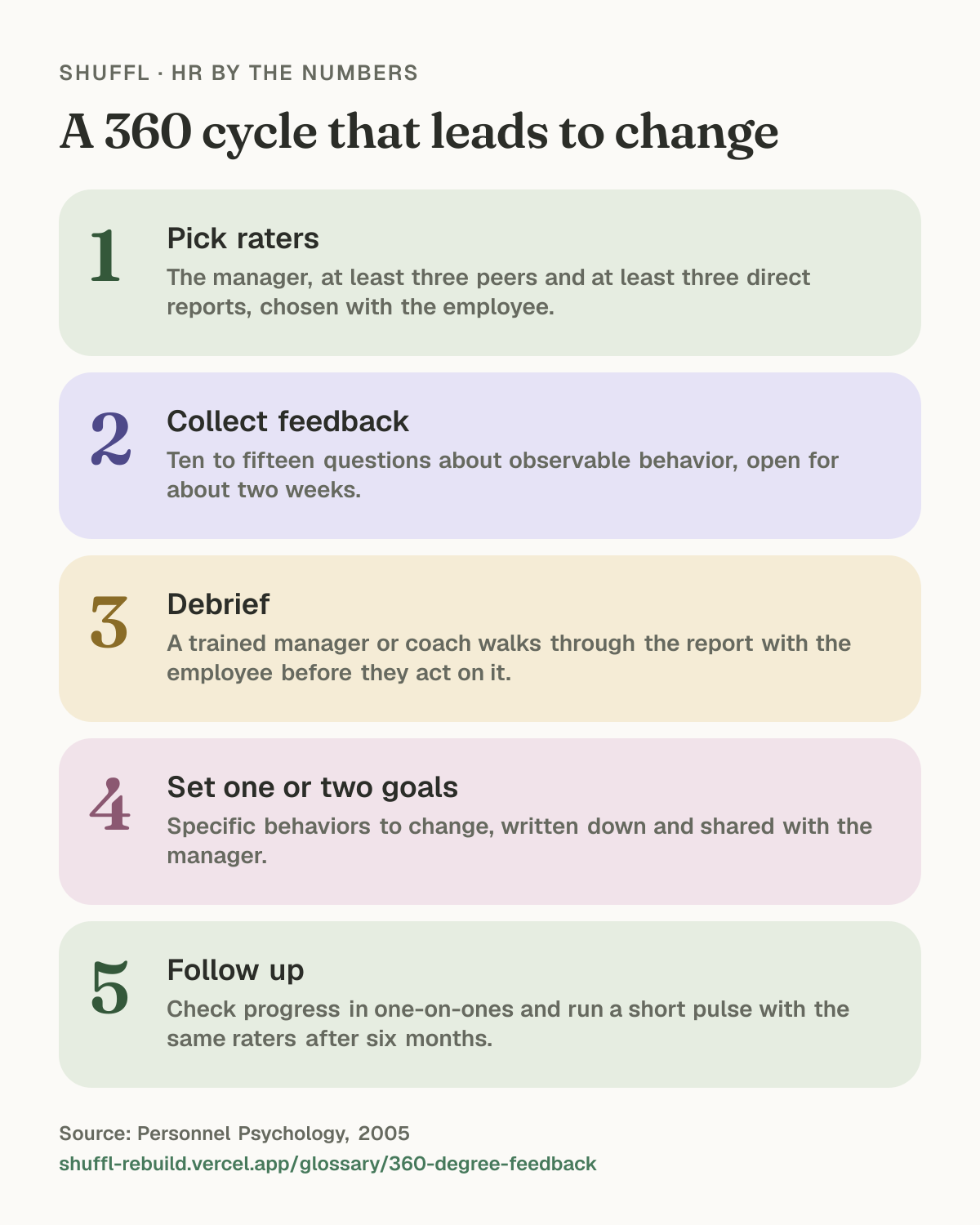
A 360 cycle that leads to change. 1. Pick raters: The manager, at least three peers and at least three direct reports, chosen with the employee. 2. Collect feedback: Ten to fifteen questions about observable behavior, open for about two weeks. 3. Debrief: A trained manager or coach walks through the report with the employee before they act on it. 4. Set one or two goals: Specific behaviors to change, written down and shared with the manager. 5. Follow up: Check progress in one-on-ones and run a short pulse with the same raters after six months. Source: Personnel Psychology, 2005.
An example
A 90-person marketing agency runs 360s for its 12 team leads each spring. One lead scored 4.4 out of 5 from her manager on planning, but her five reports gave her 2.9 on “sets clear priorities for the week.”
In the debrief she said she kept priorities in her head and assumed the team knew them. She picked one goal: a short priorities note every Monday morning. When the agency ran a pulse with the same five reports six months later, that item had moved to 3.6.
How to do it well
A few choices in the setup decide whether people trust the results.
- Ask about things raters have actually seen, like “explains the reasons behind decisions,” rather than traits like “is a strong leader.”
- Keep 360 results for development. Once they feed pay, raters tend to soften what they say.
- Only show a rater group’s scores when at least three people in it responded.
- Never hand over a report without a conversation to go with it.
- Give raters a few examples of useful written comments before the survey opens.
Common questions
- How many reviewers should give 360 feedback?
- Five to ten, spread across manager, peers and reports.
- Is 360 feedback anonymous?
- Usually, yes, except the manager’s. Anonymity makes people more candid.
Sources
Read on . Numbers change as new studies come out, so check the source before you quote it.
- Personnel Psychology, Does performance improve following multisource feedback? A theoretical model, meta-analysis, and review of empirical findings (Smither, London and Reilly), 2005. Peer-reviewed meta-analysis of 24 longitudinal studies of multisource (360-degree) feedback.