
HR glossary
Exit interview
An exit interview is a conversation or survey with a departing employee about their reasons for leaving and their experience at the company.
An exit interview happens during someone’s last days. The goal is to learn why they’re leaving and what the company could have done differently.
People are more honest with someone outside their reporting line, so HR usually runs it, not the manager. A written survey works for people who’d rather not talk.
One exit interview is an anecdote. Twenty that mention the same manager or the same pay gap are a finding. Collect them in one place and read them together.
What the research says
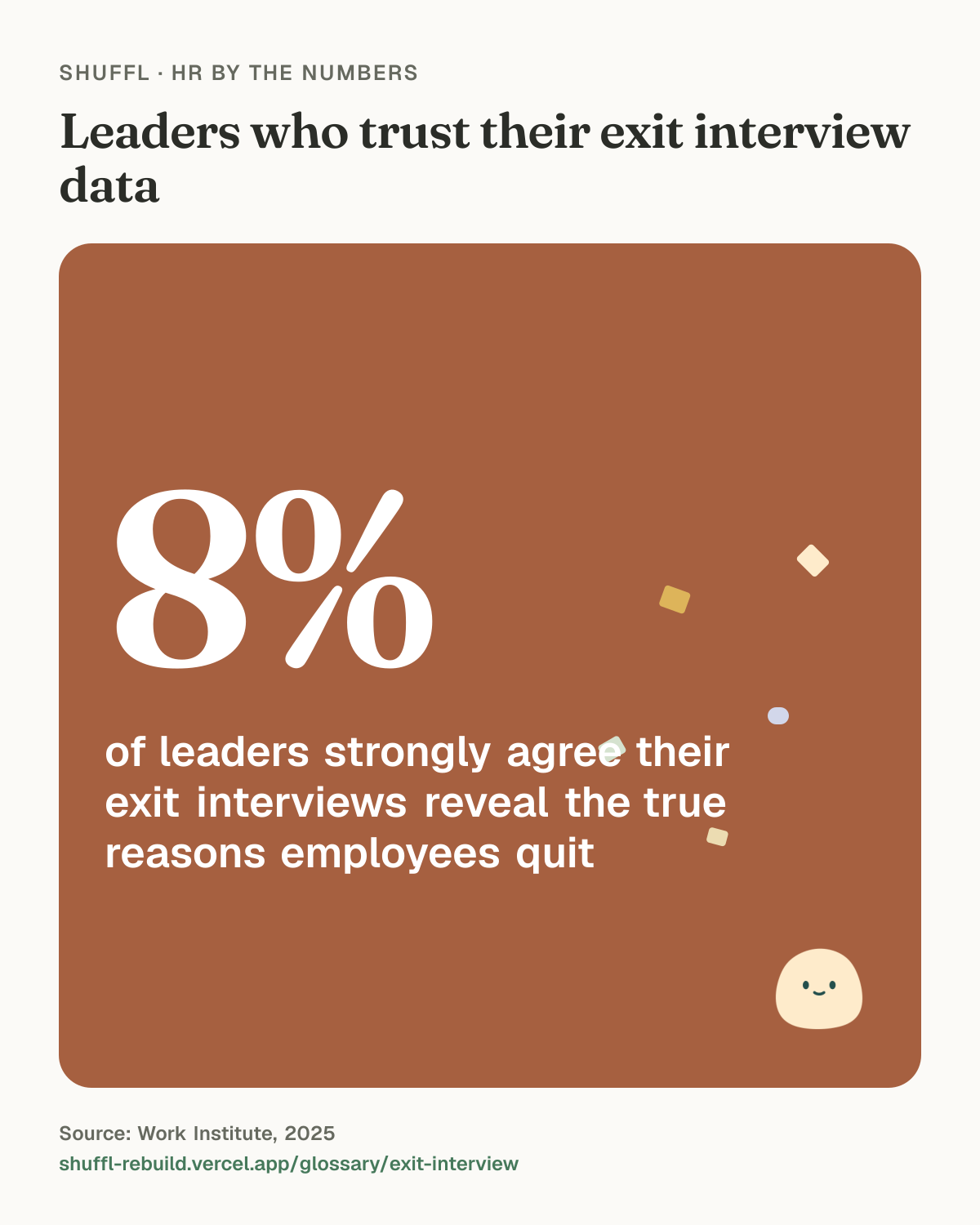
Few companies trust their exit interviews. In a Work Institute survey of 88 HR and operations leaders, only 8% strongly agreed that their exit interviews reveal the true reasons people quit, and only 6% of senior HR executives said they always conduct them1.
How the interview is run makes a difference. More than 90% of Work Institute’s own exit interview data was collected after the employee had left and by a third party1. People who have already left, talking to someone who isn’t their manager, have less reason to hold back.
Shuffl · HR by the numbers
Leaders who trust their exit interview data

Leaders who trust their exit interview data: 8% of leaders strongly agree their exit interviews reveal the true reasons employees quit. Source: Work Institute, 2025.
How to get honest answers
Most of the gains come from timing, who asks, and whether anyone reads the results.
- Offer a follow-up conversation two to four weeks after the last day, when the final paycheck and references are no longer at stake.
- Have HR or an outside firm run it, never the person’s manager.
- Ask the same core questions every time so answers can be counted.
- Code each exit into one main reason, such as career, pay, manager, schedule or relocation.
- Report the totals to leaders every quarter, by team, and say what changed as a result.
An example
A 400-person home health agency had 52 exits last year. HR coded each exit interview by main reason. Scheduling came up in 19 of them, and 14 of those were aides on one branch’s rotating weekend schedule.
The branch moved to fixed weekends chosen at hire and let aides trade shifts through a shared sign-up sheet. In the next two quarters, scheduling came up in 3 exit interviews from that branch. The agency now checks exit reasons by branch every quarter.
Shuffl · HR by the numbers
Exit interviews as a habit vs. as a data source
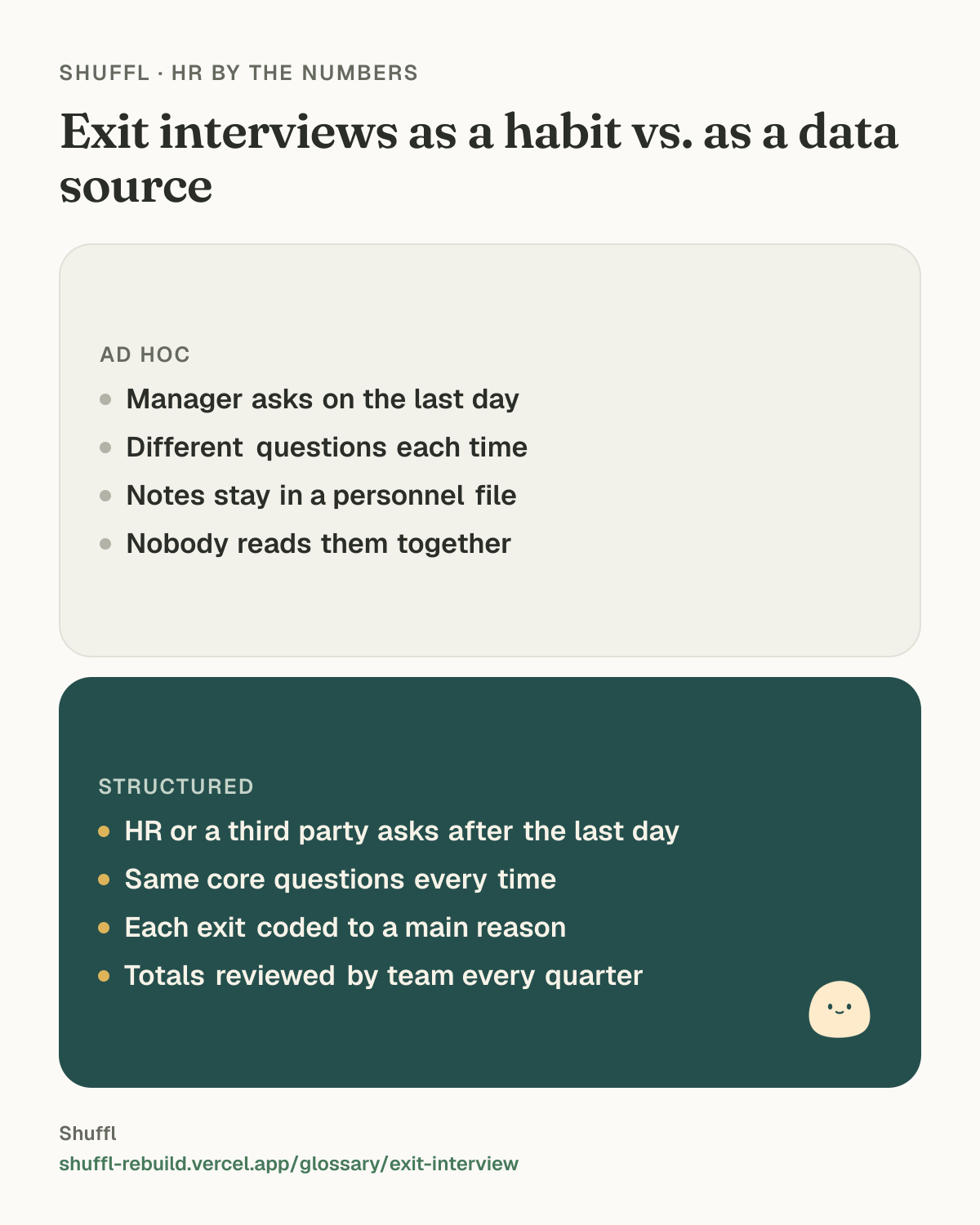
Exit interviews as a habit vs. as a data source. Ad hoc: Manager asks on the last day; Different questions each time; Notes stay in a personnel file; Nobody reads them together. Structured: HR or a third party asks after the last day; Same core questions every time; Each exit coded to a main reason; Totals reviewed by team every quarter.
Common questions
- What questions are asked in an exit interview?
- Why they’re leaving, what they liked, what they’d change, whether they felt supported by their manager, and whether they’d come back.
- Are exit interviews mandatory?
- In most places, no. Employees can decline, and some prefer a written survey instead.
Sources
Read on . Numbers change as new studies come out, so check the source before you quote it.
- Work Institute, 2025 Retention Report: Employee Retention Truths in Today’s Workplace, 2025. Based on 123,297 exit interviews Work Institute conducted from 2019 to 2024 (14,215 in 2024) with employees of over 175 US companies, over 90% collected after the employee left and by Work Institute as a third party. Leader figures come from a survey of 88 HR and operational leaders, December 1, 2024 to January 15, 2025.