
· Updated · Shuffl team
Should AI answer your employees' HR questions?
Most employees don't want an HR chatbot on its own. They want a quick answer they can check, and a person when it's about them. Here's how to set that up.
Short answer
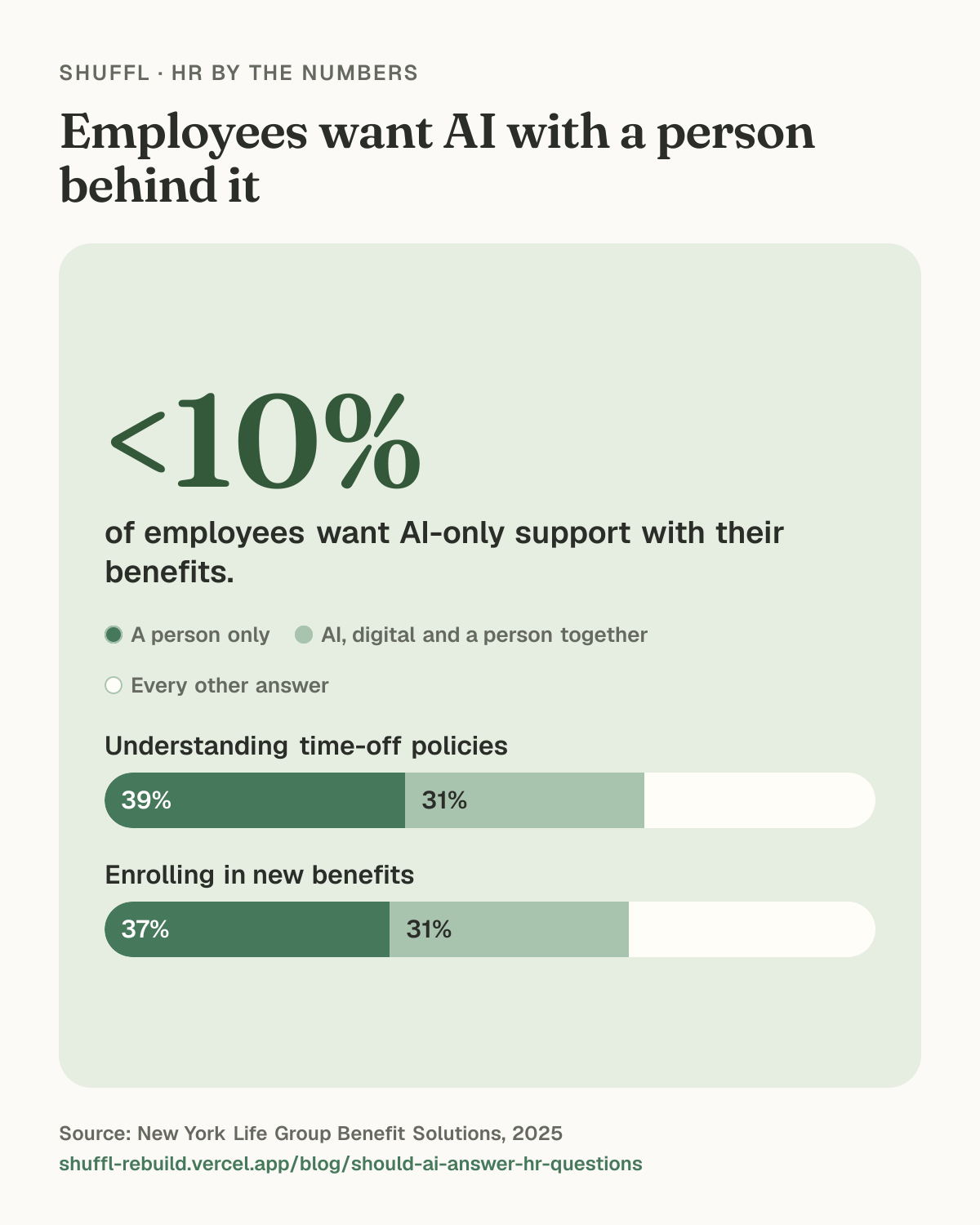
Yes, for questions your written policies already answer, as long as every answer cites the approved policy and anything personal goes to a person. Employees don't want AI on its own. Fewer than 10% want AI-only help with benefits, but many are happy with AI and people working together.2
The Sunday night parental leave question
It's 9pm on a Sunday. A new parent messages you: can they split parental leave into two blocks? The answer is on page 14 of the handbook. They didn't find it, because nobody reads page 14.
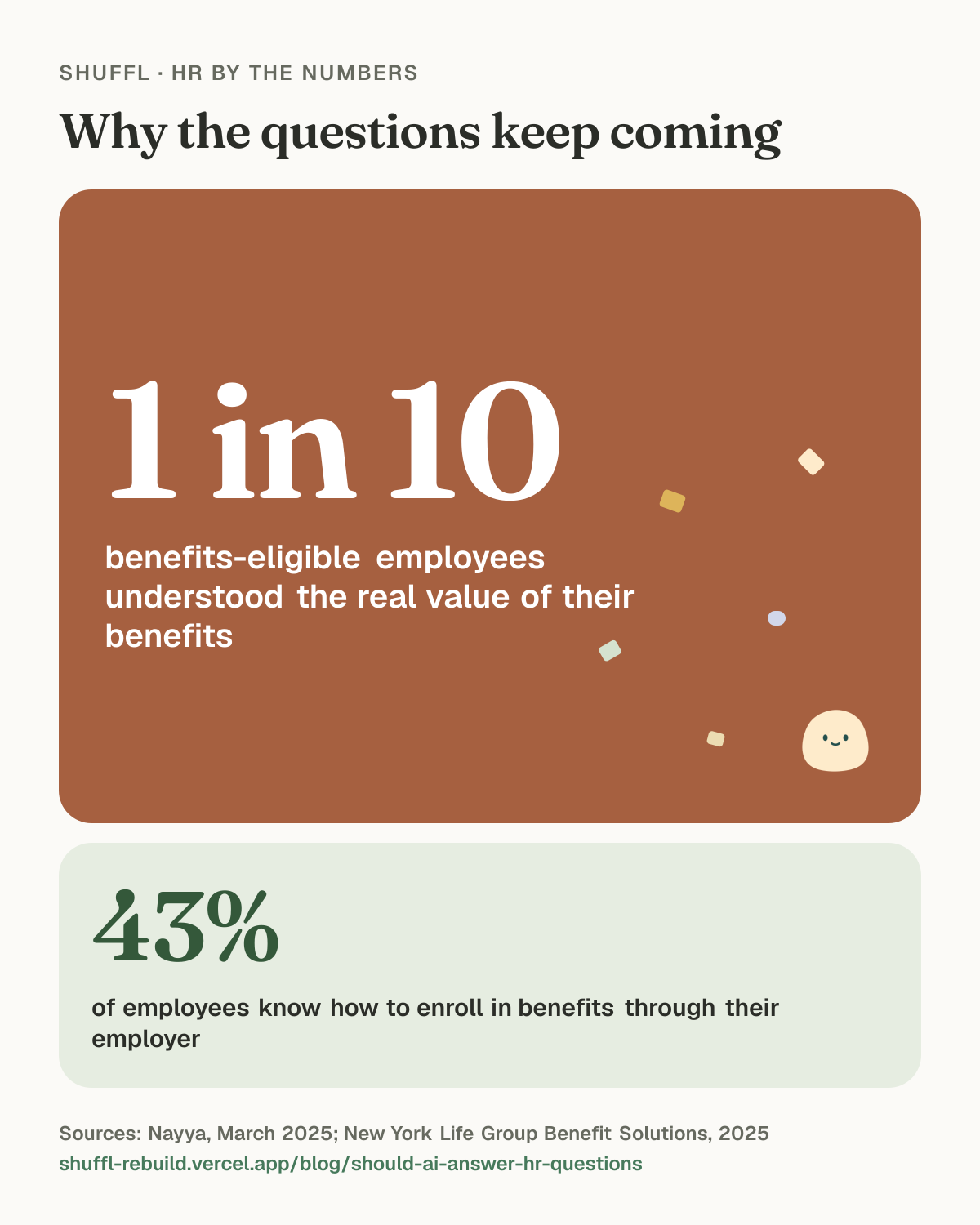
They aren’t unusual. In a Nayya survey of 500 benefits-eligible employees, just one in ten understood the real value of their benefits.1 New York Life found that only 43% of employees know how to enroll in benefits through their employer.2 So people ask you, and you answer the same thing for the fourth time this month.
Shuffl · HR by the numbers
Why the questions keep coming

Why the questions keep coming. 1 in 10 benefits-eligible employees understood the real value of their benefits (Nayya, March 2025). 43% of employees know how to enroll in benefits through their employer (New York Life Group Benefit Solutions, 2025).
What do employees want from AI in HR?
The obvious fix is a chatbot in front of the handbook. Employees are wary of that, and they have a point. When New York Life surveyed 858 adults in August 2025, fewer than 10% wanted AI-only support with their benefits.2
Nearly a third were happy to use AI as long as a person was part of it. They want the quick answer, and a way to reach someone when the question is about their own situation.
Shuffl · HR by the numbers
Employees want AI with a person behind it
Employees want AI with a person behind it. <10% of employees want AI-only support with their benefits.. Understanding time-off policies: 39% A person only, 31% AI, digital and a person together, 30% Every other answer. Enrolling in new benefits: 37% A person only, 31% AI, digital and a person together, 32% Every other answer. Source: New York Life Group Benefit Solutions, 2025.
Which HR questions can AI answer safely?
The safe ones have the same answer for everyone allowed to read the policy. How many holidays do we get? When does open enrollment close? Is the home office stipend taxable? Where's the expense policy?
The ones it shouldn’t answer are about one person: a leave balance, whether someone qualifies for something, a complaint about a manager. A handbook can’t tell you someone’s eligibility, and an assistant that guesses does more harm than one that says nothing.
A good HR assistant knows the difference between a policy question and a personal one, and tells the employee which one they asked.
How do you keep AI answers accurate?
Four rules do most of the work. They also make employee self-service something people trust instead of something they route around.
- Answer only from policies HR approved. Drafts, old PDFs and stray wiki pages stay out.
- Cite the passage. An employee should be able to click through and read the exact text the answer came from.
- Say "not covered" when it isn’t. The honest reply to "what’s my balance?" is a pointer to a person.
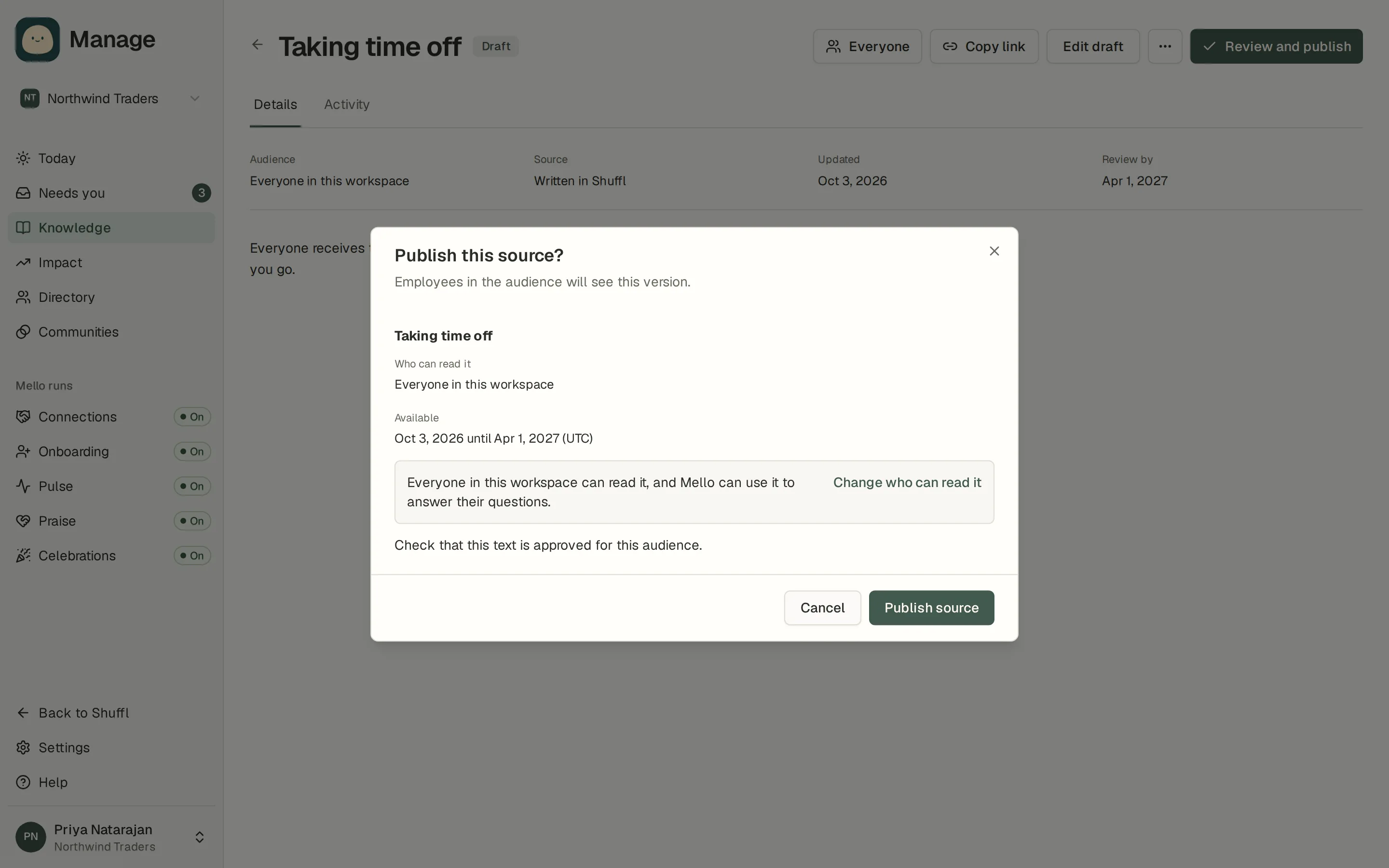
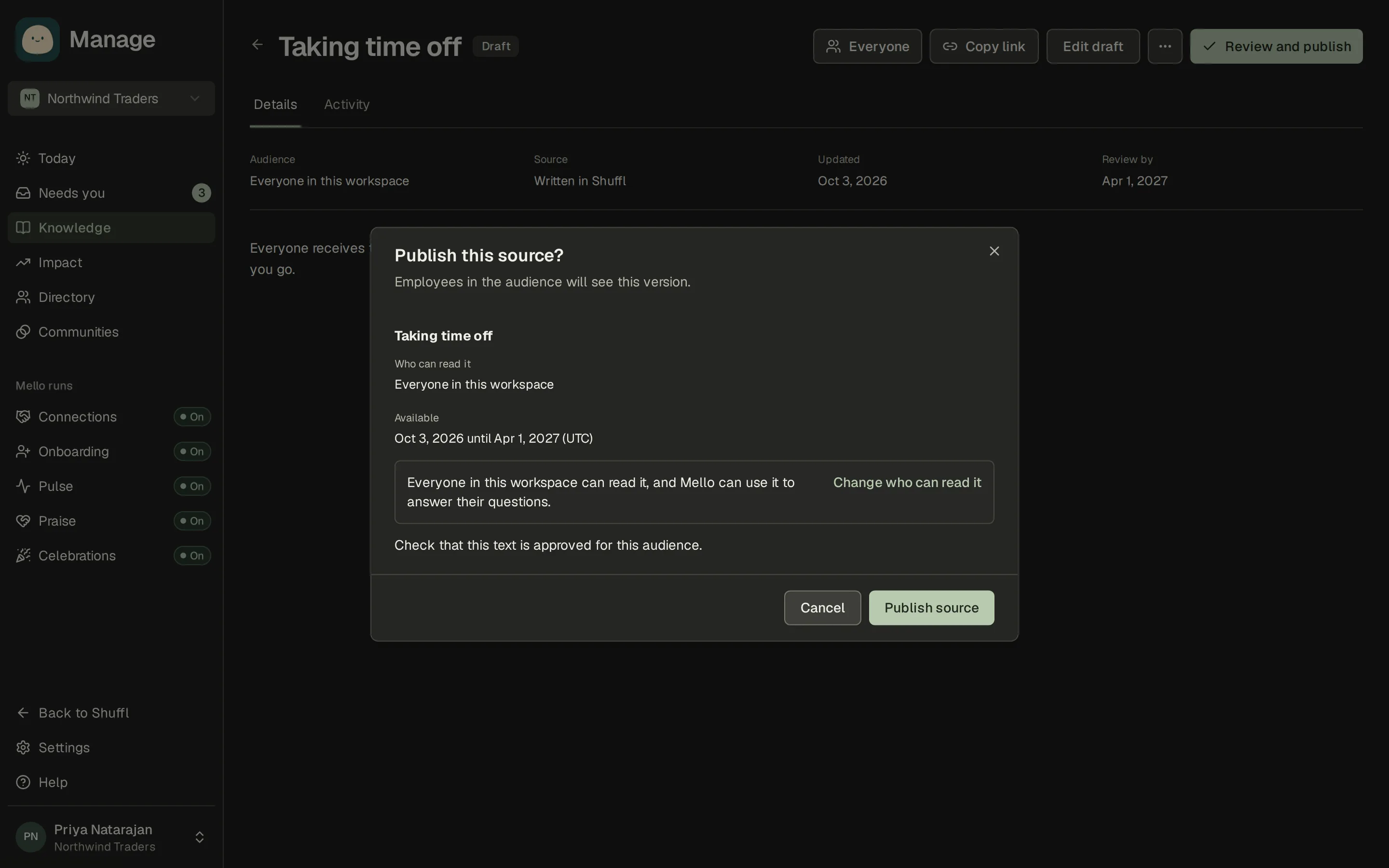
- Give every policy a review date. When it passes, stop answering from that policy until someone checks it.
What should happen when AI can’t answer?
Most tools stop at a generic "contact HR". The employee has to explain everything again, sometimes in a channel where the wrong people can see it.
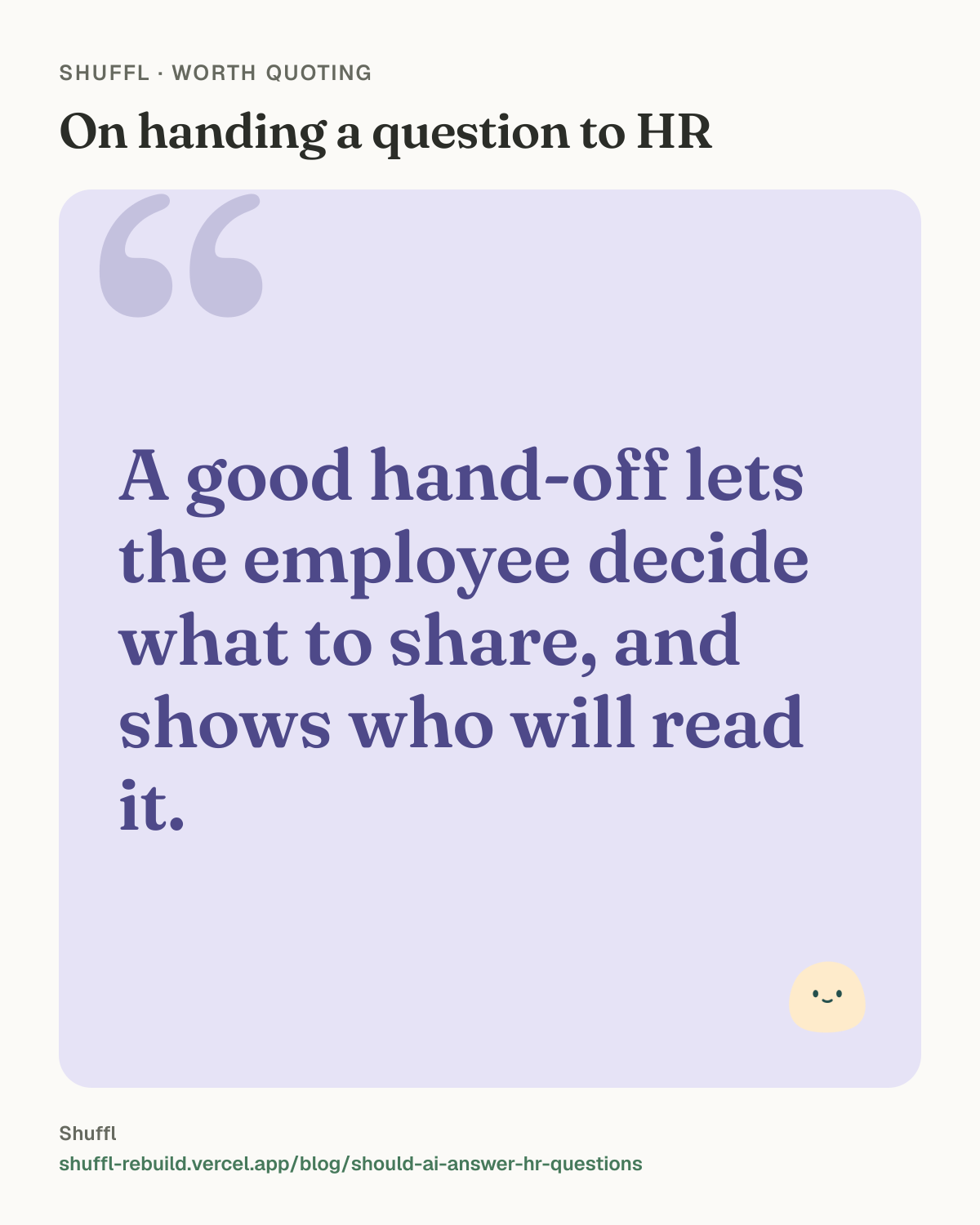
A better hand-off lets the employee decide what to share, shows who will read it, and sends the question with its context so nobody starts from zero.
Shuffl · Worth quoting
On handing a question to HR
On handing a question to HR: “A good hand-off lets the employee decide what to share, and shows who will read it.”
How Shuffl handles this
Shuffl answers from knowledge an HR admin reviewed and published, and cites the exact passage it used. Every source has an effective date and a review date. Once the review date passes, employees stop getting answers from it until someone looks again.
When no approved source covers the question, Shuffl says so. When a question needs a person, Mello prepares the message, and the employee sees the exact text and the named HR responders before anything is sent. In a shared Slack channel Shuffl only uses sources published to the whole workspace, and moves anything personal to a direct message.
Shuffl, Mello included, is free for every team at any size.
Frequently asked questions
Will an AI assistant replace our HR team?
No. It takes the repeat policy questions so the team has time for the ones that need judgement. Personal and sensitive questions still go to a person.
Can AI tell an employee their leave balance?
Not from a handbook. A balance is a fact about one person, and a policy document can't establish it. A careful assistant hands those questions to HR.
Is it safe to answer HR questions in a Slack channel?
Only with policies everyone in the channel is allowed to read. Anything personal should move to a direct message.
How do we keep AI answers up to date?
Give each policy a review date, and stop answering from it once that date passes until HR has checked it.
Sources
- Nayya, Benefits Value Gap report, March 2025. Survey of 500 benefits-eligible employees.
- New York Life Group Benefit Solutions, Employees strongly prefer human support in benefits guidance, 2025. 858 adults surveyed August 23–25, 2025; margin of error ±3 points.